As funding and margin pressures continue to weigh on financial institutions, many are revisiting the make-up of their balance sheets to determine what their optimal asset allocation may look like.
However, finding the right asset mix is a delicate balance, and not always about picking the highest yield. Rather, it’s about generating returns that are commensurate with the associated risk and the goals of the institution. With that in mind, pricing assets appropriately is now as important as ever.
Using a Risk-Adjusted Framework
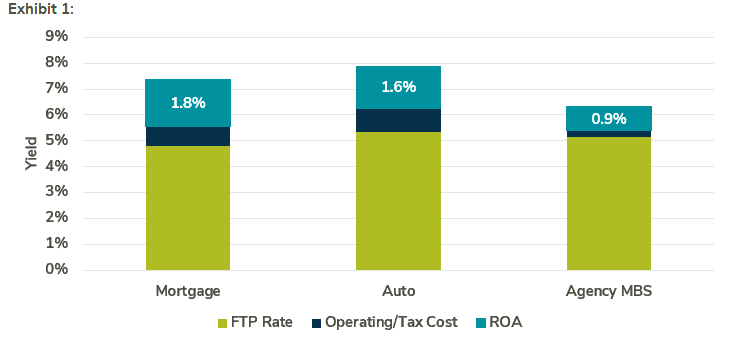
While effective asset pricing can take different forms, practitioners will often utilize a risk-adjusted return on capital (RAROC) framework. This removes any personal biases or “gut-feelings” from asset pricing and allows for an apples-to-apples comparison across asset classes. Headline yields can be deceiving and often don’t tell the full story. For example, the evaluation below includes a 30-year mortgage, an auto loan, and an Agency Mortgage-Backed Security (MBS). Highlighted in Exhibit 1 is a breakdown of the various risk components that comprise each asset’s yield or a funds-transfer pricing (FTP) rate.
The illustration represents a hypothetical situation and is not intended to be representative of any particular
client or situation.
Accurately Pricing Risk with Market-Based Funding Costs
The FTP rate includes the cost of funds, credit cost, and options cost. Options cost is the cost associated with assets that have embedded options (callable securities, mortgages, etc.). In a rising rate environment, the borrower is less incentivized to prepay so these assets extend, and the institution will have to fund them at higher rates. In a declining rate environment, the borrower is more likely to prepay, so the assets contract and the institution has to reinvest at lower rates. The options cost accounts for those associated risks and costs. From there, the cost of funds for each asset is assumed to be duration-matched to remove the interest risk component. Using a market-based funding source is important to accurately price risk rather than the institution’s average funding costs. In a traditional funds transfer pricing model, the ability for an institution to source and retain cheap, sticky funding (core deposits) should be attributable to deposit gatherers, rather than loan officers. This misconception can lead to a myriad of potential issues, which have become all too evident industry-wide recently. Mispricing risk often can lead to or create liquidity issues and reduce the marketability of the assets being funded. Not only can this be dilutive to the institution, as assets fail to meet required returns on capital, but liquidity and financeability are often reduced if market-based funding is not accounted for properly. In addition to the FTP rate, we also include any operating costs and tax expenses.
Managing the Balance Sheet in an ROE Framework
After accounting for the various yield components and risk costs, what remains is the risk-adjusted return on asset (ROA). While this is a better estimate of risk compensation, a critical piece of the decision-making process is still missing – what are the capitalization requirements? In a dual capital mandate (Net worth/Leverage Ratio and risk-based capital), incorporating risk-weightings to account for leverage and required capital is a common practice and should help determine the most efficient use of marginal capital.
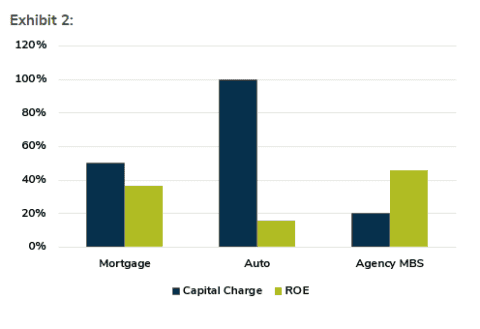
To incorporate leverage and required capital, the ROA is converted into a return on equity (ROE) by applying the asset’s capital charge. In Exhibit 2, the capital charge for each asset is shown alongside their ROE. Though the auto loan has the highest yield, it has the lowest ROE, since the depository would have to hold the most capital against that asset.
Balancing Loan Growth with Risk & Profitability
One dilemma facing balance sheet managers is that risk-based pricing can come at the cost of loan growth. Typically, competitive pricing drives loan growth. However, that rate may not make sense in a risk-adjusted framework. Chasing loan growth or competitor pricing can lead to adding unwanted credit or liquidity risk, and potentially erode profits for the depository. Institutions should remember that their balance sheet has a finite capacity to add assets, and each asset should be evaluated thoroughly. Adding low ROE or mispriced loans comes at the opportunity cost of adding higher margin/ROE loans.
Taking the Investment Portfolio into Account
While the discussion thus far has primarily centered around lending, we can’t forget about the other parts of the balance sheet, and the role they play for high performing institutions – namely, the investment portfolio. In exhibit 3, the average balance sheet mix for Credit Unions and Community Banks is shown. On average, the investment portfolio is between 20-25 percent of the balance sheet. Though this number might not be the same for your specific institution, it can be a helpful gauge, since the investment portfolio is a crucial piece of balance sheet management.

One analogy that may be helpful to use when looking at the investment portfolio is comparing it to the rudder of a ship. It’s where the institution has the most control of the balance sheet and can “steer” it in the right direction. One function of the investment portfolio is managing interest rate risk. It should be built with the rest of the balance sheet in mind, complementing the overall risk profile. For example, if a depository is a large mortgage lender, and takes most of their interest rate risk in the loan book, they may choose to maintain a shorter duration in their investment portfolio.
Another key component of the portfolio is to provide liquidity. Prudent balance sheet management includes a strong liquidity buffer, and the investment portfolio is an integral part of that process. These assets can be pledged to the Federal Home Loan Bank (FHLB), the Federal Reserve, or utilized in other areas of the capital markets including repurchase agreements(repo) and dollar roll transactions. High-quality fixed income tends to have a superior liquidity profile and lower haircuts compared to loans, which include tight bid/ask spreads, and a high number of observables or comparable transactions.
The investment portfolio can also help manage the credit risk of the balance sheet. If an institution struggles to organically generate loans, the investment portfolio can be deployed and become a surrogate to scale credit risk. Often, high yield asset-backed securities or corporate bonds are too capital intensive to justify meaningful capital allocations. But, within the investment grade landscape, credit-risky securities can be added in bulk with relative ease and increase expected returns versus risk-free or Agency alternatives.
The other side of the coin should ring true, as well. For a commercial lender, who uses up most of their risk-based capital in their loan portfolio, low-risk weighted assets such as Agency Mortgage Backed-Securities (MBS) can be combined to generate higher income compared to Treasuries or Agency Debentures without adding credit risk.
The Importance of Feedback Loops
Although ex-ante estimates of risk/return are used in the initial decision-making process, it’s also important to look in the rearview mirror. Short and consistent feedback loops that evaluate and measure ex-post performance complete the decision-making framework. This allows balance sheet managers to ensure models are tuned appropriately, and that the risk the balance sheet is assuming remains commensurate with return on allocated capital. When evaluating performance, there should be very few surprises. Managers should understand how each asset added to the balance sheet will perform in various scenarios, and where the lion’s share of return is coming from.
A Constantly Evolving Process
Achieving the right mix of assets is dependent on each institution’s goals, risk appetites and more. Though a depository should not stray too far from a base target, as this can hinder the liquidity, credit, and interest rate risk management of the balance sheet, the right asset mix will constantly be evolving. By introducing a risk-based analytical framework into the asset pricing and allocation discussion, balance sheet managers will find themselves equipped to quickly evaluate changing market conditions and target required risk-adjusted returns commensurate with capital requirements.