
Welcome to part one of our three-part series on enhancing your merger integration readiness.
In this series, we’ll walk you through the foundational steps that set the tone for a successful merger—from the earliest strategic decisions to the tools your team will need when you start integration. The series is structured as a journey moving us through strategic considerations to prepare you and your team:
The series is structured as a journey moving us through strategic considerations to prepare you and your team:
- Strategic Preparations
- Planning and Design Activities
- Tooling Readiness
We, Darren and John, share real-world insights drawn from hands-on experience. This isn’t just about what to do—it’s about when to do it. Timing is everything in integration, and the precision of your team’s readiness can make or break the momentum of your post-close execution.
Let’s get started with the strategic groundwork that will shape everything that follows.
What Could Go Wrong on the First Day of Integration?
The day after the closure of a merger or acquisition (M&A) transaction is a critical milestone. It marks the first day that two previously separate organizations officially begin operating as one unified entity. Integration efforts transition from planning to execution, involving coordinated actions across, but not limited to: human resources, IT systems, finance, and customer/member service. Kicking off your first day of the integration phase, is typically synchronized with the legal close or completion date of the acquisition, and it is essential for ensuring business continuity, employee communication, customer engagement, and regulatory compliance. So what could go wrong?
Your deal team is not your post-merger integration staff. Period. That means each team provides a special set of skills and talents to bring two organizations together in a coordinated and seamless way. When your integration team is not pulled in early enough, then there are plenty of failure points that will trickle into each day after close. For example, as a senior manager, John had the privilege of leading a technical group to implement a new enterprise CRM as part of the post-merger integration team. The instruction I was given by his executive was simply: install the application, and carry over the data and fields from both systems. The end result is that he completed the project 5-months later but the system was unusable until the merged ADFS (user registry) was completed by the technical infrastructure team. When we lack the organization and forethought to lay the proper groundwork and dependencies, then we face a compounding problem of integration debt.
Your integration team requires laser-like focus to address operational risk, ensure data migration, align organizational structures, and stabilize key business functions. There is so much to prepare that first-time integration leads can quickly get overwhelmed. This blog series will break down the good preparation activities so you know what and when of how to get you and your team ready. Your first day of integration can kick-off with amazing success. In Part 1 of this blog series, we write about five strategic activities. In Part 2, we will cover the planning and design work that should be done ahead of time. Then we will close in Part 3 with the tooling you will need to purchase, set up, and configure so your integration runs well and is powered by automation.
Getting You on the Proper Track
The following strategic practices can help set your team on the right path from the very beginning. As your authors, we are conveying experience and learning from the mistakes we’ve made. And we understand that you will need to work these practices into your culture or way of doing things.
Starting with A Strong Integration Strategy
An integration strategy is the comprehensive blueprint that guides the unification of two organizations following a merger or acquisition. Crafted well ahead of the integration phase, this strategy articulates the vision, goals, and guiding principles for bringing together people, processes, technologies, and cultures into a cohesive whole. Typically, your integration strategy is discussed near the end of due diligence. And defining your strategy will coincide with the timing of your regulatory filings.
Your strategy is an intentional and structured approach, balancing the need to realize synergies or benefits with the imperative of maintaining business continuity. The strategy considers every facet of the organization— from talent management and customer communications to IT infrastructure and regulatory requirements, ensuring that each element is harmonized with the merger’s broader objectives.
At its core, an integration strategy is about making informed decisions early and sequencing activities to maximize impact and minimize risk. It begins with a thorough assessment of both entities to identify similarities, differences, and critical dependencies that could affect the combined institution’s success. By mapping out these factors, integration leaders can prioritize high-value opportunities and address areas of potential friction before they become problematic. The strategy also establishes clear metrics, timelines, and governance models to provide accountability and agility. Ultimately, a thoughtful integration strategy lays the foundation for a defining North Star, smooth transition, aligning teams and resources to deliver on the promise of the deal while positioning the new organization for long-term growth and value creation.
By the time Operational Day 1 arrives, the integration strategy serves as a cohesive roadmap that empowers the combined organization to move forward confidently, execute critical actions seamlessly, and lay the groundwork for long-term value creation.
Building the Steering Committee
Depending on the complexity of your merger integration effort, a Steering Committee may be employed. The purpose of the Steering Committee is to serve as an intermediary executive layer to triage complicated cross-functional questions, decisions, risks or issues. This does not imply that Workstream Leads are not up to the job. Rather, in complex environments that need a bridge to resolution, it is important to have the appropriate knowledge and authority. Additionally, the Steering Committee members will serve to champion the ultimate decisions due to their roles in the united organization.
Making decisions is not the sole responsibility of the Steering Committee. Once decisions are made, they must be communicated. Making a concerted effort to inform, discuss and get buy-in from the parties who are impacted is a diplomatic endeavor.
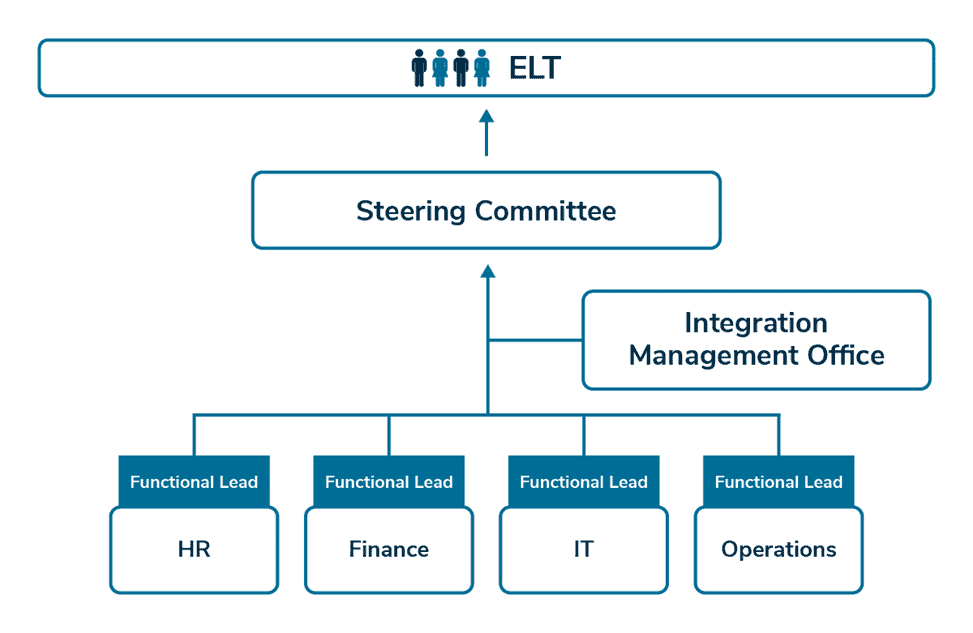
The graph above shows how the Steering Committee sits at the top, providing strategic oversight and decision-making, while coordinating with the Integration Management Office (IMO), functional workstreams (e.g., HR, Finance, IT), and external advisors.
Choosing who will join the Steering Committee can become political. Since this group has an incredible amount of influence and adjudication, the selection must be done by your executive team. Also, informal assignments may start as early as due diligence. And that is because those involved in the early conversation will have proper context for the high-level and cross-functional decisions that need mitigation.
Defining and Establishing the Integration Management Office (IMO)
Defining a dedicated integration management office (IMO) composed of key leaders from both organizations is no small effort. There will be plenty of discussions of ownership, accountability, and assignments. This group is responsible for setting the overall vision, priorities, and guiding principles for the integration. Therefore, the selection of the key assignments may start as early as due diligence. And that is because those involved in the early conversation may be the same people who champion the integration.
Early on, the IMO conducts a comprehensive assessment to identify the critical business processes, cultural differences, systems, and regulatory requirements that must be addressed. They define clear objectives, success metrics, and governance structures to ensure accountability and rapid decision-making. By mapping out dependencies and sequencing activities, the team can focus on high-impact areas such as talent retention, customer/member experience, and technology alignment.
Once the strategic framework is established, the integration team engages functional and cross-functional workstreams to develop detailed plans for each area of the business—such as HR, IT, finance, operations, and communications. These workstreams identify key risks and quick wins, outline transition steps, and establish protocols for issue escalation. Communication strategies are crafted to keep employees, customers/members, and stakeholders informed and engaged throughout the process. Regular checkpoints and scenario planning help the team anticipate challenges and adapt the strategy as needed.
Plan for Integration Readiness
How do you know whether both organizations are ready to take the massive leap forward into the first day of merger integration? Even with proper planning, it is not uncommon to feel uneasiness.
Here are proven examples to help better interpret the readiness barometer:
- Survey participants: Getting the pulse of those involved in the integration activities is a great start. Ask non-leading questions that can provide accurate insights such as:
- How comfortable are you with the milestones set for your Workstream?
- Are there any risks that we do not have a good resolution for yet?
- Do you feel you were given enough preparation time?
- Survey executives: As you capture the opinions of this audience, remember that there may be a motive to keep responses positive. Aim to capture any strategic risks or issues so you will know what to triage early.
- Survey yourself: It never hurts to look in the mirror. Do this by yourself. Do this with your team. While everyone on the integration team is invested in the program, knowing what lies ahead is critically important to mitigate the wrong path.
- Have a punch list: What must be done by Legal Day 1? Consequently, what needs to be ready on LD1 + 1, which is your first day of integration? Similar to making a first impression, kicking off your first day of integration can set the tone well or poorly.
- Ensuring your North Star, e.g., for credit unions, it means ensuring your mission is clear, shines brightly: What is the overall strategic goal driving this transaction? For example, “Together, we are building a stronger, more resilient credit union—one that honors our shared values, deepens our commitment to our members, and expands opportunities for our communities.” This type of clear vision sets the penultimate tone for the entire integration process.
Prepare Your Communications Plan
If you don’t have a communications plan in place, then your institution may not be ready to step into the integration phase quite yet.
Developing a communications plan before integration begins is essential as it sets the foundation for how change will be understood, accepted, and acted upon. Early planning ensures that messaging is proactive rather than reactive to manage expectations, reduce uncertainty, and build trust across both organizations. It allows leadership to identify key audiences, tailor messages to their needs, and establish consistent channels for updates and feedback. By anticipating potential concerns and aligning communication with strategic goals, the plan becomes a guiding tool that supports smoother transitions, stronger engagement, and a more unified integration experience.
Having a thorough communications plan is fundamental. A strong communications plan will make a big impact on how the integration process is perceived, and whether that information is shared with consistency and reliability. Repetition of key items is vital for each of your key stakeholder groups. Along with clear and highly-tailored messages, your plan should include effective distribution channels and timelines to ensure regular communications within newsletters, updates to the integration portal and release notes at go-live. Integrations that neglect a complete communication roadmap could experience unnecessary and easily avoidable complications.
Onto Part 2
We are excited to share our top 5 strategic preparations. With this foundation in place, it’s time to move from vision to execution. In Part 2, we’ll dive into the planning and design work that sets the stage for a seamless integration. From mapping your functional workstreams to aligning risk plans, this phase ensures your team is equipped to move forward with clarity and confidence. Let’s explore the key planning activities that make integration success not just possible—but predictable.
Learn more about Forvis Mazars’ Post-merger integration team at https://www.forvismazars.com/group/en/services/financial-advisory/deals/post-merger-integration
Want to discuss your credit union’s post-merger integration in more detail? Contact ALM First’s team of experts to learn more.
