Series: Ask ALM
Banks and credit unions alike are faced with balancing regulatory dual capital mandates. As a result, efficient allocation of capital is a vital part of capital management.
Although a financial institution’s allowance for loan loss and provisions held on the balance sheet of the institution should be adequate to cover expected losses caused by normal operating conditions, capital also must be available to absorb any additional expected or unexpected losses. Further, capital promotes confidence among an institution’s stakeholders that it can continue as an going concern, while also providing benefits to their shareholders. To be specific, capital is essential to reduce systemic risk and protect depositors, as well as federal or private insurance funds.
But if capital is so important, shouldn’t all financial institutions strive to hold large amounts of it on their balance sheets? Of course, regulators would prefer that institutions hold large amounts of capital as this moves the put option of the bank or credit union farther away from affecting the deposit insurance funds. But this just transfers some of the risk from the insurance fund to the owners of capital. Instead, bank shareholders and credit union members want their institutions to hold less capital so they can leverage profitability. The fact is, holding excess capital can be expensive, if it isn’t deployed in a timely, efficient manner. That’s because an institution holding excess capital must take on incremental risk so it can earn higher profits, all else equal, to generate the same return on equity.
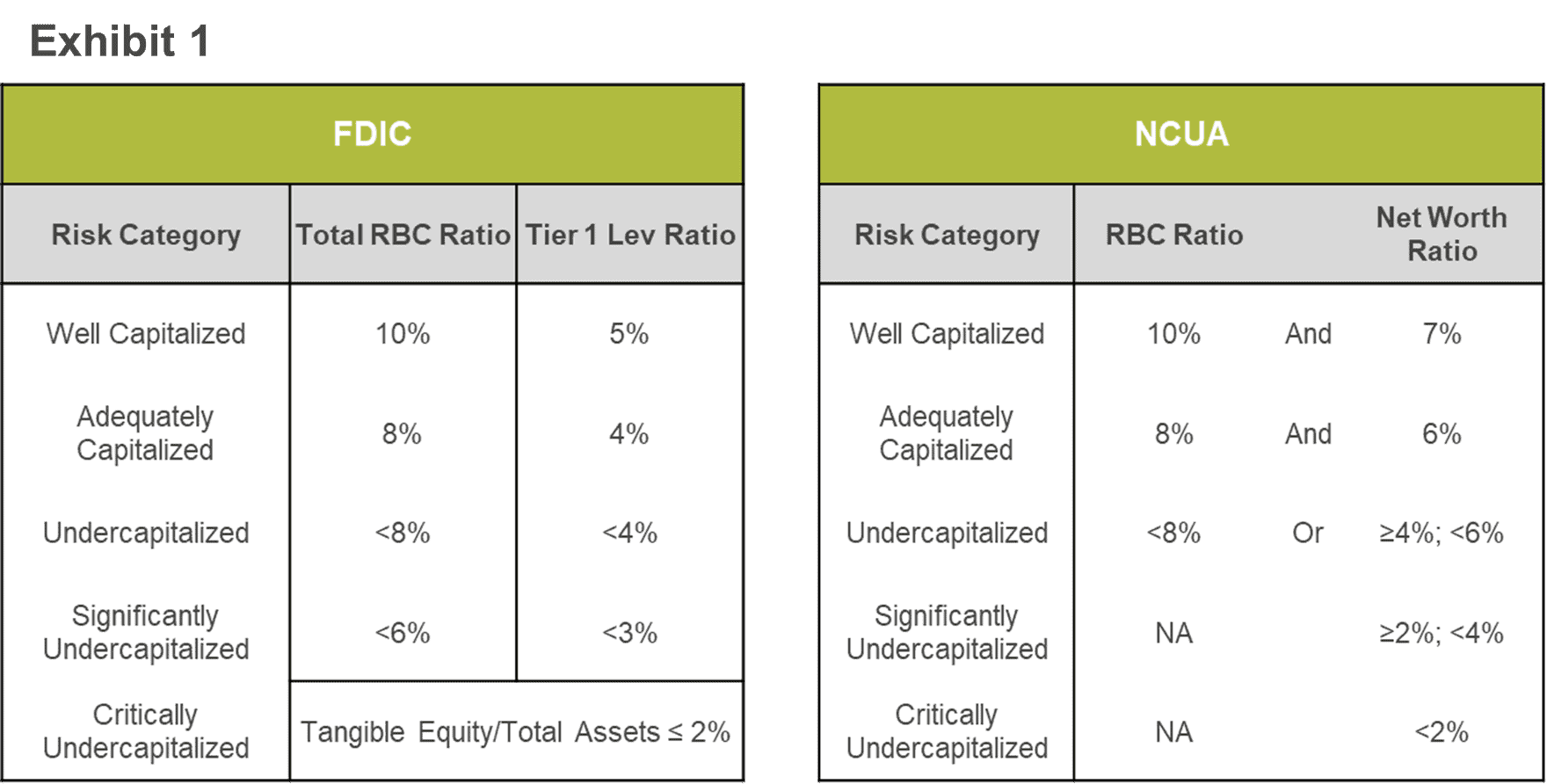
Regulatory agencies established capital requirements to ensure the stability of the banking system, which includes not allowing them to engage in excess leverage as this could cause an ultimate insolvency. Since the NCUA adopted risk-based capital requirements, all financial institutions operate under a dual capital mandate that requires regulatory capital limits and risk-based capital (RBC). The BASEL committee implemented minimum tier capital and leverage ratio limits. For example, Tier 1 is the core capital, such as retained earnings and shareholder common stock; while Tier 2 includes loan loss reserves, subordinated debt and general provisions. However, before NCUA adhered to these requirements, banks and credit unions were governed using different rules for holding capita, creating a “push-and- pull” situation between these like entities. Exhibit 1 below shows current risk-based capital and regulatory capital limits for banks and credit unions.
Exhibit 1
Risk-based capital uses risk weightings that require more capital to be reserved against riskier assets. Common risk weightings are 0, 20, 50, 75, 100 and 150 percent. Here’s an example: A 0% risk weighting would be assigned to cash or U.S. Treasuries, while 150% weighting would be assigned to a higher risk commercial real estate loan.
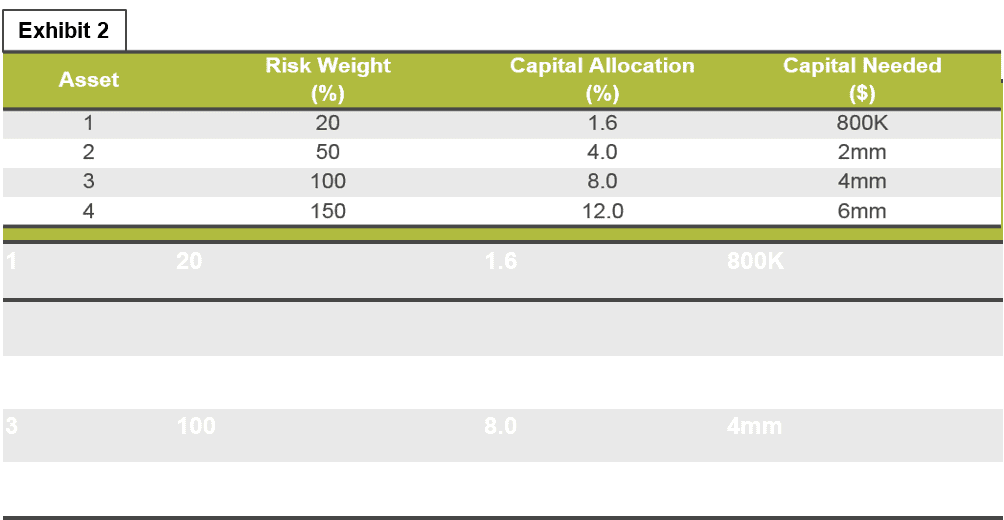
In Exhibit 2, four assets are listed with assigned risk weightings. For an adequately capitalized institution of 8%, the capital allocation is calculated by multiplying 8% by the assigned risk weighting. If an institution’s strategy is $50 million of asset growth, the last column shows how many dollars of capital would be required for each individual asset to be added to the balance sheet.
Exhibit 2
Capital management involves targeting a level of capital and allocating it efficiently utilizing the dual mandate requirements. One mathematical method of optimizing capital is to maximize marginal return on equity (ROE). If the ROE exceeds the established optimal level of capital, the asset is positively contributing to capital.
Let’s break down the ROE calculation into the following:
ROE = [ (S x L) + F ] x (1 – T)
S = Assets net spread represents the risk adjusted spread after adjusting the gross yield for various components such as liquidity spread, options cost, credit spread and duration cost.
L = Leverage multiplier is 1 / required capital
F = Funding benefit of equity is commonly assumed to be a duration matched swap rate. This is added back into the equation since a portion of the assets are funded with equity. The funding cost of equity is zero.
T = Tax rate
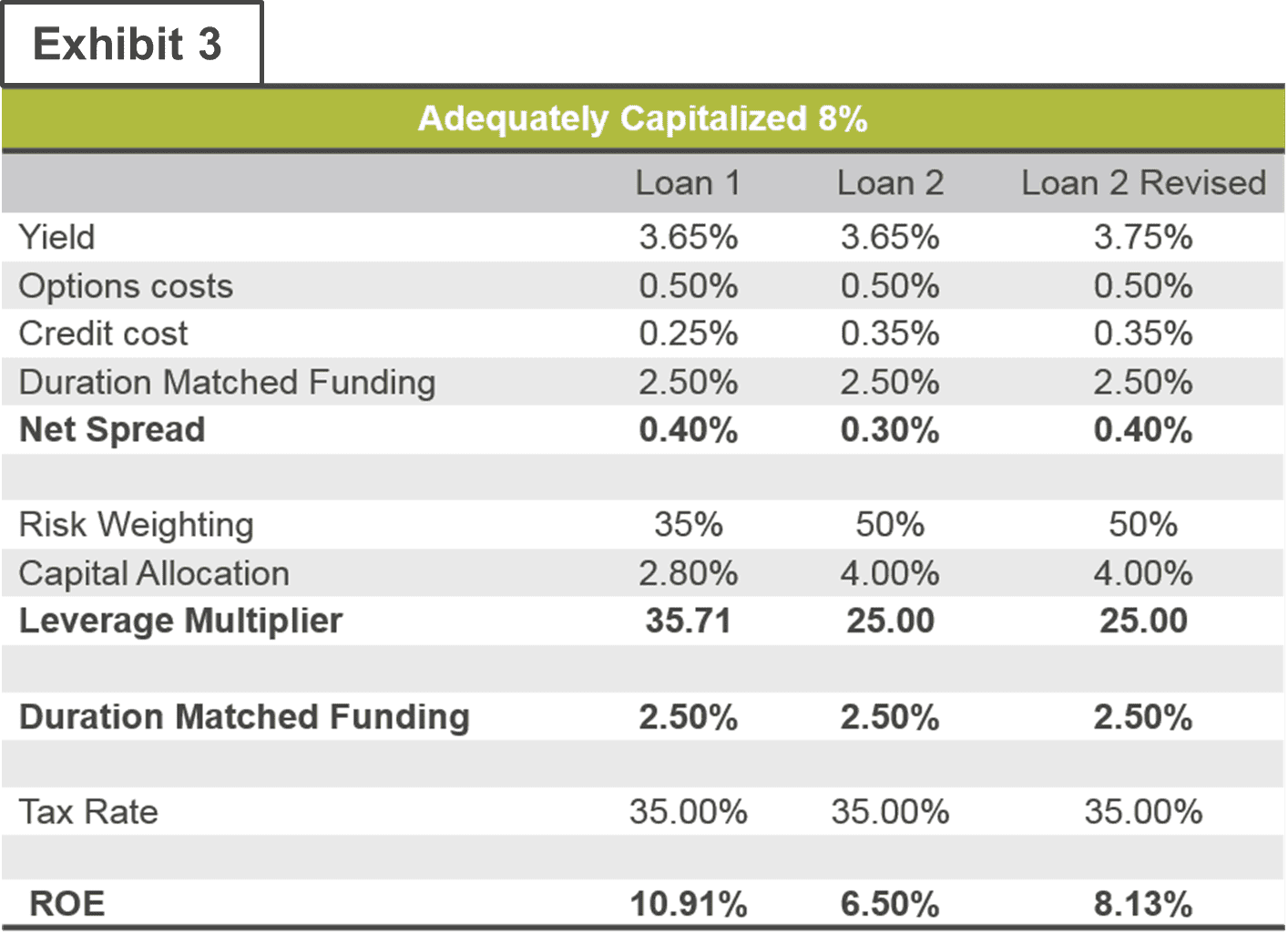
Exhibit 3 (below) shows apply the ROE formula using Basel III standards for an institution with a desired capital level of 8%; that is, adequately capitalized. The example compares two fixed-rate mortgage loans with similar characteristics (Loan 1 and 2). Note, if an institution is regulated by NCUA, the risk weighting used in the example would be slightly different and there would be no tax rate applied. Assume the offering rate on these loans is the same at 3.65%, even though the second loan has a slightly higher risk weighting. Using the formula reviewed earlier, the ROE on these loans would be 10.91% and 6.50%, respectively. Also note that the ROE of 6.50% on the second loan falls short of the desired capital level of 8%; thus, the economic value added on this loan would be negative (6.50% – 8.00% = -1.50%).
One can draw a few conclusions from this simple example. While several factors are used in loan pricing, ROE calculations can assist somewhat. The second loan’s offer rate of 3.65% is too low, given the current risk profile and weighting; so, the last column in Exhibit 3 shows that the offering rate on the second loan would need to be offered 10 basis points higher to exceed the desired capital level of 8.00%.
Exhibit 3
An institution’s capital management begins with establishing a desired level of capital and then determining how to allocate it. ROE can assist in rank-ordering various assets to evaluate the options that exceed the desired level. The most efficient way to use capital is to combine the various loans with the highest ROE to maximize economic value added to capital.