The various market risk factors impacting portfolio performance are not static.
As such managers must continuously evaluate opportunities to rebalance portfolios to maximize expected risk-adjusted returns given portfolio objectives and guidelines. At the same time, good portfolio managers aim to achieve these objectives with the least number of trades possible, which may negatively impact returns given associated costs. The parties engaged to execute these rebalancing transactions (broker dealers) can have different incentives, however, as those transactional costs boost their overall profitability.
There are both offensive and defensive motives for executing a portfolio rebalancing. The former can include altering sector allocations to increase the portfolio’s risk-adjusted spread, a primary measure of expected return. On the defensive front, compensation for certain risks may be limited and no longer justify allocation to certain securities/sectors. For example, spreads in a certain sector, such as corporate debt, may be trading at historically low/tight levels, and selling securities with the greatest sensitivity to future changes in spreads (as measured by spread duration) may be a very practical decision.
For some investor types, straightforward economic decisions may be muddled by accounting challenges. In other words, executing a rebalancing trade could trigger an accounting gain or loss through earnings for investors that do not mark changes in market values through the income statement each period (e.g., depository institutions). On the other hand, we should also never execute trades that have the perception of a positive accounting impact but negative economics. How we account for an asset does not change the economics over its life.
Evaluating “Bond Swaps”
Managers of depository investment portfolios are often presented with “bond swap” opportunities by the regional broker dealer community. These analyses often target assets with low accounting (book) yields as an opportunity to boost earnings by replacing those assets with higher current market yields. However, such an analysis is never so simple and there are several questions for portfolio managers to answer. First and foremost, how are these “underwater” assets funded? This is critical to understanding how the assets are impacting current profitability. As a simple example, if a bond with a book yield of 2% is being funded by a liability with a 4% rate, this asset has negative carry and is already adversely impacting earnings each period, regardless of how it is accounted for. Conversely, if the 2% assets is being funded by core deposits at a lower rate, this asset may still have positive carry through earnings (interest margins). However, this question is not always so simple to answer, so we move on to other criteria to evaluate.
If the primary goal is to boost portfolio expected returns, there are multiple ways to accomplish this. The first and simplest approach is to accomplish this through an evaluation of marginal reinvestment. Depending on portfolio make up and amount of regular principal cashflow, this step could take longer than desired. The next option could be to redirect more cash to the portfolio, increasing its size and adding assets with wider risk-adjusted spreads.
The third option generally requires the evaluation of differing degrees of firm capital usage. If we sell assets with unrealized accounting losses, we reduce firm capital by that amount. In other words, we increase overall balance sheet leverage. Alternatively, we could borrow funds to reinvest in securities with wider spreads. Between these two options, the decision comes down to the cheapest cost of funds. We look at the bid side/market yield to evaluate and compare to similar duration whole-sale funding options (FHLB, Brokered CDs, etc.) Exhibit 1 shows the comparison of funding costs between selling fixed-rate Agency Commercial Mortgage-Backed Securities (ACMBS) and similar duration wholesale funding sources.

For a leverage trade to be accretive to earnings, the reinvestment spread must exceed the borrowing spread. When we sell assets, the market yield/spread is effectively our cost of funds. It is the present value of the future income foregone.
A common trade discussed recently is selling low-yielding assets, and reinvesting in higher yielding bonds, while also adding down-rate protection. Exhibit 2 shows the economics of this trade.
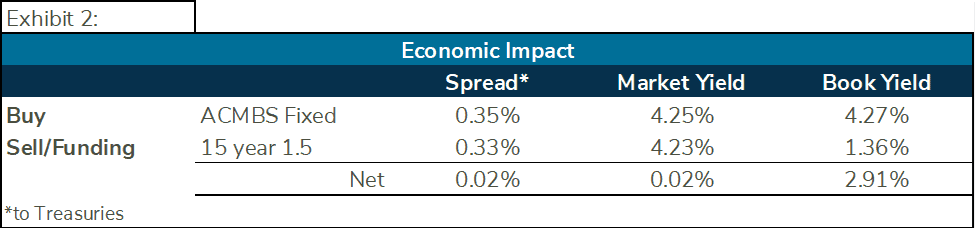
In this example, the institution would be selling low-yielding mortgage-backed securities (15 year 1.5% pool), commonly purchased throughout 2020-2022. They would then reinvest in fixed-rate ACMBS, which would have a higher book yield as well as more stable cashflows in a downrate environment. To make this a more apples-to-apples comparison, both bonds have similar durations, so this removes any changes in interest rate risk associated with the trade. As seen in the example, there is minimal pick-up in the economics of the rebalance, even though it shows a large change to book yield. The institution would be realizing a large accounting loss, with minimal positive economics going forward. That’s not to say there aren’t times that rebalancing out of bonds makes sense, but we MUST evaluate that reinvestment spread exceeds the funding spread. If not, we are booking negative or minimal profits. Exhibit 3 shows an example of a rebalance with positive economics.
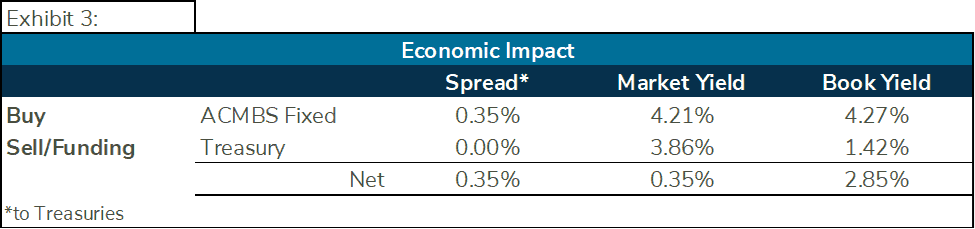
In this example, the reinvestment asset is the same where the institution is adding bonds that have a higher yield and offer down-rate protection, but we are funding these by selling Treasuries. There are more positive economics on this trade, so it would be beneficial for the institution going forward. When using capital to fund the purchase (whether through realizing a loss or adding leverage) the decision comes down to finding the cheapest cost of funds, and ensuring a spread between the funding source and the asset. Lastly, we must also consider the nature of the assets we are looking to sell from the portfolio. Assuming there are no credit concerns, many depository portfolios are comprised of short duration securities that will pay down over a relatively short timeframe. A life insurance portfolio is an entirely different story. However, in both cases, we must always consider the liabilities funding those assets.
Want to discuss Portfolio Rebalancing Opportunities in more detail? Contact ALM First.