
Core deposit growth has been challenging for many financial institutions in recent years, leading to much discussion surrounding an ongoing “fight for deposits” within the industry.
However, not all deposit run off is necessarily bad, especially if an increasing cost of funds (COF) is putting pressure on the net interest margin (NIM) or capital is constrained.
The business of banking naturally leads to interest rate risk (IRR) as shorter-duration liabilities such as core deposits don’t always match up with longer-duration assets such as loans. When the timing of cash inflows does not align with the timing of outflows, liquidity risk arises. Balance sheet managers must consider all of these factors and more when making decisions, including evaluating different opportunities when it comes to funding costs.
Borrowing Can Be a Smart Strategy
Despite increases since 2020, depositories are still able to borrow at relatively low rates. The cost of borrowing to receive cash can vary among the different options available to financial institutions. However, it is important to note that there is nothing wrong with borrowing – it can be a good strategy.
In general, banks tend to be more leveraged than credit unions. This is especially true of larger institutions with higher amounts of borrowings. It’s important for depositories to consider the cost of cash using common options such as:
- FHLB / Fed Advances: the advance rate
- Brokered CDs
- Investment sales: market yield (note it is not the book yield)
- Secondary Market Sales
- Dollar Roll: implied financing rate
- Reverse repo: repo rate
Rate Shoppers Tend to Shop Early
As the Fed began increasing rates dramatically in 2022, savers started to weigh their options and shift their funds. Over the last few years, this has led to larger increases in short term CDs amongst credit unions and smaller banks compared with larger banks.
High-yield accounts generally suffer the most decay in a rising rate environment. Decays tend to be aggressive at the front-end of a rising cycle since rate shoppers shop early as they likely have a lot of options available to them. This can impact IRR and liquidity risk.
Traditional savings accounts are similar in nature to high-yield accounts as decays tend to be at the front-end of the cycle but are more muted. Financial institutions should be mindful of the deposit promos they run because they can lead to some cannibalization of current deposits – increasing the COF without always gaining strictly new deposits.
Creating a Resilient, Diversified Funding Strategy
A resilient funding strategy relies on multiple sources – no single source should dominate. Each of the options has their pros and cons. Core Deposits, Term Deposits (CDs), FHLB Advances, FRB/CLF/Emergency Lines, Brokered / Listing Service, and Hedged Funding should all be considered.
As depositories evaluate their funding options, it’s important to remember that the cheapest isn’t always the best. Core deposits, for example, may be low cost but can be volatile without loyalty programs. There are operational costs involved with each of the various options as well as potential concentration risk. Institutions should test their borrowing capacity quarterly – rather than just assume availability – and set policy limits along with early warning triggers.
When to Let Deposits Flow Out
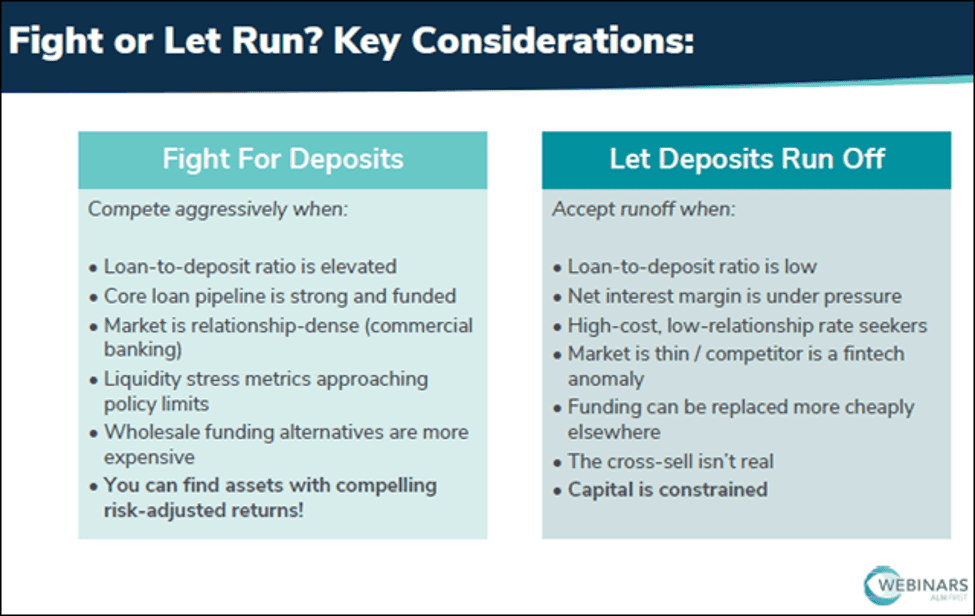
As the graph below summarizes, there are times to consider competing aggressively and times to accept runoff. Marginal deposit growth can be expensive if existing balances are simply repriced at higher rates. The challenge in measuring cannibalization is identifying which funds were most likely going to leave the institution without a more competitive offering. Understanding where deposits are going can help institutions price their own deposits more effectively.
If the implied cost of Non-Core Funding exceeds wholesale liquidity costs, such as overnight repo, then economically COF will be optimized through allowing hot money outflows.
A Strong Framework to Make Funding Decisions
Every dollar of asset growth requires a funding decision. The framework a depository utilizes should enforce this discipline.
That discipline runs in both directions, because asset pricing and funding needs are directly linked. If an institution is struggling to originate assets at quality, appropriately risk-adjusted rates, there is little reason to fight for the funding in the first place. Strong loan demand at healthy spreads may justify paying up for deposits, while weak or thinly priced origination opportunities argue for letting higher-cost money run off rather than funding growth that erodes the margin.
When market rates fall, financial institutions need to price their own deposit rates down. While funding has stabilized over the last few years as core deposit growth has remained more consistent, having multiple lines of borrowing available is key. So is knowing the cost, availability, and behavior characteristics of each source.
The decision to fight for deposits or let them roll off is largely dependent upon institutional dynamics. Evaluate whether there are true opportunities to deploy funding more effectively. If loan demand is low and there is nothing to buy, your institution may not need the funding. The same holds true when assets can only be added at rates that don’t adequately compensate for the risk — in that environment, competing aggressively for deposits simply funds unprofitable growth.
Want to discuss your funding strategy in more detail? Contact ALM First to speak with our team today.
