
Series: Ask ALM
Often, institutions are more willing to accept credit risk in their loan portfolio but avoid it in the bond portfolio.
Adding credit exposure to an investment portfolio gives investors an opportunity to improve expected returns, as well as diversify risk at the portfolio level. Comparable to the process for underwriting loans, portfolio managers must thoroughly analyze potential investments before adding them to the portfolio. In addition, these securities need to be monitored as part of a regular portfolio management process.
The Benefits of Credit Risk
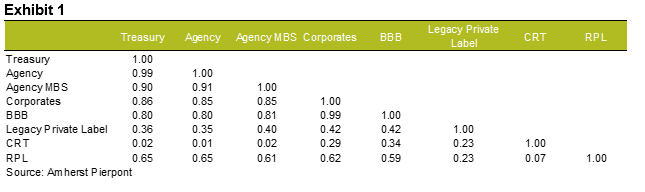
Performance analysis demonstrates that credit-risky assets have some diversification benefit when combined with agency MBS. Exhibit 1 shows the two-year correlations of monthly returns. As the table illustrates, agency MBS have lower correlations with credit-risky assets than they do with Treasuries and agency bullets.
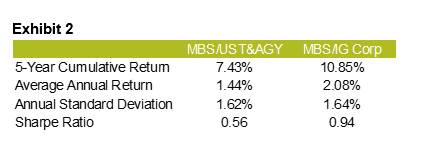
Adding these assets can lead to higher risk-adjusted returns than a portfolio constructed with MBS and agency bullets and Treasuries. Consider two simple portfolios: one is 50% agency bullets/US Treasuries and 50% agency MBS, and the other is 50% investment grade credit and 50% agency MBS. As Exhibit 2 illustrates, the portfolio with an allocation to credit not only outperformed on a gross return basis (5-year cumulative returns of 10.85% vs 7.43%), but on a risk-adjusted basis as well; the comparative Sharpe ratios were 0.94 vs 0.56.
Risk Assessment
Cash flows are the backbone of effective credit analysis because investors want to know how likely they are to receive their principal back. However, credit risk is a broad umbrella, and there are a variety of ways for a portfolio to gain credit exposure. Investors can’t use the same approach to evaluate credit risk as a part of the investment portfolio. For example, an investor would use a different set of evaluation criteria for a non-agency RMBS transaction than for that of a corporate debenture.
Mortgage Credit
When evaluating mortgage credit, investors should recognize that they are not buying a simple package of loans where principal and losses are shared pro rata across all investors. Rather, they are buying a structured transaction in which some investors are senior to others and take priority in terms of principal distribution; it is paramount to understand any potential investment’s structure.
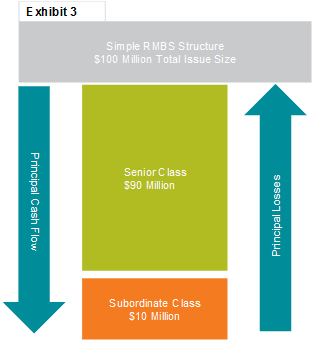
Exhibit 3 shows a very simple non-agency RMBS structure. In this deal, there is one senior class that makes up 90% of the entire deal, and one subordinate class that comprises the remaining 10%. Here, principal payments flow down from the senior class to the subordinate class, while losses flow the opposite direction. In this example, investors in the senior classes have credit support of 10%, which means that losses on the underlying loans would have to exceed 10% of the principal balance before the senior class starts taking losses. Given that the size of the subordinate class is only 10% of the entire deal, it doesn’t take much in terms of defaults for investors in that class to experience losses.
After gaining a thorough understanding of the structure, managers need to analyze the underlying collateral to evaluate how the loans are paying, what portion is defaulting, and how much of those losses are being recovered.
Knowledge of collateral performance helps determine investors’ stress testing of the bond. When stressing a deal, investors make assumptions regarding three basic variables:
- Voluntary Prepayment Rate (VPR) – the rate/pace predicted for future unexpected principal payment
- Constant Default Rate (CDR) – the rate/pace expected for the underlying collateral to go into default on an annualized basis
- Loss Given Default (LGD) – if the loan defaults, the percentage of the current loan balance expected to be lost during liquidation and how long the property stays in the liquidation pipeline
Typically, investors in these types of transactions change one of these variables on the underlying pool of loans to stress the bonds. Then, investors can evaluate their potential deal performance, given a particular stress scenario.
Investment-Grade Credit
Analyzing corporate credit can be done in a variety of ways, but one of the more popular methods is the use of a structural model, such as the Kealhofer Merton Vasicek (KMV) model. This approach uses the basic accounting formula (assets = liabilities + equity) and states that a company defaults when its debts exceed its market value. To determine how likely a firm is to default in the future, the model needs to forecast the future path of the firm’s market value. Since the current market value of a firm’s assets can’t be directly observed, it must be derived. One way to do this is to consider the firm’s equity as a call option on the firm’s market value.
Equity holders lose their stake if a firm defaults. Conversely, if a firm succeeds, shareholders benefit one-for-one in the increasing value. This payoff profile looks like a call option, with the strike price being the book value of the firm’s liabilities. Investors use option-pricing models and equity information to derive the market value of a firm’s assets. Given the market value of the firm’s assets and equity volatility, it’s possible for investors to project forward market values with the difference between the market value at a given point in time and the book value of liabilities being the distance to default.
The Need for Monitoring
Following the addition of credit-risky bonds to a portfolio, the need for analysis doesn’t end. Portfolio managers must understand that these risks are not static and must be frequently measured. Prudent investors stress their credit-risky assets in the same way they did prior to purchase. Periodically running models to test their investments and comparing actual performance with expectations is a best practice.
Non-agency RMBS investors keep track of changes in prepayments, both voluntary and involuntary, as well as changes to the loss severity. Investment-grade credit investors track rating and outlook changes to a particular credit to determine if the change is temporary and/or represents something more structural.
In summary, balance sheet and portfolio managers are in the business of managing risks, and that includes credit risk. The addition of credit risk to a bond portfolio can enhance returns and add diversification benefits. However, investors need to understand the risks they are assuming and manage them by thorough analysis of credit-risky assets, as well as frequent monitoring.
