
Series: Ask ALM
As credit unions continue to navigate challenges in hiring, talent retention, and demands for greater workplace flexibility, paying for rising benefits expenses is a common challenge.
Financial institutions are focused on extracting the maximum value possible from their investment portfolios to keep pace with growing expenses amid the historically low interest rate environment and shrinking loan to deposit ratios.
Here are a few important considerations to keep in mind as you seek to understand your institution’s unrealized losses. These items may also be helpful to utilize as discussion points if you plan to have more conversations around this topic at upcoming board, senior management, or ALCO meetings.
With the advent of NCUA regulation 701.19(c) in 2003, federal credit unions received expanded investment authority to pre-fund employee benefit plan obligations. Many states mirror this language, which allows credit unions to invest in otherwise impermissible asset classes and build a portfolio with a return profile more likely to keep pace with their rising benefits costs.
Here are five simple steps to help you get started:
1. Unrealized Your Options
There are two broad categories that credit union pre-funded benefits investments fall under: insurance assets and securities. Insurance products have long been used by financial institutions, mainly in the form of institution-owned life insurance (COLI/BOLI/CUOLI). Most purchasers of these products are attracted by “guaranteed” returns and accounting friendliness, but a deeper dive might leave you thinking otherwise.
Policies can be structured in a variety of ways, yet always with complex administrative and legal architecture. General account policies are most common given their seemingly straightforward return profile but lack risk transparency and require faith in the insurance carrier to provide consistent returns at stable fees. Separate account policies improve upon general account via added investment control but retain a key [costly] feature not to be overlooked: the tax advantage. Life insurance products are tax shelters, which is a strong selling point for taxable entities such as banks. However, this feature is often misaligned with the needs of credit unions, raising the question: Is traditional institution-owned life insurance the best investment vehicle for employee benefits pre-funding?
2. Define Your Risk Appetite
Separately managed investment portfolios have seen increasing popularity in recent years as an alternative to insurance products, offering more transparency, simplicity, and customization at lower overall costs. There is no regulatory cap on the aggregate size of 701.19(c) investments for federal charters, and nearly unlimited strategy options based on risk appetite and return objectives. As such, preliminary conversations between the Board of Directors and executive management team should center around risk preferences and education before defining and implementing a strategy.
Expanded investment authority goes hand in hand with the potential for greater risk. As with the core investment portfolio, a pre-funded benefits portfolio should complement the balance sheet in an asset/liability management (ALM) framework. Attention should be given to macro-factor risk exposure including interest rate, credit, and liquidity risk and the institution’s marginal capacity to take on each.
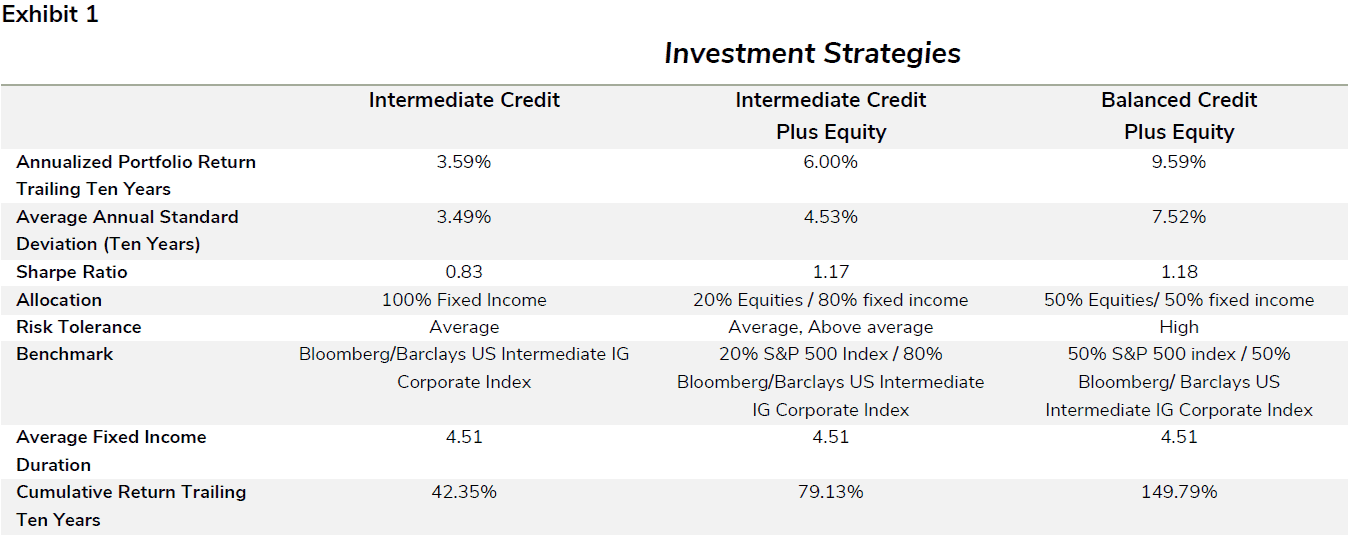
Pre-funded benefits portfolio strategies frequently lean on credit and liquidity risk exposure for enhanced returns, often via investment grade senior and subordinated corporate debt instruments. Institutions with higher risk tolerances may also elect to layer in equity exposure, known equally for its volatility and unmatched returns. Three common strategies, each with varying degrees of equity allocation, are shown in Exhibit 1.
Source: ALM First
Past performance is no guarantee of future results. Returns are for the trailing ten-year period ending September 30, 2021. Returns are net of model fees, which is the highest fee a client would be charged for following this model. For more details on the methodology and benchmark comparisons please see the disclosure.
3. Consider the Accounting
Understanding the accounting treatment investments will receive is vital to the education process, particularly as it pertains to equities. While fixed income investments may be held available-for-sale, mutual funds, exchange traded funds (ETFs), and other common equity investments require a mark-to-market treatment which can cause volatility of the earnings statement and capital position.
Traditionally, more risk averse institutions have turned to insurance products or an exclusively fixed income portfolio, but another option exists: an insurance “wrap” known as a Stable Value Annuity (SVA). Compared to BOLI/COLI/CUOLI products, the annuity product is a much simpler and more cost-effective structure which also provides preferrable accounting treatment. The “wrap” is provided by an insurance carrier and the SVA technology smooths the accounting impact of more volatile market movements. The annuity is considered an insurance contract and the book value is gradually adjusted through a crediting rate formula over a longer time horizon, dependent upon actual market performance.
The most important takeaway is that a SVA is only meant to be an accounting solution and does not provide any economic benefit or principal protection. However, having access to this option may expand an institution’s preferable investment opportunities.
Expanded investment authority goes hand in hand with the potential for greater risk. As with the core investment portfolio, a pre-funded benefits portfolio should complement the balance sheet in an asset/liability management (ALM) framework. Attention should be given to macro-factor risk exposure including interest rate, credit, and liquidity risk and the institution’s marginal capacity to take on each.
4. Establish a Direct Relationship
According to regulations, a direct relationship between the benefit obligation and investment must be established, meaning that the portfolio return cannot exceed the current or potential benefit expense obligation. Once a strategic direction is determined, the maximum portfolio size by strategy is dictated by the benefit expense divided by the anticipated investment return. Strategies with lower risk exposure, and therefore lower anticipated returns, will warrant a larger maximum portfolio size to extinguish the benefit obligation as compared to a higher risk, higher anticipated return strategy. It is best practice to right size the portfolio based on risk preferences rather than take on added risk to limit the footprint of the portfolio.
5. Put Clear Guidelines in Place
The last step before funding and investment execution is approval of portfolio guidelines. The guidelines serve to define the portfolio strategy, permissible investments, risk controls, and reasonable timelines for investment by the asset manager. Ex-post performance reporting should be reviewed periodically, and the direct relationship between benefit expense and both realized and expected investment returns should be reaffirmed given changes in either strategy or projected expense. As with any long-horizon investment strategy, monthly return variability should not deter investors. The long-term cumulative benefits of having a well-designed and managed pre-funded benefits portfolios far exceeds intermittent return volatility.
Proper education, risk evaluation, and product utilization can help credit unions safely and soundly tap into the financial advantages of pre-funded benefits investment portfolios. With tools like a Stable Value Annuity, there are even more options available to institutions to fund rising expenses and boost margins while minimizing cost and financial statement volatility.
Want to learn more? Contact ALM First.
Returns are gross of fees, unaudited, and estimated using the Modified Dietz method. ALM First does not have complete discretionary trading authority over each account reflected in the performance discussed herein. Some clients had investment results materially different from those portrayed in this document. These data were compiled from client portfolios that consistently accepted ALM First investment advice.
Portfolio performance is discussed for illustrative purposes only and does not necessarily predict or depict performance of that strategy in an individual client’s account. It must be noted that investments are not necessarily limited to the investments comprising the portfolio and may be adjusted by individual clients’ account restrictions. A portfolio cannot be purchased directly by investors.
The results shown do not represent the results of actual trading using client assets but were achieved by means of the retroactive application of a model that was designed with the benefit of hindsight. Past performance is no guarantee of future results. There can be no assurance that future results achieved by a client portfolio will in any way resemble those of the above strategies. Index performance is discussed for illustrative purposes only as a benchmark for each strategy’s performance and does not predict or depict performance of that strategy. While index comparisons may be useful to provide a benchmark for a strategy’s performance, it must be noted that investments are not limited to the investments comprising the indices. Each of the strategy benchmark indices are unmanaged and cannot be purchased directly by investors.
