
Series: Ask ALM
Fixed income investment managers are facing tighter asset spreads, making excess returns potentially elusive in 2021 as prepayment models struggle to estimate mortgage prepayments and reinvestment needs from new money and portfolio principal reductions continue to be high.
At the same time, additional stimulus payments, traditional seasonal liquidity trends, lower loan demand and the low-rate environment could challenge financial institutions even further to deploy excess cash effectively in 2021. We believe now is the time to ensure your depository has a disciplined investment approach, established guidelines and is utilizing time-tested best practices to help you manage risk and generate returns by putting those funds to work and potentially enhancing bottom-line performance.
While all investment decisions will impact a portfolio’s future returns, the decision-making framework in which they are made is generally more important than the individual decisions themselves. This article will outline the fixed-income investment process (the decision-making framework), discuss analytical models and why we need them, and conclude with a snapshot and comments on today’s fixed-income landscape.
A Framework for Sound Portfolio Decision-Making
Institutional fixed-income portfolio management is best thought of as a “rinse and repeat” process, in which portfolio riskiness is increased when compensation for risk is high and vice-versa. For example, if yield spreads and expected returns on corporate bonds or mortgage-backed securities (MBS) are low, portfolio weights and exposure to these assets would also be low. As spreads widen relative to U.S. Treasuries or interest rate swap rates, exposure is increased. A data and research-oriented framework, combined with sound trading level analytical models, arm today’s successful fixed-income managers to address portfolio management in a very controlled manner. Individual security selection can be thought of as the raw materials for portfolio returns. And as a best practice, consider relative value analysis using robust trading level analysis in an option and credit-adjusted framework.
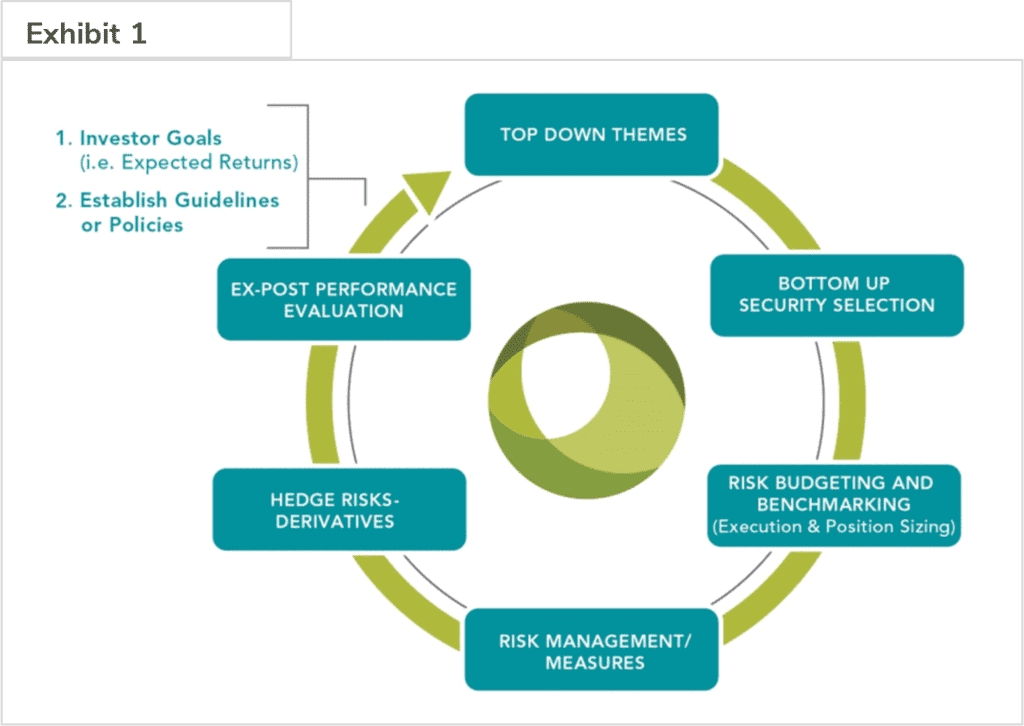
Exhibit 1 displays a portfolio management “feedback loop” that starts with understanding investor goals and establishing guidelines or policies to express these goals. From here, top-down market themes lead the way through our investment process. Security selection, risk budgeting and measurement and hedging, if permitted, bring us to the finish, with ex-post performance evaluation. Actively managed fixed-income portfolios are at some stage of this feedback loop at all times. For example, we might see monthly top-down themes, combined with daily security selection, weekly risk analysis and monthly performance reporting. Duration targeting and interest rate risk management take the guesswork off the table. Notice there’s no discussion here on the direction of rates or when the Fed is going to move. Interest rate forecasts, rate bets, and trades that are explicitly positioned for a specific interest rate change have no place in this process and often can cause portfolio managers to rue the day. Instead, portfolio performance comes from good, old-fashioned risk measurement and management, as well as sector and security selection.
Why Do We Need Analytical Models?
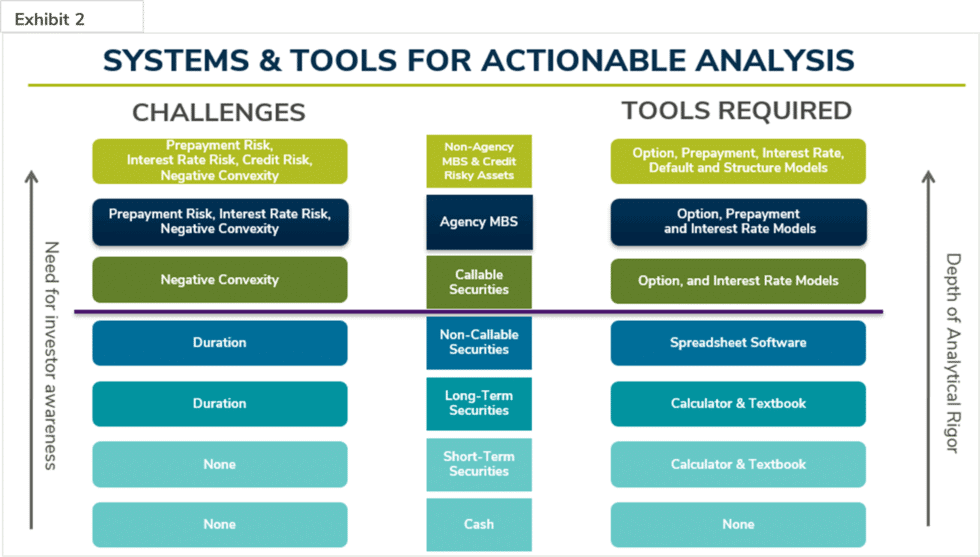
We need analytical models to identify and measure risks, and potential returns. In today’s dynamic fixed-income markets, the need for robust analytical models increases with the complexity of the assets or asset classes being evaluated.
Exhibit II shows this graphically. The line in the sand is clearly drawn between option and credit embedded assets and their other, simpler, cousins. We believe it is best to evaluate callable bonds using a lattice approach, while given the path dependent nature of the prepayment option, MBS are better evaluated using Monte-Carlo simulations. Interest rate and option models should price observable market instruments accurately and be arbitrage free, and prepayment models should exhibit a “best data fit” approach. Of course, we can’t forget the popular phrases “model users beware” and “use models at own risk.” There are plenty of historical examples of financial models leading investors to their early demise. So proceed cautiously; understand the inputs and assumptions; and absolutely, positively be critical of outputs. Models can help us make decisions, but they are not the end-all be-all.
Current Market Themes
Treasury yields were higher and steeper over the month of December, as illustrated in Exhibit 3. This reversed all the curve flattening that occurred post-election in November (and more), and the 2-year/10-year slope metric ended the month 3 bps below the current-cycle high of 0.82% set on December 18. We provided the YTD comparison as well for added perspective. Rates were significantly lower across the curve given the Fed’s actions in Q1, but all measures of curve slope were steeper over the year.
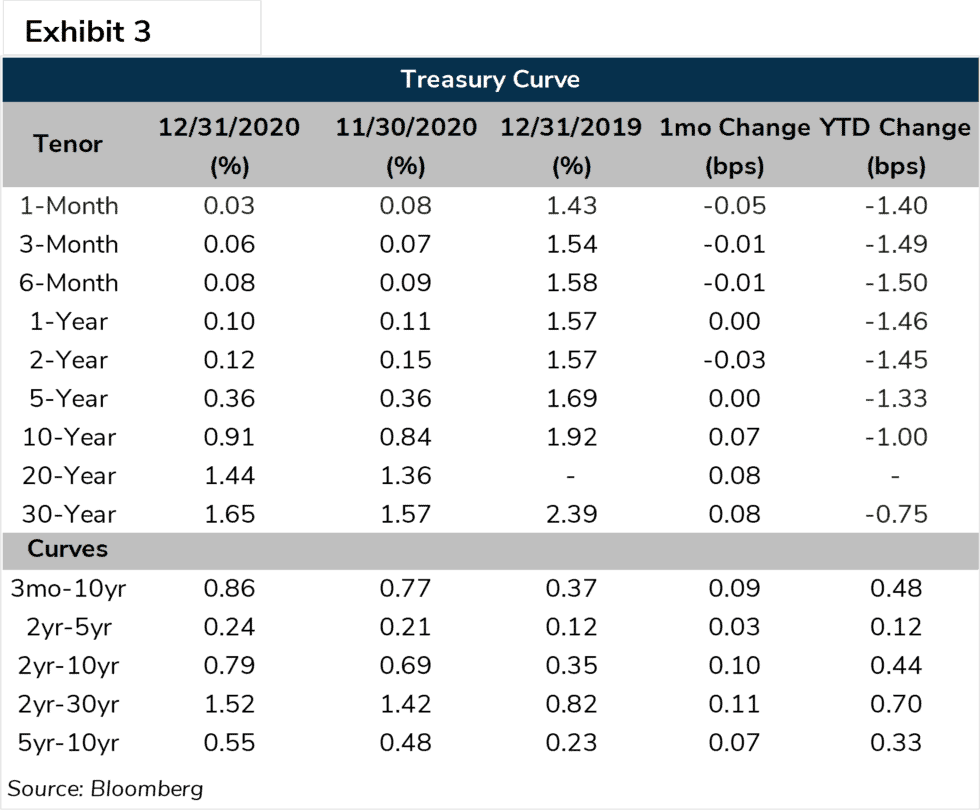
Looking ahead, another round of fiscal stimulus/spending and/or accelerated economic improvement should contribute to more steepening pressure, although the wild card on that front continues to be the Fed. Modest or gradual steepening may be more palatable than a sharper shift in curve slope, which could potentially spark an adjustment to the Fed’s asset purchases, including duration extension and/or yield curve control. Volatility in short rates (2 years and in) should remain subdued and anchored throughout 2021 by Fed interest rate policy expectations.
ALM First’s Team of Professionals is Here to Assist You! Contact us to discuss your institution’s investment needs and how partnering with ALM First could benefit your institution.
