
Series: Ask ALM
Regardless of rate forecasts and growth expectations, it will remain critical for healthy financial institutions to ensure that adequate liquidity sources are available in the event of the unexpected.
Depositories should employ tools and resources that provide comprehensive liquidity forecasts and ongoing stress tests in order to evaluate the overall effectiveness of the institution’s liquidity policies.
What is Liquidity & What are the Risks?
A simple definition of liquidity is the capacity to meet cash & collateral obligations at a reasonable cost. This includes both expected & unexpected events. Liquidity risk is the risk of not being able to obtain funds at a reasonable price within a reasonable time period to meet those obligations as they come due.
Within the past twenty years, we’ve had two significant events that demonstrate why sound liquidity forecasting is imperative for institutions of all sizes. During the summer of 2008, Fannie and Freddie were conserved and Lehman Brothers and Merrill Lynch failed. While those broker-dealers didn’t have a deposit base like financial institutions do, their failure shows that a global event can impact a bank or credit union regardless of size. The Federal Home Loan Bank, which many financial institutions rely upon for their borrowings, was impacted. Also, the liquidity crisis also impacted the spreads on all assets and, therefore, the execution of security sales by financial institutions.
In 1998, the Asian Flu led to currency devaluations which flowed through Europe to the U.S. All major broker-dealers had given friendly terms to a hedge fund that made wrong way bets during this period, causing another liquidity crisis with far-reaching impacts.
These events changed the regulatory environment and led to the Interagency Policy Statement on Funding & Liquidity Risk Management in March 2010. Banks and credit unions are now required to have much more in-depth liquidity forecasting as a result.
How Should Institutions Monitor & Manage Liquidity?
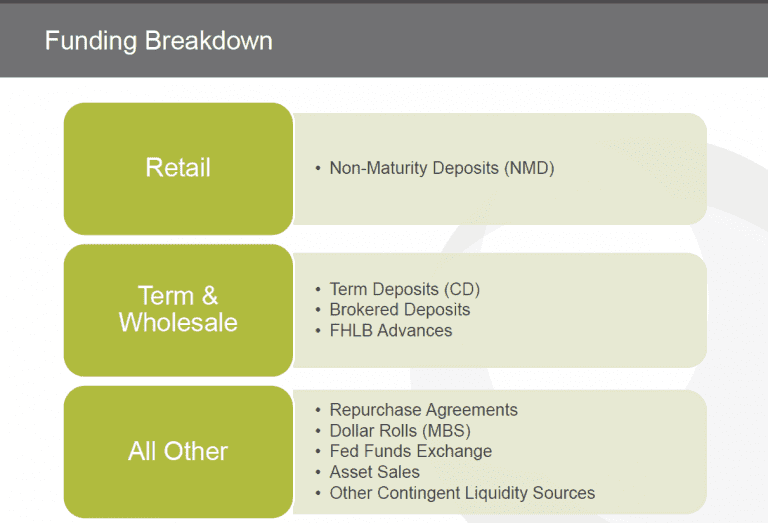
While your institution’s liquidity management policy is dependent upon the complexity of your balance sheet and funding sources, institutions of all sizes should always be aware of their current liquidity position. This includes a daily cash management sheet along with regularly forecasted ratios. Institutions of all sizes should also identify alternative liquidity sources and clearly understand what their funding mix looks like to better manage it. As shown in the chart below, retail, wholesale and other/non-traditional funding sources should be explored.
While LCR is a regulatory requirement for the largest institutions, many of our clients have developed a 30-day coverage ratio as a best practice internally.
How Can We Integrate Liquidity Management?
A financial institution needs a liquidity policy just as it must have an asset liability management policy and an investment policy. The policy should discuss sources and use, where you can go to borrow, your plan to raise additional liquidity.
As shown in the chart, the Liquidity Policy will work closely with your Contingency Funding Plan (CFP) which should include an action plan if warning indicators or policy limits are reached. Regular monitoring and establishing clear procedures, controls & limits are also vital parts of liquidity management.
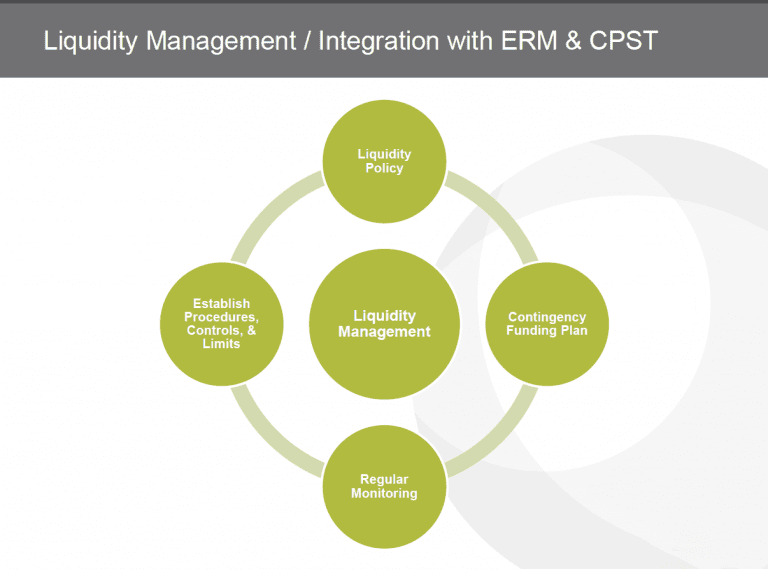
Your CFP may include trigger points and should take institution specific events into account when developing action plans. In addition to identifying and assessing stress events and funding sources, the CFP establishes the monitoring framework and the liquidity event management process.
Contingent liability events may include:
- Inability to fund asset growth
- Inability to renew or replace maturing funding
- Unexpected withdrawals
- Changes in market value & price volatility
- Changes in economic conditions, market perception, or dislocations in financial markets
- Disturbances in payment & settlement systems due to operational or local disasters
How Can My Institution Take Steps to Ensure Safety & Soundness in 2020 and Beyond?
Liquidity risk remains a major focus for financial institutions and their regulators. Therefore, building a sound liquidity risk management framework and CFP is crucial. In fact, failure to do so is considered an unsafe & unsound practice. Be sure to use your controls, limits, & guidelines.
Interested in learning more about effective liquidity forecasting? Contact ALM First at info@almfirst.com to request access to our recorded webinar, which includes a more in-depth discussion of best practices in liquidity management.
