
Economic Update
- Something finally broke and not in an area that market participants were expecting
- Fresh regulations for the banking industry are almost certain, and we contemplate what those might look like
- The FOMC moved forward with a 25 basis point rate hike on March 22 amid the banking turmoil, while acknowledging the uncertain impact of tighter credit conditions on jobs, inflation, and economic growth
Something finally broke. After nearly 500 basis points of rate hikes in a year and balance sheet reduction by the Fed, a pocket of financial instability emerged. Where it arrived was perhaps a greater surprise for financial market participants. The abrupt failure of Silicon Valley Bank (SVB) on March 10 and the ensuing takeover of Signature Bank (SBNY) on March 12 by state and federal regulators triggered a panic in financial markets that a broader run on the banking system might occur in the coming days, particularly for small and mid-size depository institutions. To calm these fears, the FDIC announced that all deposits, including those above the $250k insurance limit, would be protected, and the Federal Reserve announced a new emergency funding facility, dubbed the Bank Term Funding Program, that would provide an additional source of liquidity to counter any systemic deposit outflows. Interest rate volatility surged to the highest levels since the Great Financial Crisis, as Treasury yields fluctuated in roller-coaster fashion on a daily basis.
Some of the focus in recent weeks (or the last year for that matter) has been a significant increase in unrealized losses within depositories’ Available for Sale (AFS) investment portfolios. This has been well documented in both traditional and social media commentaries recently, and almost all of it has ignored the increase in the overall value of core depository liabilities over the same timeframe. It would be difficult, if not impossible, for any depository institution to survive 25% of deposits walking out the door in a single day (SVB). The difference for SVB and SBNY, to a lesser extent, relative to the industry was the significant share of uninsured deposits. In other words, 25% of SVB’s deposits leaving came from a far fewer number of accounts than the typical depository, which leads us to the concept of deposit concentration. In a sound asset-liability management (ALM) framework, an institution with similar outflow risk would offset it by limiting interest-rate and liquidity risk in the securities portfolio (and use interest-rate derivatives as needed). That obviously didn’t happen at SVB, and just the top 10 depositors leaving would have accounted for more than $13 billion in cash outflows.
What Comes Next for Depositories?
There have been many commentaries to this point discussing the follies of SVB management that initiated the recent turmoil in the banking system, including the brief intro above. Rather than rehashing those factors, we will instead contemplate the potential ramifications of recent events, which could impact industry profitability and economic growth in the months/years to come. Facing political backlash, the regulator response to the failures of SVB and SBNY will most certainly not be zero.
Much of the post-GFC regulatory focus was concentrated on balance sheet credit and liquidity risk, including supervisory focus on asset diversification and reliance on wholesale funding. There was little regulation in place that focused on deposit concentration. A key regulatory framework that emerged in the wake of the GFC was the Liquidity Coverage Ratio (LCR). LCR required that banks hold enough high-quality liquid assets (HQLA) to cover a 30-day net outflow of deposits in a stress scenario. HQLA was broken into tiers, with level 1 effectively cash at the Fed and Treasuries (no haircut for these assets). The other tiers include GSE and other securities, which required a haircut beyond fair value. The required amount of HQLA varied by bank size, with Global Systemically Important Banks (GSIBs) and those with more than $250 billion in assets required to fully cover the 30-day cashflow scenario with HQLAs, calculated daily. Banks in the $50bn-$250bn range were required to have enough HQLA to cover 70% of the outflow scenario, and any institutions below $50 billion had no such requirements. However, as part of a bill passed by Congress in 2018, non-GSIBs received some relief on the outflow coverage percentage. For $50bn-$100bn institutions, LCR no longer applied, and the coverage ratio for $100bn-$700bn banks was reduced to 50%-85% (higher figure for $250bn and up).
There are two ways regulators could (not necessarily should) potentially make LCR more stringent going forward – modify HQLA and/or modify the net cash outflow stress scenario. The former seems like a more likely starting point, beginning with a reversal of the relaxed rules from the 2018 legislation. Additionally, the threshold for required participation could be lowered below $50 billion in total assets. An increased allocation to HQLA has to come from somewhere, primarily the lending book, and these HQLAs must be unencumbered. In the near/intermediate term, this would have negative implications for industry profitability, and reduced lending would also impact overall economic growth.
Other potential regulatory responses could include increased capitalization requirements, even if recent events had little to do with capitalization or asset quality. Additionally, reserve requirements, which were lowered to zero in 2020, could be reinstituted. However, while reserve requirements, in theory, are to protect against heavy deposit outflows, the Fed and other central banks have traditionally viewed them more as another monetary policy tool for price stability. In addition to changes in the benchmark policy rate (e.g., fed funds), central bankers would alter bank reserve requirements as part of policy expansion or contraction. Reserve requirements were lowered in March 2020 to encourage lending in the early COVID fallout as part of expansionary monetary policy, but despite the Fed now being engaged in aggressive tightening, reserve requirements remain zero. The combination of LCR requirements for large banks (requiring more cash reserves) and paying interest on reserves (began in 2008) likely changed the Fed’s viewpoint on the effectiveness and efficiency of reserve requirements as a monetary policy tool, particularly with trillions of dollars of excess reserves still in the system. Perhaps this will be a greater topic of regulatory discussion going forward.
As we have noted several times over the years, the banking industry, as a whole, was much healthier than the period immediately prior to the GFC following implementation of many new regulatory frameworks. Even well-capitalized institutions with strong asset quality and robust liquidity risk management programs would be susceptible to a bank run, particularly with almost all asset fair values well below book following the Fed’s ultra-aggressive rate hikes over the last year. A successful banking model relies on positive duration assumptions of non-maturity deposits based on empirical evidence. The stickier the core deposits, the longer the duration assumption. Take a much more conservative stance on those liability assumptions, even if empirical data supports them, and the financial intermediation model (and available credit for businesses and consumers) looks very different.
What Will the Fed Do?
On March 22, the FOMC decided to move forward with another 25 basis point rate hike, while acknowledging economic and financial stability uncertainties related to the recent banking turmoil. The move was perhaps aimed at not conveying additional panic by the regulator of the largest US banks. During the press conference, Fed Chair Powell acknowledged that recent developments “are likely to result in tighter conditions for households and businesses and to weigh on economic activity, hiring, and inflation.” However, when pressed to quantify the impact of tighter credit, Powell said its unknown at this point as to how much of an impact it may have.
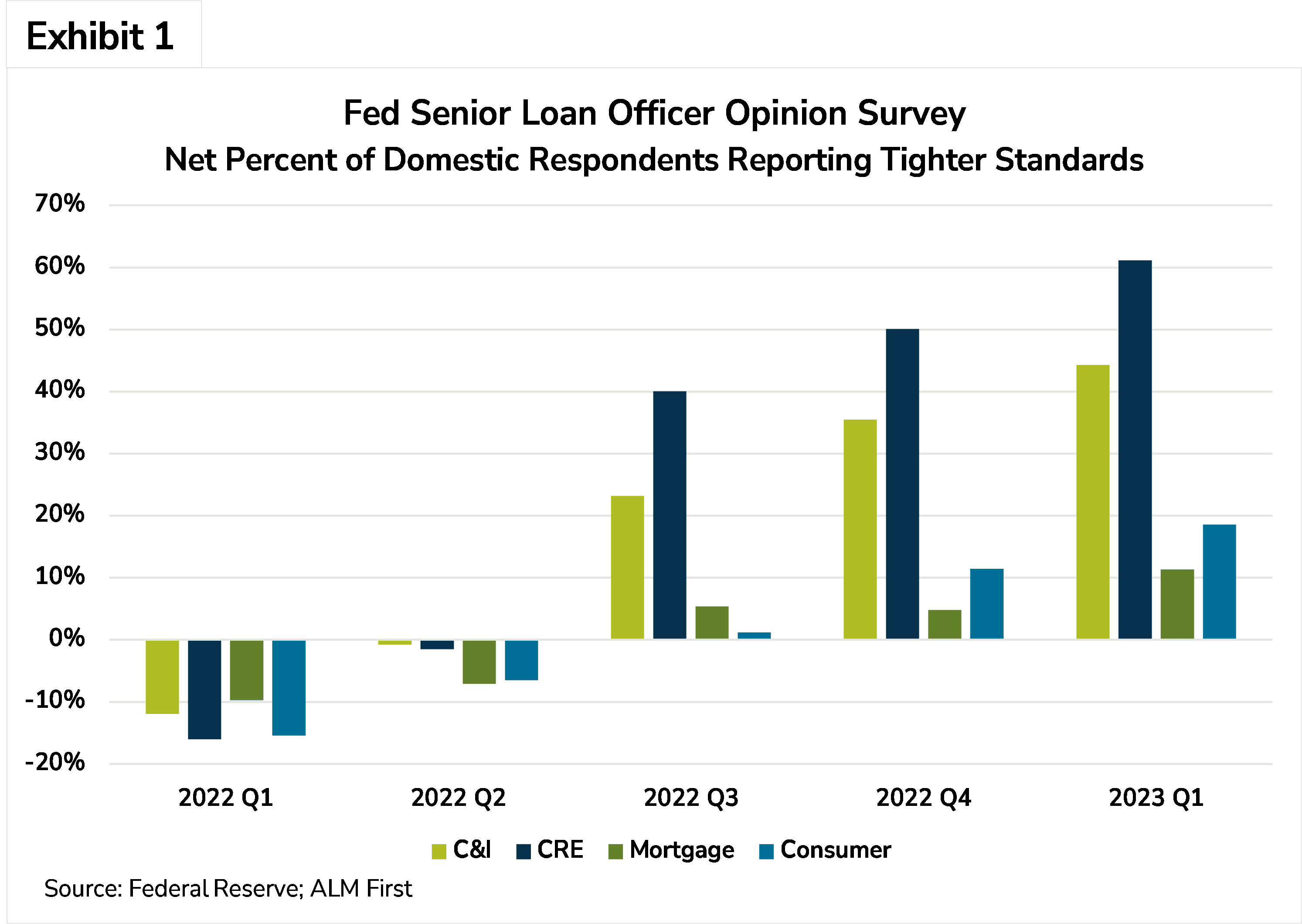
The tightening of credit conditions didn’t begin following SVB’s collapse. When reviewing the Fed’s periodic survey of senior loan officers, the tightening of credit standards began in Q3 of last year, particularly for commercial loans (Exhibit 1). Tighter credit conditions do ultimately have a negative impact on GDP, but how soon and how much are the tricky questions. The Fed continues to fight an overheated labor market and well-above target inflation, and as such, financial markets have been pricing higher probability of a hard landing.
This brings us back full circle to three of our four primary themes for 2023 – rate volatility, recession risks for 2023, and liquidity in the banking system. The first two months of this year were characterized by big swings in benchmark yields as market pricing for Fed rate hikes diverged (January), then converged (February), and are back divergent again, with current pricing in Fed funds futures close to where we began February (rate cuts in the second half of this year). This volatility has contributed to liquidity challenges in financial markets as a whole, but particularly for depository institutions. What will potentially break next? Hard to say, but there are multiple external risks looming in the coming months, including the US debt ceiling debate, a potential hawkish pivot by the Bank of Japan, higher oil prices following the recent OPEC decision, and general geopolitical tensions.
To download this economic update portion of our Monthly Market Commentary, please click here.
To continue reading the full month’s market commentary, and to learn more about current market themes, market sectors, sector performances, and applied strategies, log in to the ALM First portal, and select this month’s commentary in the Resource Center. If you do not have a log in and you would still like to access the document, please send your inquiry to info@almfirst.com.
