Economic Update
- President Trump announced sweeping tariffs against all U.S. trading partners on April 2
- A minimum 10% levy will be applied to all exports to the U.S., with 60 nations subject to much higher rates, but the White House signaled an openness to bilateral negotiation
- Risk assets have sold off materially, while Treasuries have rallied
- The Fed sits in an unenviable position of managing stagflation risks in the coming months
On April 2, President Trump announced sweeping tariffs on all U.S. trading partners, dubbed “Liberation Day,” and the breadth of the tariffs exceeded market expectations. A minimum 10% levy will be applied to all exports to the U.S., and even larger tariffs will be imposed on 60 nations. China is hit the hardest, with a new 34% tariff added to the 20% tariff the White House had already imposed. Southeast Asia was the hardest hit region, including a 56% tariff on Vietnamese imports. Japan faces a 24% tariff and the European Union 20%. The previously announced 25% tariffs on automobiles and parts took effect at midnight on April 2, with the remaining tariffs set to take effect over the coming days. White House officials signaled that the maximum levies announced are the starting point for negotiations, and now we see what retaliatory tariffs will be announced. The initial reaction in global markets was sharply negative. U.S. equity futures traded down 3%-4.5% in the overnight session following the announcement, and Treasury yields 11-14 basis points (bps) in the 2-year to 10-year part of the curve.
Now we wait for the next steps. The suggestion that the tariffs are very negotiable is unlikely to spark business investment in the coming months. In other words, companies will likely be in a wait-and-see mode as it relates to significant capital expenditures given the perceived lack of permanence of the tariffs. As it stands today, the tariffs are expected to have a materially negative impact on global growth and inflation, the duration of the latter more dependent on what retaliatory measures are taken by trading partners. Will U.S. companies subject to 20-60% tariffs on products/components be able to pass along the price hike to consumers? If not, how do they respond to compressed margins? The latter would typically involve reducing other costs, such as labor costs via layoffs. That said, the wild card in all of this is the “negotiation” component and how long these levies will be in place. This leads to the question of how much pain the White House is willing to stomach from an economic perspective, which could impact the speed and level of concessions in bilateral negotiations.
This represents the biggest trade shift by the United States in a century, and financial markets are expectedly anxious regarding the ultimate impact. Since February 19, when markets became more concerned about universal tariffs, the NASDAQ 100 index has fallen approximately 15% (as of the morning of April 3), and the S&P 500 is down more than 10% over the same period. In fixed income markets, high-yield credit spreads had widened nearly 100 bps versus Treasuries since February 19 prior to the April 2 announcement, and credit spreads have widened further in early trading on April 3.
Fed leaders currently reside in an unenviable position. Heightened uncertainty related to White House trade policies make achieving the Fed’s dual mandate of price stability and full employment much more challenging. Yes, policy mistakes have been made by the current regime, most notably the delay in responding to the inflation storm of the post-Covid era. That said, the FOMC initiated a series of rate cuts in the second half of 2024 on the premise that inflation was heading back toward the 2% target and the labor market was cooling off. Recent data point to a slowing economy in the coming months, which would typically lead to more accommodative Fed policy, but at the same time, inflation is poised to move higher. In fact, the February core PCE inflation surprised to the upside, rising 0.4% m/m, and the year-over-year metric rose to 2.8%.
Real personal spending rose just 0.1% in February after falling 0.6% the prior month. While the January weakness was somewhat attributable to poor winter weather across the country, the February weakness corresponded with sharp reductions in consumer sentiment metrics and increased consumer inflation expectations over the last two months. The University of Michigan consumer sentiment survey showed long-term inflation expectations rising above 4% for the first time in 30 years. As highlighted in last month’s commentary, there is likely political bias in the survey responses, but in February, survey scoring for consumer economic expectations fell for all three categories – Democrat, Independent, and Republican. The primary source of waning economic growth and higher inflation expectations is the Trump administration’s tariff plans, which have lacked clear guidance as to breadth and tenure.
Circling back to the Fed, the nightmare for monetary policymakers is potentially on the horizon – a slowing economy and weakening labor market coupled with rising inflation. When the former occurs, the natural policy response is to cut the fed funds rate, but if inflation and/or inflation expectations are rising, Fed leaders will have a much more difficult decision. Exhibit 1 tracks inflation swaps over various time horizons, which is used as a metric of market inflation expectations. The increase in inflation expectations began when the Fed initiated the first 50 basis point rate cut last year, and expectations have ratcheted up in recent weeks on tariff worries, particularly for shorter tenors.
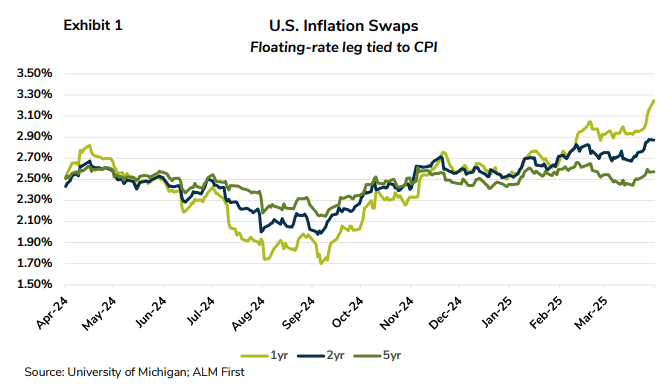
The primary objective of any central bank is price stability, regardless of the unique dual mandate of the Fed. Following the March 19 FOMC meeting, the updated participant forecasts showed no change in the median expectation for the fed funds rate over the next few years, despite lowering the GDP forecast and increasing the inflation forecast. It was as if participants simply copy and pasted the prior interest rate forecasts from the December report as a way of effectively saying “more information needed” on the tariff front. As it currently stands, the median forecast shows 50 basis points (bps) of cuts in 2025, but there is clearly a scenario where no rate cuts occur. The fed funds futures market is currently priced for just under 75 bps of cuts this year, but there seems to be little confidence in forecasts at this time, regardless of source.
To download the PDF of this econ only version, please click here.
To continue reading the full month’s market commentary, and to learn more about current market themes, market sectors, sector performances, and applied strategies, log in to the ALM First portal, and select this month’s commentary in the Resource Center.
If you do not have a login and you would still like to access the document, please send your inquiry to info@almfirst.com.