
Economic Update
- Financial markets faced fresh risks in March as the military action in the Middle East sent oil prices sharply higher
- Fixed income credit was less reactive to the Iran conflict for much of March, but a prolonged conflict could threaten economic growth and increase credit risks
- With private credit worries continuing to make headlines, we lay out a general framework for evaluating alternative investments
March was a fresh reminder of how quickly the narrative can change in financial markets. At the end of February, fed funds futures were priced for 60 basis points (bps) of rate cuts by the Fed in 2026. By the end of March, those projected rate cuts effectively disappeared. This coincided with a sharp increase in Treasury yields across the curve as oil prices surged above $100 per barrel amid the ongoing military conflict in the Middle East, which has greatly constricted the flow of energy and other materials through the critical Strait of Hormuz. For much of March, the concern was inflation risk from a supply shock to energy prices, but by the end of the month, the bond market shifted somewhat to economic growth worries via demand destruction.
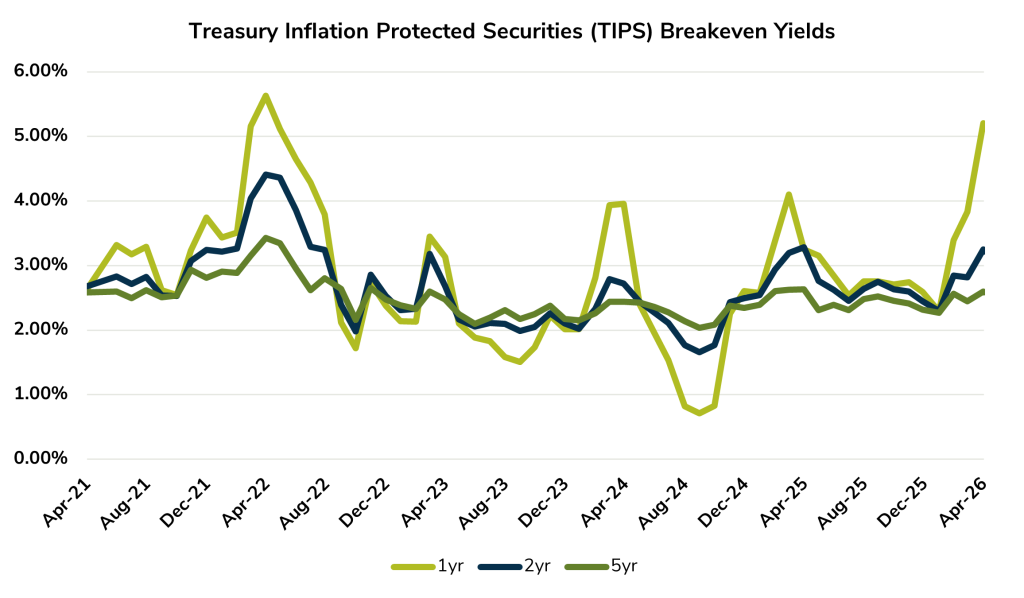
It has been a fluid situation, and the most pressing questions are: how long will this conflict last? And how long will the Strait of Hormuz remain closed? The answers to these questions will impact the ultimate economic costs. Exhibit 1 tracks a measure of market inflation expectations via TIPS breakeven yields. All three measures are higher over the last month, but the market clearly views any inflation impact as a more short-lived phenomenon given the sharper run-up in the 1-year breakeven yield. This also underscores the idea of a prolonged oil price shock weighing on global economic growth, which is deflationary by nature. On March 31, markets received some relief when the Wall Street Journal reported that President Trump was considering ending US military involvement even if the Strait of Hormuz remained closed. On April 1, President Trump addressed the nation and said that the war in Iran is “very close” to completion while also threatening escalation. The initial reaction from financial markets was higher oil prices and lower stock prices.
Exhibit 1
For much of the month of March, the Iran conflict had more of an impact on the level of interest rates than credit premiums in fixed income markets. In other words, Treasury yields were higher on inflation risks, but credit spreads were more stable across most sectors. However, as the conflict persisted with little signs of an endgame, worries about broader economic implications weighed on riskier assets. At the same time, pockets of fixed income credit remained more attuned to negative headlines related to private credit and potential extended fallout.
As noted in last month’s commentary, there have been growing worries in private markets (credit and equity) that AI could seriously disrupt future revenues of software companies, which were a favored private credit borrower over the last several years. Given the lack of transparency related to borrower fundamentals in that market, the negative headlines have fueled increased redemption requests from investors, particularly retail investors. Private credit loans are highly illiquid by nature, which is why most funds have relatively tight liquidity restrictions of 5%-10% per quarter (“liquidity gates”).
These liquidity gates help limit a typical “run on the bank” scenario, but they do not eliminate it. In the end, one-way capital flows are unsustainable in the long-run, and regardless of whether negative sentiment is aligned with actual credit fundamentals, the former can overwhelm the latter in a short time horizon. This is particularly true when the ability to track credit fundamental trends of underlying borrowers is very difficult or impossible. This is the challenge that some of the largest asset managers in the private sector are trying to address – improving transparency.
Evaluating Alternative Assets
An alternative asset is typically classified as any investment that falls outside of public stocks, bonds, or cash. Private credit/equity would be a popular example of an alternative asset. Other examples include real estate, life insurance settlements, real assets (e.g., solar), and some hedge fund investments. Many of these alternative assets are advertised with promises of high yield/return with low volatility. Additionally, some are advertised as having low correlation to large cap equity indices like the S&P 500. In other words, an equity-like return without the day-to-day volatility of public equities. In evaluating these opportunities, we would consider the following factors.
1. Understand the sources of return, cashflows and associated risks
How is the expected return derived? When applicable, what are the underlying cashflows and how are they being modeled looking forward? What risk factors are these cashflows exposed to, and what are the estimated sensitivities to these risk factors? What happens to the estimated returns when these sensitivities are stressed?
2. Is it enough return?
The promised return of an alternative asset is often attractive on the surface relative to other options an investor is typically considering, but is it enough return? This is not only the idea of whether the return is commensurate with the level of risk, but assuming this hurdle is breached, is this the highest risk-adjusted return within the specific asset class?
3. How are valuations derived?
Many alternative assets have low liquidity and, consequently, a lack of observable market price inputs on the underlying assets. In many cases, the manager will use a “mark to model” approach to valuing the assets that could be very different than the liquidation value. In many cases (and market environments) this can be viewed favorably by investors because it limits the periodic price volatility exhibited in other more on-the-run assets. However, this does not necessarily imply an “uncorrelated” return. For example, a private equity fund’s price return can appear much less volatile than a broad public equity index like the Russell 2000, but is that private equity return truly uncorrelated to the market? For mark-to-model pricing, are we comfortable with the assumptions driving those valuations? What conditions could force a mark-to-market event?
4. What’s the appropriate position size?
Assuming we work our way through the above checklist and determine that the alternative investment is a good opportunity, perhaps the most important decision of all is the relative investment size. As with any credit allocation, we should be thoughtful of multiple considerations, including liquidity and unexpected risks to capital. Risk budgeting is an important component of any sophisticated investment process.
In summary, alternative investments are rarely going to have the same amount of information available for pre-purchase evaluation as more on-the-run and traditional investments. However, that does not mean we shouldn’t be able to work through a reasonable evaluation process and answer these questions. In addition to the above considerations, we must also sometimes resort to more straightforward common sense. As the old maxim goes, “if it’s too good to be true, it probably is.”
To download the PDF of this econ only version, please click here.
To continue reading the full month’s market commentary, and to learn more about current market themes, market sectors, sector performances, and applied strategies, log in to the ALM First portal, and select this month’s commentary in the Resource Center.
If you do not have a login and you would still like to access the document, please send your inquiry to info@almfirst.com.
