
Economic Update
- The recent rally in Treasuries fueled some questions regarding the strength of the current recovery, particularly with COVID-19 back atop headlines
- Current economic fundamentals remain sound, and consumer and corporate balance sheets are in relatively strong positions looking ahead
“Rarely a straight line.” That’s a phrase veteran market participants understand all too well, and the activity of the last several weeks has brought forth reminders of the various obstacles that can dampen sentiment in any business cycle. Since the initial COVID-19 outbreak in Q1 2020, there has been over $5 trillion of fiscal aid and a $4+ trillion expansion of the Fed’s balance sheet, the combination of which have fueled economic growth rates not seen in several decades. Even with such support, however, confidence can be fickle, and technicals can overwhelm fundamentals at times. Despite robust consumption data and above-target inflation readings in recent months, long-end Treasury yields ended July down 20-25 basis points (bps), the lowest since early to mid-February, and there were no obvious explanations for the bullish curve flattening.
On the technical front, an ongoing deluge of central bank liquidity/intervention and reduced Treasury supply created perfect conditions for a Treasury market rally early in the month, particularly with a notable amount of short positions in place. At the same time, a combination of negative COVID-19 headlines and downside surprises in recent economic data also cast, at least some, doubt on the fundamentals of the post-pandemic recovery.
The spread of the delta variant weighed on risk sentiment at times in July, although major equity indices still ended the month in the green (S&P 500 +0.99%). While hospitalization rates have risen to the highest levels since the first quarter, the 7-day moving average of new hospital admissions ended July at approximately 35% of the peak from the first week of 2021 according to CDC data, and 70% of the adult population in the U.S. now has at least one dose of a vaccine. Still, it shouldn’t be surprising for a little anxiety to surface in financial markets with memories of 2020 lockdowns still fresh.
Fundamentals Still Sound
Recent market activity notwithstanding, the overall fundamentals of the economy remain sound. The initial estimate of Q2 GDP was less than expected at 6.5% q/q (annualized), but the downside miss was largely attributable to another decline in business inventories, which shed 1.13% from the topline growth figure. Personal consumption ballooned 11.8% q/q in Q2, higher than expected and the third double-digit gain in the last four quarters. For added perspective, the 20-year average for consumption growth is 2.4% q/q. Consumers have undoubtedly been aided by significant fiscal stimulus, and as discussed in last month’s commentary, consumer balance sheets are in very good condition given increased income and deleveraging over the last eighteen months.
Corporate balance sheets are in good condition as well thanks to increasing profit margins and improved leverage metrics. These solid fundamentals can be seen in migration statistics between investment-grade and high-yield corporate debt. Thus far in 2021, nearly twice as much corporate debt has been upgraded to investment grade (rising stars) as the amount downgraded to high yield (fallen angels) using J.P. Morgan corporate bond indices as a proxy.
Shifting Hawkish
For the second consecutive month, the July FOMC meeting carried what could be interpreted as conveying a hawkish tone. The Fed was careful to distance future monetary policy decisions from the recent uptick in cases, and the official statement (OS) was more upbeat about the overall economic outlook. In fact, the OS did not make any references to the delta variant or the uptick in COVID-19 cases or hospitalizations. Instead, there were subtle upgrades to the committee’s assessment of sectors most affected by the pandemic, and the characterization of COVID risks was actually downgraded. Regarding the latter, the word “significantly” was removed from the statement in June that “the path of the economy will depend significantly on the course of the virus.” That subtle change and the lack of reference to the recent outbreak suggests the Fed is placing less emphasis on public health risks to economic growth.
The biggest policy question mark right now is related to the Fed’s decision on asset purchase tapering. The July 28 OS acknowledged the recent progress toward employment goals but still short of the “substantial further progress” hurdle set for QE tapering. Powell and his colleagues have refused to be more specific about what constitutes “substantial,” but Powell has conceded that they were at least “talking about talking about” reducing the monthly pace of purchases. If anything, the July meeting put the taper announcement on the table for any upcoming meeting. It still seems more likely that the announcement won’t come until November or December, but if there was an early surprise, it could come from Powell’s Jackson Hole speech later this month. Beyond the timing of tapering, the pace of tapering is perhaps more important. A faster than expected pace would be expected to have a greater impact on fixed income spreads, and there’s also open questions related to the mix of tapering between Treasuries and MBS. In other words, would MBS be tapered earlier or at a faster pace than Treasuries? In the July 28 press conference, Powell said he believes Treasury and MBS purchases affect the economy similarly and, as such, doesn’t see a compelling reason to treat them differently.
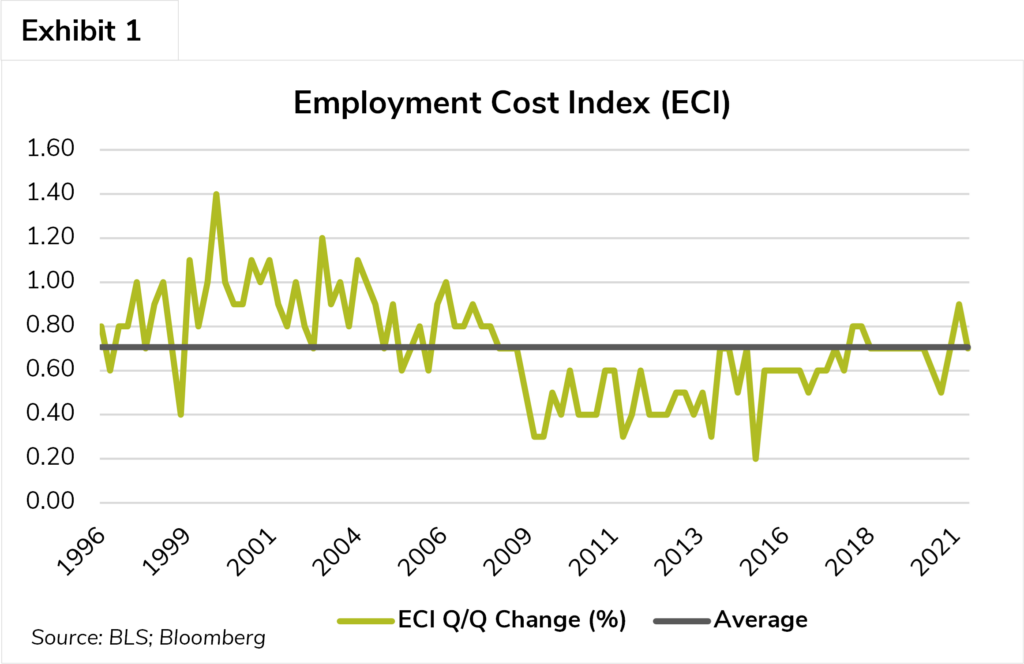
On the still-dovish front, the description of inflation risks was unchanged in the July official statement, still attributing the recent surge in core prices to “transitory factors,” but it’s also worth noting that Chair Powell managed to avoid using the word “transitory” throughout the press conference on July 28, expressing “some confidence” that inflation will move back down in the medium term. Recent measures of core inflation growth continue to be dominated by what could easily be considered transitory factors, specifically for used cars, hotels, airfare, and apparel. Recent measures of wage growth and consumer inflation expectations, both considered sources of more permanent inflation measures, have come in lower than expected. The Employment Cost Index (ECI) rose just 0.7% in Q2 versus expectations of a 0.9% gain. This is a preferred measure of wage inflation for the Fed because it includes bonuses and other benefits, and after a 15-year high in Q1, the second quarter gain is right on top of the long-run average (see Exhibit 1).
To continue reading this month’s market commentary, and to learn more about current market themes, market sectors, sector performances, and applied strategies, log in to the ALM First portal, and select this month’s commentary in the Resource Center. If you do not have a log in and you would still like to access the document, please send your inquiry to info@almfirst.com.
