Site Search

Looking for something? Use the search bar below or visit our Resources page.


Author ALM First

Published

Estimated


Economic Update

  • A predominant buzzword for 2021, “transitory” may need to be retired as a description of inflation risks according to Fed Chair Jerome Powell
  • A demand shock from trillions in fiscal and monetary stimulus continues to overwhelm supply, causing more dovish leaders at the Fed to reconsider prior plans to leave the fed funds rate unchanged in 2022
  • Detection of the Omicron variant was another reminder that Covid remains a stubborn risk to global growth and inflation expectations nearly 2 years after the start of the pandemic

If there was a ranking of economic buzzwords for 2021, the term ‘transitory’ would have to be near the top of the list. This word has been used over and over by Fed Chair Jerome Powell and his colleagues to describe inflation pressures emerging from the reopening of the global economy. However, inflation rates, even after excluding food and energy prices, have remained stubbornly elevated near multi-decade highs, making inflation a hot topic in mainstream media and politics. The latter has shined an even brighter light on Powell, who was at the same time vying for a second term as Fed chair. Competing with Powell for the top job was Fed Governor Lael Brainard, who was generally perceived to be more dovish of the two (a very relative comparison). Given the heightened public focus on rising consumer prices, the dovishness was likely a notable factor in the White House’s decision to announce on November 22 that Powell would indeed get the nod for a second term. The bond market responded to the news by pricing for more hawkish policy in the near/intermediate term.

On November 30, in his first major appearance since the nomination announcement, Powell caught markets off guard with a definitive shift in tone regarding inflation risks. Testifying before the Senate Banking Committee, Powell effectively extinguished the transitory inflation assessment. When pressed on the topic, Powell said, “I think it’s probably a good time to retire that word and try to explain more clearly what we mean.” In other words, the price increases of the last several months may indeed be more permanent than the Fed had been anticipating, and as such, a more hawkish policy response may be necessary. To that end, Powell also noted potential policy changes to combat non-transitory price pressures, specifically the pace of asset purchase tapering. “At this point, the economy is very strong and inflationary pressures are higher, and it is therefore appropriate in my view to consider wrapping up the taper of our asset purchases…perhaps a few months sooner,” he said. At the November 3 FOMC meeting, the Fed announced, as expected, a tapering pace of $15 billion per month, which would imply no new purchases (other than principal reinvestment) by the end of Q2. Shortening the pace by three months would increase monthly tapering by approximately $10 billion (~$25 billion total).

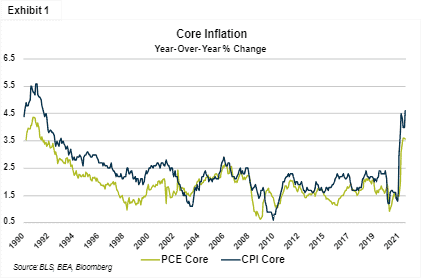
Perfect Inflation Storm Exhibit 1 illustrates the surge in core inflation that has occurred this year, pushing both CPI and PCE to the highest levels since the early 1990s. In 2020, the Fed shifted to a new policy framework that called for flexible average inflation targeting (FAIT), which would theoretically allow inflation to run above the 2% target for “some time” to offset prior periods of below-target inflation and effectively reset inflation expectations. Central bankers at the Fed and overseas are feeling the pressure to respond to these inflation pressures, and while not the first action (tapering already announced), Powell ditching the “transitory” characterization is a clear change in tone/guidance.

Supply shortages have undoubtedly fueled price pressures, and this supply/demand imbalance has persisted longer than many economists expected. It is always important to note that shortages are always relative to demand. In other words, supply chain disruptions can be alleviated over time, but if supply still lags demand, prices will move higher.

What we experienced in the Covid crisis was an unprecedented demand shock. Trillions of dollars in monetary and fiscal stimulus from major developed economies more than compensated for lost income during lockdowns, but the supply of goods and services that those incomes had been providing was left untouched. In other words, if I pay you to stay at home, you’re staying at home buying the products that you’re not at work producing. At the same time, income that may have normally been spent on services (restaurants, travel, etc.) shifted to goods, putting more pressure on supply chains still inhibited by labor shortages and Covid protocols. It’s a perfect storm for the inflation that we have experienced.

The impact of massive stimulus should eventually fade, and demand for goods and services should eventually realign with supply. Timing is everything, though, and there’s only so long that central bankers can idly stand by while inflation runs more than double the target rate. 2022 will certainly test Fed leaders on that front.

Covid Remains a Risk

Approaching the 2-year anniversary of the pandemic, we were reminded again in late November that Covid remains a stubborn risk to the global economy. Detection of the newest variant (Omicron) sparked a global risk-off trade the day after Thanksgiving that sent U.S. equities down more than 2% and term Treasury yields down 14-18 basis points (bps). To be fair, the reaction in financial markets was exacerbated by poor liquidity on the day after a major holiday, and at this point, there appears to be very little political will to mandate activity restrictions in response to increased infection rates. Nevertheless, continued flare ups of the virus can certainly impact global travel, manufacturing, and shipping. As such, the virus remains a risk to economic growth and inflation, and it’s a scenario like this that brings words like “stagflation” into the conversation.


To continue reading this month’s market commentary, and to learn more about current market themes, market sectors, sector performances, and applied strategies, log in to the ALM First portal, and select this month’s commentary in the Resource Center. If you do not have a log in and you would still like to access the document, please send your inquiry to info@almfirst.com.

ALM First

ALM First was founded in 1995 with the focus on financial advisory services for credit union clients.

LinkedIn

  Commentary Disclaimer

ALM First Financial Advisors is an SEC registered investment advisor with a fiduciary duty that requires it to act in the best interests of clients and to place the interests of clients before its own; however, registration as an investment advisor does not imply any level of skill or training. ALM First Financial Advisors, LLC (“ALM First Financial Advisors”), an affiliate of ALM First Group, LLC (“ALM First”), is a separate entity and all investment decisions are made independently by the asset managers at ALM First Financial Advisors. Access to ALM First Financial Advisors is only available to clients pursuant to an Investment Advisory Agreement and acceptance of ALM First Financial Advisors\' Brochure. You are encouraged to read these documents carefully. All investments involve risk and may lose money.

The content in this article is provided for informational purposes and should not be relied upon as recommendations or financial planning advice. We encourage you to seek personalized advice from qualified professionals regarding all personal finance issues. While such information is believed to be reliable, no representation or warranty is made concerning the accuracy of any information presented. Statements herein that reflect projections or expectations of future financial or economic performance are forward-looking statements. Such “forward-looking” statements are based on various assumptions, which assumptions may not prove to be correct. Accordingly, there can be no assurance that such assumptions and statements will accurately predict future events or actual performance. No representation or warranty can be given that the estimates, opinions or assumptions made herein will prove to be accurate. Actual results for any period may or may not approximate such forward-looking statements. No representations or warranties whatsoever are made by ALM First Financial Advisors as to the future profitability of investments recommended by ALM First Financial Advisors.

Moreover, this report was prepared as of the date indicated herein. No representation or warranty is made by ALM First that any of the returns or financial metrics detailed herein will be achieved in the future, as past performance is not a reliable indicator of future results. Certain assumptions may have been made in preparing this material that have resulted in the returns and financial metrics detailed herein. Changes to the assumptions may have a material impact on any returns or financial metrics herein. Furthermore, ALM First gives no representation, warranty or undertaking, or accepts any liability, as to the accuracy or completeness of the information contained this report. This report was prepared for informational purposes only without regard to any particular user’s investment objectives, financial situation, or means, and ALM First is not soliciting any action based upon it. This material is not intended as, nor should it be construed in any way as accounting, tax, legal, or investment advice including within the meaning of Section 975 of the Dodd-Frank Wall Street Reform and Consumer Protection Act. Certain transactions give rise to substantial risk and are not suitable for all investors. The strategies discussed herein can have volatile performance and may employ leverage. Moreover, investment advisory fees and expenses may offset trading gains. This report was prepared by ALM First Financial Advisors, LLC. The hereto mentioned report contains information which is confidential and may also be privileged. It is for the exclusive use of the intended recipient(s). If you are not the intended recipient(s), please note that any distribution, copying, or use of this report or the information contained herein is strictly prohibited. If you have received this report in error, please notify the sender immediately and then destroy any copies of it. ALM First neither owes nor accepts any duty or responsibility to the unauthorized reader. ALM First shall not be liable in respect of any loss, damage, or expense of whatsoever nature which is caused by any use the unauthorized reader may choose to make of this report, or which is otherwise a result of gaining access to the report by the unauthorized reader. This content contains information derived from third-party sources. We believe that this third-party data is reliable; however, we cannot guarantee this data’s currency, accuracy, timeliness, completeness, or fitness for any particular purpose.

INDEX BENCHMARKS: Index performance is discussed for illustrative purposes only as a benchmark for each strategy’s performance and does not predict or depict performance of that strategy. While index comparisons may be useful to provide a benchmark for a strategy’s performance, it must be noted that investments are not limited to the investments comprising the indices. Each of the strategy benchmark indices are unmanaged and cannot be purchased directly by investors.

HYPOTHETICAL PERFORMANCE DISCLAIMERS: Performance figures derived from model portfolios are hypothetical in nature and the results of any individual investor will differ as a result of various factors, including investment limitations relative to model portfolio guidelines, availability of same or similar assets, and fee structures. Investments are presumed to have been made at the beginning of the time period and there are no inflows or outflows of cash during the period. There are limitations and risks associated with the use of model performance or hypothetical performance information, and you should be cautious when looking at any presentation of model or hypothetical performance information. Investment strategies should not be based solely on the use of model or hypothetical information. Actual results will be different from those shown in model or hypothetical performance. The model portfolio returns reflect actual trading including the reinvestment of coupon payments and are net of transaction costs, administrative costs and a strategy-specific per annum fee ranging from 5 bps to 50 bps, which is the amount of the highest fee charged to any ALM First Financial Advisors, LLC customer employing that particular strategy during the period under consideration (the “Model Fee”). Actual fees will vary depending on, among other things, the applicable fee schedule and portfolio size. ALM First\'s fees are available upon request and also may be found in its Form ADV Part 2A. Past performance does not guarantee future results.


Strategic Partners

Let’s Work Together

ALM First is your agile partner with a trusted history of delivering results.
