
Economic Update
- The U.S. economy has outperformed economist and market expectations in 2023 thanks to resilient U.S. households
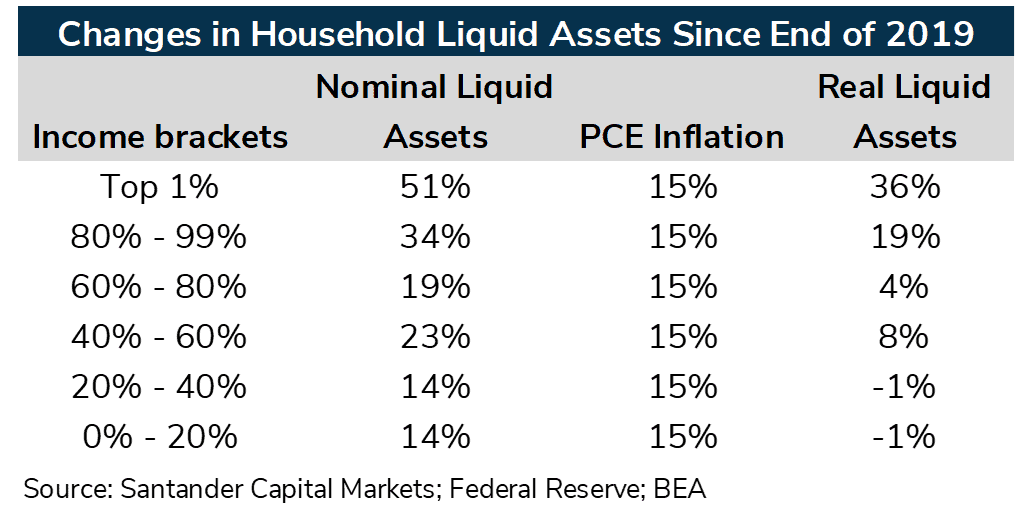
- After accounting for inflation, liquid assets of most U.S. households are back to pre-COVID levels, which could lead to more subdued consumption patterns in 2024
- Fed funds futures repriced for a much more dovish Fed in 2024, which appears inconsistent with current economic fundamentals
As we began 2023, expectations for the U.S. economy were much gloomier than what has actually evolved in the first 11 months of the year. According to Bloomberg’s economist survey in December 2022, the median forecast of GDP growth this year was just 0.37%. However, real GDP has expanded by 2.4% through the first 3 quarters of 2023 (not annualized), and current quarter growth is expected to remain in positive territory. The Fed wasn’t much more optimistic entering this year. The December 2022 Summary of Economic Projections showed a median forecast of 0.5% for real GDP growth in 2023. This unexpected resilience has come despite multiple obstacles, including the bank failures in March, Chinese economic struggles, and geopolitical events. As we have discussed in past commentaries, the stimulus-induced windfall of liquidity for U.S. households created a strong headwind for consumer spending, particularly with the unemployment rate historically low and wage growth historically high. According to Federal Reserve data, household liquid assets, which include bank deposits and money market fund balances, surged in 2020 and 2021, which along with wage growth fueled the better-than-expected consumption over the last year.
Exhibit 1 takes an updated look at household liquidity data through Q2 across income brackets using the most recent information from the Federal Reserve. After accounting for inflation, all but the top 2 income brackets are now close to pre-COVID levels in terms of liquid assets, with the lowest income brackets, not surprisingly, suffering the most from higher prices for goods and services. As such, households may take a more defensive posture on spending in 2024.
Exhibit 1
Markets Pricing For More Dovish Fed
Financial markets priced for a more dovish Fed in 2024 as November progressed. By month-end, fed funds futures priced an initial rate cut in the second quarter, with roughly 135 basis points of cuts by year-end 2024. That would be an aggressive path for the Fed, and there’s clearly a disconnect with the median economist forecast for GDP growth in 2024 of 1.2% with no negative quarters according to the current Bloomberg survey (i.e., soft landing). If upcoming employment and inflation reports reveal stickier employment and inflation data, the market would need to reprice for a less dovish Fed outlook.
We have seen this play out multiple times over the last year and a half. In other words, rate volatility is not likely to return to subdued levels anytime soon, keeping the operating environment for financial institutions challenging for at least the next several months. For the Fed to ease as aggressively as is currently priced in, one would assume a more-than-mild recession evolves in the first half of next year, which would seem to be a low probability event given current economic fundamentals, barring an unforeseen external shock.
To download the PDF of this econ only version, please click here.
To continue reading the full month’s market commentary, and to learn more about current market themes, market sectors, sector performances, and applied strategies, log in to the ALM First portal, and select this month’s commentary in the Resource Center.
If you do not have a login and you would still like to access the document, please send your inquiry to info@almfirst.com.
