Economic Update
- The bond market got off to a great start in January, boosted by lower rates, tighter spreads, and reduced rate volatility
- Financial markets continue to fight Fed guidance by pricing for rate cuts in the second half of the year; Fed Chair Powell’s February 1 press conference didn’t do enough to push back on these expectations
- Inflation risk was the predominant economic theme of 2022, but a debt ceiling standoff threatens to take the top spot in 2023
It was a nice start to the year for a bond market still reeling from a very tough 2022. Last year was marked by sharply higher interest rates, wider spreads, and persistently high-rate volatility, all of which negatively impacted liquidity conditions and overall performance. In January, all these risk factors reversed course on speculation that the Fed has effectively won the war on inflation, allowing investors to take advantage of attractive bond yields. The Fed has so far refused to acknowledge any such victory on the inflation front, particularly while labor markets remain historically tight and wage growth well above average. While we are likely closer to the terminal fed funds rate based on recent economic data trends, there is still a question of how long the Fed holds the benchmark rate at its terminal level. This is where the bond market is currently at odds with Fed guidance. In the updated Summary of Economic Projections (SEP) released at the December 14 FOMC meeting, 17 of the 19 participants forecasted a fed funds rate of 5.125% or higher at the end of this year, and as illustrated in Exhibit 1, fed funds futures and overnight index swaps (OIS) continue to price for rate cuts in the second half of the year.
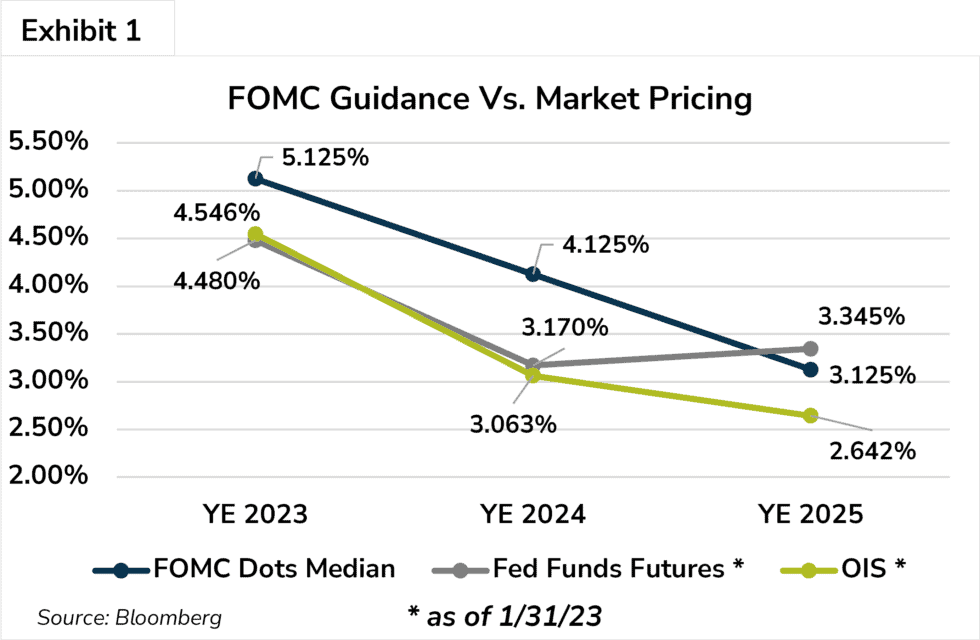
At the February 1 FOMC meeting, a 25 basis point rate hike was announced, as expected, and the official statement said that the Fed anticipates “ongoing increases in the target range will be appropriate.” The plurality of “increases” suggests a fed funds target rate reaching at least 5.25% as the Fed sees things today. However, Fed Chair Powell failed to firmly push back on current market pricing of rate cuts in the second half of the year, which sparked a 10-12 basis point decline in intermediate Treasury yields. Whether by intent or not, Powell’s reluctance, or inability, to hammer home a hawkish tone was a bit surprising given that it was announced earlier in the day that job openings, one of the main areas of concern for he and his colleagues in the last year, unexpectedly rose by nearly 600,000 in January to 11.012 million, the highest since last July.
On the data front, recent inflation readings continue to feed the narrative that peak inflation is in the rearview mirror, but labor market data have remained more robust, which as noted above has been a primary source of angst for Fed leaders. Perhaps a source of optimism was found in the Q4 Employment Cost Index (ECI), which slowed to a 1% q/q pace (1.1% expected). On an annualized basis, this pace is still above the Fed’s comfort zone, and the Q1 ECI report released in April will perhaps provide better evidence of any moderation in wage inflation given that annual pay bumps typically come at the first of the year. The Q4 GDP report also showed signs of moderating economic momentum. The headline growth rate came in above expectations (2.9% vs. 2.6%) thanks to a large increase in inventories and decline in imports; however, personal consumption and real final sales to domestic purchasers (AKA core GDP) both experienced greater than expected declines.
All of this ultimately impacts the Fed’s future monetary policy decisions, which remain a source of uncertainty and a source of potential rate volatility in the near term. In other words, if the Fed does indeed stick to its ‘higher for longer’ guidance, front-end rates will need to reprice accordingly. Another potential source of rate volatility in 2023 is debate surrounding an increase to the U.S. debt limit.
The Debt Ceiling Showdown (Circus)
It has unfortunately become a more regular occurrence since 2010 that Congress engage in political theater surrounding necessary increases in the U.S. debt ceiling and the potential for a technical default on the country’s obligations. While inflation risk and the Fed’s response to it was the predominant economic theme for 2022, the U.S. debt ceiling standoff could potentially be the biggest theme for 2023. For added perspective, the debt ceiling was first introduced in 1917 in the wake of World War I and further modified in 1939 to the current version. There were several debt limit impasses in Congress over the next several decades, and while there have been numerous government shutdowns over the years, with limited economic impact, there have been no defaults on federal debt, at least according to modern conventions.
In late January, the U.S. reached its current debt limit of $31.4 trillion. From that point forward, no net issuance of Treasury debt is allowed until the limit is increased, and until that time, the Treasury will utilize so-called extraordinary measures (primarily, the $450 billion of cash deposited at the Fed) until exhausted, known as the “X”, or drop-dead, date. The X date is impossible to know with certainty, but Treasury Secretary Janet Yellen suggested the government would be able to fund itself until June. Some Wall Street strategists have opined that the Treasury may even be able to fund itself through November, but any estimate is based on many unknown assumptions, particularly before April tax receipts are collected.
The implications of a U.S. default are difficult to precisely quantify, but none are pleasant as it relates to confidence, financial markets, and the overall economy. The worst-case scenario could include the following consequences:
- Further downgrades of U.S. credit rating: Potentially more broad-based and severe than the 2011 downgrade by S&P, likely followed by increased borrowing costs for the U.S. government
- Downgrades of GSEs and large U.S. banks: Those institutions perceived to be backstopped by the U.S. government would also likely be downgraded and incur higher funding costs; could also potentially trigger an increase in the risk weighting of Treasuries and loss of HQLA level 1 status
- Reduction in foreign investment in U.S. debt: Would expectedly send U.S. yields higher and the U.S. dollar lower
- Loss of reserve currency status: This status provides cover for a multitude of U.S. fiscal sins and is closely tied to the above risk related to foreign investment
- General reduction in confidence and capital expenditures: Loss of confidence typically reduces spending/investment and slows the economy
There are no “rosy” scenarios should Congress fail to reach an agreement prior to the X-date, even for a short-lived impasse that would still likely cause a mild recession. The closer we get to the X date with no deal, the more volatility should rise and liquidity worsen as market participants hoard cash. Like prior episodes, yields for short-term Treasuries with maturities near or beyond that date should rise (21-46 bps in 2011/2013). If the Treasury runs out of cash, it would likely prioritize payments of principal and interest (P&I) for Treasury securities over other payments (Social Security, contractors, payrolls, etc.), which would likely lead to quick legal challenges in the courts over such decisions. There are other potential executive actions, such as invoking the 14th Amendment or issuing a “Platinum coin,” but both are politically, if not legally, challenging. The longer the impasse lasts, the more severe the economic consequences will become.
The rational assumption is that no lawmaker of sound mind would choose to endure the consequences of a U.S. default; however, the current political climate exhibited by the vote for House Majority Leader has raised general anxiety levels surrounding this round of negotiations. As for the impact to community-based depository institutions, it really depends on the severity of outcome. In a negative scenario, one would expect an inflow of deposits into depository institutions, but financial asset valuations would likely suffer. Those institutions more heavily reliant on non-core funding could experience greater heartache, particularly if a notable amount of that funding rolls in the second half of the year. That said, there are still too many unknowns at this point. What is more certain is that a U.S. default would have severe consequences for everyone. The ideal scenario would be to get rid of the debt ceiling, period, and negotiate fiscal policy without the threat of a financial nuclear weapon, but perhaps we dream too much.
To download this economic update portion of our Monthly Market Commentary, please click here.
To continue reading the full month’s market commentary, and to learn more about current market themes, market sectors, sector performances, and applied strategies, log in to the ALM First portal, and select this month’s commentary in the Resource Center. If you do not have a log in and you would still like to access the document, please send your inquiry to info@almfirst.com.