Financial markets responded to multiple noteworthy announcements in January, including the nomination of the next Fed chair
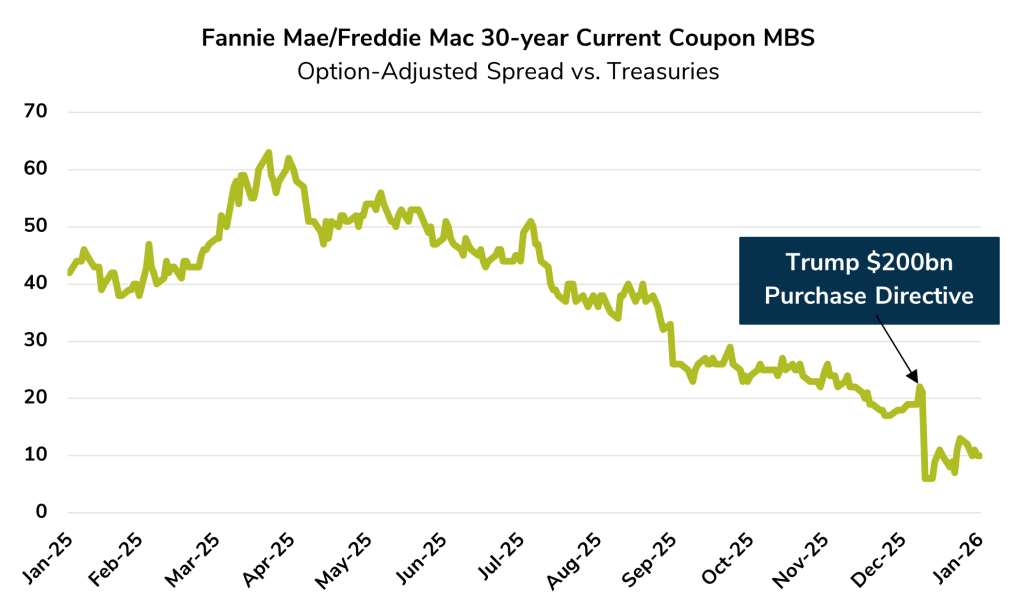
In an effort to lower mortgage rates, President Trump directed Fannie Mae and Freddie Mac to purchase $200 billion of mortgage securities
Kevin Warsh, a former Fed governor, was nominated as the next Fed chair despite being considered more hawkish in the past
The first month of 2026 included multiple announcements consequential for the bond market and financial markets as whole. President Trump and his team proposed multiple policy efforts aimed at improving affordability ahead of the midterm elections later this year, including a 1-year 10% cap on credit card interest rates, a ban on institutional homebuying, and a $200 billion MBS purchase program by Fannie Mae and Freddie Mac (FMs). The credit card interest rate cap is perhaps the most controversial given the potential negative consequences on credit availability. However, market participants were relieved when President Trump suggested that he would rely on Congress to pass a law to cap such rates, which is considered a less likely outcome.
On January 8, Trump directed Fannie Mae and Freddie Mac to purchase $200 billion of mortgage-backed securities (MBS) with the ultimate objective of driving mortgage rates lower. There have still been limited details provided, but it’s worth noting that the FMs had been buying MBS for several months, most recently at a pace of around $16 billion per month, an annualized amount of nearly $200 billion. The most recent disclosures showed that the FMs bought a larger $24.6 billion in December. As illustrated in Exhibit 1, agency MBS spreads tightened on the news, with 30-year conventional coupons trading closest to a par dollar price (e.g., 30-year 4.5% and 5.0% pools) moving the most (10-15 basis points versus Treasuries). However, in a typical “buy the rumor, sell the fact” trade, spreads retraced about half of that move over the remainder of the month, particularly after FHFA Director Bill Pulte said there would be no increase to the total purchase program size of $200 billion.
The Agency MBS market is close to $9 trillion, so a $200 billion (2%) purchase program with no speculation of an upsize will have a more limited impact on MBS spreads and mortgage rates. However, it could have a more material impact on future earnings (and ultimately privatization plans) for both. Disclosures also show the duration gap of both entities rising since the middle of 2025. While the FMs are known to hedge the duration and convexity risks of their portfolio purchases, this information would suggest they are not fully hedging these risks, which alters the risk/return dynamic for both.
Kevin Warsh Nominated for Fed Chair
At the end of the month, President Trump made the long-anticipated announcement of his nominee for the next Fed chairman when Jerome Powell’s term expires in May. Pending approval by the Senate, Kevin Warsh will take over as leader of the world’s most consequential central bank. Trump has been more than clear in his desire to see a lower fed funds rate, so Warsh may be a curious choice for some given his reputation for being one of the more hawkish members of the Board of Governors from 2006 to 2011. However, Warsh has said most recently that he believes the policy rate should be lower, an almost certain prerequisite for consideration by the President. Additionally, Warsh has been a vocal proponent of policy reform at the Fed, including criticizing balance sheet expansion in the wake of the 2008 financial crisis and average inflation targeting in 2020. This more than likely caught President Trump’s attention as having a greater legacy impact.
Perhaps most importantly, Warsh is generally viewed as someone that will defend the institution of the Federal Reserve and its independence from political influence. The initial Treasury market reaction to the announcement was a steeper yield curve, pressured by higher long-end yields. Warsh has been a vocal critic in the past of the Fed using its balance sheet as a policy tool (quantitative easing). In other words, he could potentially justify a lower policy rate (easing) as balanced by a smaller Fed balance sheet (tightening). That said, restarting balance sheet reduction, which ended late last year, will be challenging without more substantial structural changes in Fed monetary policy that would likely take more time and effort to implement. In the meantime, Warsh would likely look to build consensus for more gradual steps to reduce the Fed’s balance sheet footprint with minimal market disruption.
Following last week’s FOMC meeting and Warsh’s nomination, fed funds futures were little changed as it relates to pricing for rate cuts in 2026 and beyond. The bond market remains priced for approximately 2 rate cuts in 2026 (50 basis points total), with the first move occurring this summer. The official statement from last week’s FOMC meeting and the Powell press conference that followed suggested the Fed is comfortably on hold until a new data trend emerges.
To download the PDF of this econ only version, please click here.
To continue reading the full month’s market commentary, and to learn more about current market themes, market sectors, sector performances, and applied strategies, log in to the ALM First portal, and select this month’s commentary in the Resource Center.
If you do not have a login and you would still like to access the document, please send your inquiry to info@almfirst.com.