
Economic Update
- The calendar has thankfully turned on a dreadful year for most financial markets
- The Fed transitioned from a ‘transitory’ characterization of inflation risks to extreme policy tightening in 2022, including 425 basis points of rate hikes and >$400 billion of balance sheet reduction
- We highlight four themes to consider for the year ahead
The calendar has thankfully turned on what was a very challenging year for financial markets in general and the bond market in particular. After mistakenly characterizing inflation as transitory in 2021, the Fed spent most of 2022 playing an extreme game of catch-up regarding monetary policy tightening. Included in the Fed’s efforts were 425 basis points (bps) of rate hikes and more than $400 billion of balance sheet reduction. Both contributed to historically high levels of interest rate volatility for a sustained period, which had a notable impact on liquidity and performance of broad fixed income. However, in the final two months of 2022, tamer inflation reports and emerging recession signals fueled a market narrative that peak inflation had been reached. Despite the Fed maintaining very hawkish guidance at the December 14 FOMC meeting, short-term rate markets continue to price for rate cuts in the second half of 2023.
As we begin the New Year, there are multiple themes to consider, from a more attractive outlook for bonds to growing recession risks. Below we summarize the themes we feel are most important for 2023.
2023 Themes
#1 Bonds Poised to Rebound
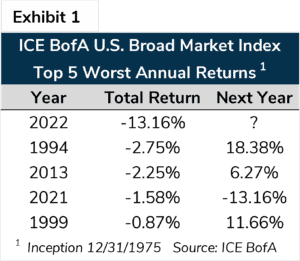
Exhibit 1 provides perspective on just how bad 2022 was for broad, investment-grade fixed income. At -13.16%, the index’s 2022 return was more than 10 points below the next worst year in its 47-year history. Also included in the table is the index return the following year, and with the clear exception of 2021/2022, each other period was followed by a relatively strong performance year. That’s not to say past performance is indicative of future results, but fixed income fundamentals are as positive to start 2023 as we’ve witnessed in approximately 15 years after more than a decade of ultra-low interest rates. Yes, there was a very brief period of similar yields and spreads in March 2020, but that was a full-blown liquidity crisis that the Fed quickly stepped in to resolve. Fixed-income spreads have narrowed from the 2022 wides but remain attractive, and all-in yields for a diversified portfolio of IG spread assets begin the year in the neighborhood of 5%.
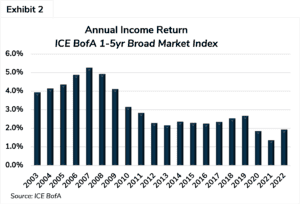
A bond’s return is comprised of income received and change in price. Exhibit 2 tracks the income portion of the ICE BofA 1-5yr Broad Market Index over the last 20 years. Not since 2007 has income surpassed 5% for a calendar year, and current expected returns are approximately double the post-crisis average. As we saw glimpses of in the final two months of 2022, investor demand should continue to improve in early 2023, particularly if inflation data reinforces the peak inflation narrative. As history proves, market dynamics can quickly change, particularly if expectations rise that peak rate volatility is behind us.
#2 Rate Volatility Should Remain a Critical Risk Factor
Rate volatility, both implied and realized, was a predominant theme for fixed income in 2022. Uncertainty related to the Fed’s response to historic inflation pressures kept vol elevated for most of the year, and it had a negative impact on market liquidity conditions as well as the year persisted. There were several factors that contributed to reduced, but still elevated, vol in the final two months of the year. First, the ultra-aggressive pace of rate hikes pushed the fed funds rate closer to what both market and Fed expectations perceived would be the likely terminal rate in the current cycle. Second, multiple inflation reports released in November came in below expectations, fueling a narrative that peak inflation was in the rearview mirror and existing pricing for the terminal rate was likely appropriate in the 5% area (i.e., less uncertainty). Liquidity conditions were modestly improved, and spreads tightened.
Further reduction in rate volatility should continue to be positive for liquidity and spreads, which would boost performance of spread sectors relative to Treasuries in the coming year. However, there are still potential sources of volatility out there for 2023, and Fed policy remains the primary source. To start the year, fed funds futures are priced for a 4.95% terminal rate in Q2 and two 25 bps rate cuts by year-end. At the December FOMC meeting, updated participant forecasts showed a median 2023 year-end funds rate of 5.125%, with 17 of the 19 participants projecting a 5.125% or higher rate. This would be in line with the Fed’s guidance of ‘higher for longer’, and if accurate, the market would have to reprice accordingly, sending rate vol higher. Even so, it is less likely that such an event would send vol higher than what was experienced last year, hence the growing market expectation that peak vol has been reached.
#3 Heightened Recession Risks for 2023
Business cycles inevitably change, and the Fed’s extraordinary efforts to rein in inflation have bolstered the odds of a recession in 2023. In simple terms, the Fed and most other major central banks are trying to slow their respective economies, and there’s budding evidence that they are succeeding. In a recent outlook, the Citigroup economics team highlighted the following factors that are currently present and typically indicators of impending recession:
- The housing sector is in contraction
- The Treasury yield curve is inverted
- Individuals and businesses feel more positive about current conditions than the future
- The unemployment rate is historically low
- Inflation is running well-above target
- The Fed is raising interest rates and financial conditions are tightening rapidly
Perhaps the better question is how the Fed will respond. As Fed Chair Powell has made clear, they are trying to slow the economy, particularly an overheated labor market. In recent comments, Powell has suggested that a labor supply and demand imbalance could persist for longer than currently expected, keeping wage inflation and, consequently, non-shelter services inflation elevated for much of 2023. These conditions would support keeping the fed funds rate elevated for longer than the market is currently pricing, as well as continuing with balance sheet reduction for the foreseeable future.
As for the severity of a potential recession at some point in 2023, we are not expecting a crisis event, like 2008. Relatively speaking, household and corporate balance sheet fundamentals are sound, thanks in large part to extraordinary stimulus in 2020/2021. If a recession does indeed evolve in 2023, it is more likely to be a mild-to-moderate downcycle, barring no unforeseen external shocks (e.g., geopolitical).
#4 Liquidity in the Banking System
There is some concern that the Fed’s balance sheet reduction efforts will create a liquidity issue at some point in 2023 as reserves drain from the banking system. However, liquidity remains very abundant in the overall system, as evidenced by the fact that the Fed’s reverse repo program (RRP) ended 2022 with more than $2.5 trillion of balances. The Fed’s tightening efforts are aimed at draining this excess liquidity, which has contributed to inflation. The increase in RRP balances throughout 2022 was largely a metric of increased money market fund inflows as large banks have been hesitant/unwilling to chase these deposits via higher rates.
For community depository institutions, a major theme for 2022 was historic loan growth for credit unions, which took over the top spot for auto lending market share by lender category. Recent data suggests that credit unions have begun to increase loan rates, but not before a significant amount of COVID-related liquidity drained from those institutions. A combination of below-market loan rates and upward pressure on funding costs in 2023 could present heightened liquidity risks for credit unions with higher loan-to-share ratios, and as such, it wasn’t surprising to see increased issuance of wholesale deposits in the second half of last year.
While liquid assets and deposits have generally declined for depositories, deposit funding remains high. Rising rates and monetary tightening could have a material impact on earnings and capital for institutions that face funding needs. Deposit stability is a key consideration in that context, particularly for COVID-related surge deposits. Overall, the primary business function of depositories serving as financial intermediaries means maintaining discipline on pricing of both deposits and loans is key to avoiding a financial mismatch. Institutions tight on liquidity have had success bringing in funding via more aggressive retail deposit pricing at rates still below Treasury rates, albeit at relatively high cannibalization rates. Alternatively, brokered deposits are a non-borrowing funding option, which are much closer to, if not higher than, Treasury rates. Low-income credit unions (LICUs) have access to nonmember funding, worth about 30bps in rate compared to non-LICU funding rates.
To download this economic update portion of our Monthly Market Commentary, please click here.
To continue reading the full month’s market commentary, and to learn more about current market themes, market sectors, sector performances, and applied strategies, log in to the ALM First portal, and select this month’s commentary in the Resource Center. If you do not have a log in and you would still like to access the document, please send your inquiry to info@almfirst.com.
