The U.S. economy greatly outperformed economist expectations in 2023, but we open 2024 with another relatively pessimistic outlook from the economist community
We unveil our 2024 themes for the U.S. economy and financial institutions
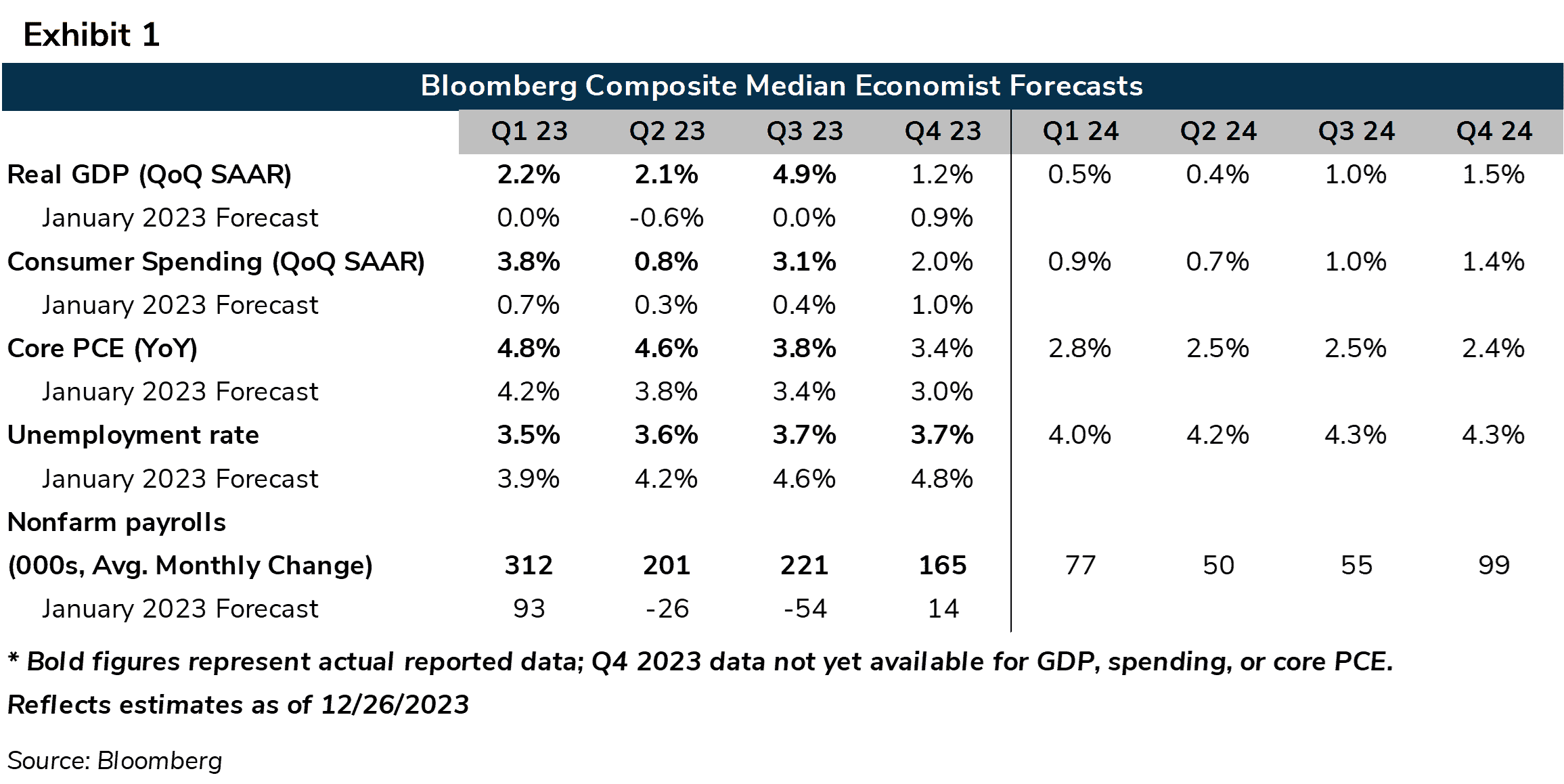
We begin 2024 with financial markets once again preparing for a pivot of the U.S. economy and monetary policy. One year ago, GDP growth was expected to have been negative in the first half of 2023 (a recession) according to the composite Bloomberg survey. Instead, the economy was on pace to expand by 3% in 2023 (Q4 data not yet available), well above the widely-accepted trend rate of 1.8%. The current Bloomberg composite forecast once again portrays a more pessimistic view of the economy in the first half of this year before picking up steam in the second half (Exhibit 1).
One could argue that any economic sluggishness would more likely occur later in 2024 than earlier given the momentum from 2023. Regardless, below is a list of economic and market themes we are contemplating as we begin the new year.
1. Consumer spending finally cools
A major theme of the last two years has been a torrid pace of consumption by U.S. households, greatly exceeding broad economist expectations. As we have noted several times over that timeframe, this consumption was greatly fueled by COVID-era stimulus and pent-up demand, which pushed aggregate household liquid assets significantly higher relative to longer-term trends. However, as we noted in last month’s commentary, inflation and heavy spending appear to have finally eroded this excess liquidity for all but the top two income brackets, which should lead to a slower pace of spending in 2024.
2. Inflation cools but could be stickier than expected
Inflation rates surprised to the downside in the second half of 2023, fueling market optimism of a sooner and more aggressive Fed pivot this year. However, much of this has been attributable to what are typically more volatile components of core inflation, which could be poised to rebound in the first half of 2024. Additionally, there are other long-term factors that could drive stickier inflation in the years to come. Namely, the growing trend of anti-globalism politics and heightened geopolitical turmoil across the world. A reduction in global trade and economic cooperation can be inflationary and could be a headwind for global central bankers attempting to keep inflation subdued.
3. Monetary policy and rate volatility
Financial markets have recently priced a very dovish path for Fed interest rate policy in 2024 and beyond, and there have also been recent rumblings that the Fed’s quantitative tightening (QT) program may have to slow/end sooner than policymakers would prefer. As we ended 2023, fed funds futures were priced for 150 basis points (bps) of rate cuts in 2024, double the median Fed forecast from the December 14 FOMC meeting. If inflation does indeed prove stickier than markets expect, the Fed may have to keep the funds rate on hold well into 2024. This scenario would likely keep rate volatility elevated as markets continue to swing back and forth as fresh data is released, and elevated rate volatility has coincided with poor market liquidity in recent years.
Regarding Fed balance sheet reduction, the hurdle to alter the current pace of roll off for Fed leaders is likely much higher than market participants expect. The balance sheet and level of bank reserves remain well above pre-COVID levels, even after accounting for economic growth over that timeframe. Policymakers likely want to build dry powder for the next sharp downturn, and it would likely take a severe disturbance in the repo and money market complex for that bias to change, even if rate cuts have begun.
4. Geopolitics, fiscal deficits, etc.
There are unforeseen events that can impact the global economy, including rising geopolitical tensions. The war in Ukraine has had a clear impact on the European economy, and rising conflict in the Red Sea could impact global trade. The saber rattling related to China and Taiwan (and the U.S.) will likely increase in 2024, and then there’s the November presidential election that is certainly not a source of calm for financial markets or the general public. Another important topic that could have a bigger impact for bond investors is the fiscal deficit and rising debt supply needed to fund the deficit. With the elections later this year, perhaps this is more of a 2025 topic than 2024, but it is unlikely to be ignored by investors forever. We saw pockets of this during the selloff in long-end Treasuries during Q2/Q3 last year.
5. The operating environment for financial institutions remains challenging in 2024
Margin compression, rising credit costs, and reduced profitability have been common themes for community banks and credit unions in recent months, and those themes are expected to persist in 2024. For banks with $100 billion in assets, we must add regulatory challenges to the list.
Higher short-term rates fueled much greater demand for money market funds and time deposits in 2022-2023, which followed a historic rise in the percentage of non-maturity deposit funding during the post-crisis era peaking during the COVID crisis. Reduced availability of cheaper core funding requires even more discipline in asset pricing, capital utilization/allocation, and overall risk management (interest rate risk, liquidity, etc.). In other words, you have less room for mistakes in these areas in an environment such as this, which as the themes above suggest, could persist well into 2024 and beyond. Barring a severe economic/financial crisis, the Fed isn’t likely to return to zero interest-rate policy and bond purchases anytime soon.
To download the PDF of this econ only version, please click here.
To continue reading the full month’s market commentary, and to learn more about current market themes, market sectors, sector performances, and applied strategies, log in to the ALM First portal, and select this month’s commentary in the Resource Center.
If you do not have a login and you would still like to access the document, please send your inquiry to info@almfirst.com.