
Economic Update
- Economic outlooks for 2025 are more optimistic than this time last year, but ample pockets of uncertainty remain as we turn the calendar
- Fed funds futures are priced for little change in short term rates over the next 3-5 years
- We unveil our economic themes for the next 12 months
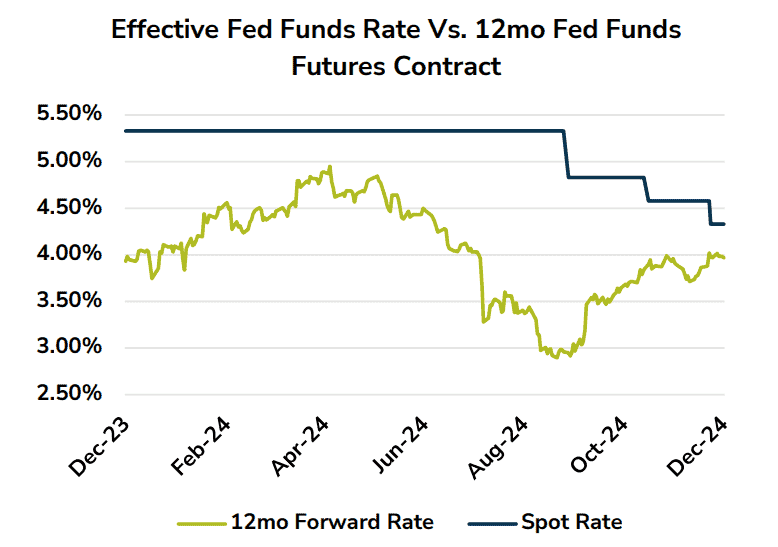
We begin 2025 with more optimism as it relates to the general economic outlook, but plenty pockets of uncertainty remain as we turn the calendar. Last year was marked by higher-than-expected growth despite a cooling labor market and lower inflation rates. This has spawned some bewilderment in economist circles and further reduces confidence in current forecasting. The bond market appears to have waved the white flag on rates forecasting as well. Exhibit 1 tracks the 12th monthly fed funds futures contract. In other words, it is market pricing for the fed funds rate 12 months forward. In 2024, this metric rose to as high as 5% following the inflation surprise of Q1 and dropped as low as 3% in September. The current 12-month forward rate is approximately 4% and holds in that general range for much of the next four years. While we have low confidence in the level of short-term rates over that timeframe, we have greater confidence in projecting the ride to be less smooth than currently forecasted.
Exhibit 1
Looking ahead, these are the list of macro themes we are considering for 2025:
1. Tailwinds for Near-Term Economic Growth
The initial reaction in equity markets to the November election results was a strong rally given expectations for less regulation and low tax rates (corporate and individual), both of which would be expected to outweigh any negative impacts of tariffs and immigration reforms. We expected 2025 real GDP growth to remain above trend (~1.8%), although it will unlikely be a straight line (rarely is). There are multiple risks to this outlook, including an unforeseen external shock (pandemic, war, etc.). Another risk would be an escalated trade war with tit-for-tat tariffs, which would be negative for the global economy.
2. Messier Than Expected
As highlighted in last month’s commentary, market forecasts for key economic metrics and the fed funds rate are remarkably linear for the next several quarters. This would suggest a very tranquil and stable environment relative to recent history and is perhaps unrealistically optimistic. The global geopolitical landscape is as tumultuous as it has been in a long time, and there is political gridlock in much of the developed world. In the U.S., the incoming Trump administration has several significant policy agenda items from taxes to immigration to tariffs, and the Republican majority in Congress is as slim as it could be. Another debt ceiling battle looms as well to start the year, and as discussed in another of our themes, long-end Treasury yields could move notably higher if large investors push back on federal spending and deficits. In the aftermath of the election, implied volatility measures for both stocks and interest rates fell sharply, but a noisier 2025 should push both above “normal” levels for much of the year.
3. A Bond Market Revolt?
The term bond vigilante has been used since the 1980s to describe a swath of investors that collectively push back against excessive government spending by driving bond yields sharply higher. Bond vigilantes were made famous in 1993/94 during the Clinton administration when a 300-basis point selloff in the 10-year yield forced the president to make major concessions on his fiscal budget plans. Since that time, this concept of “vigilantes” has been overly generalized and overused, but there are growing signs that another revolt is possible in 2025. We noted this in our 2024 themes, that after the elections, this scenario would likely become more probable regardless of who won.
Despite a growing economy and low unemployment, current fiscal deficits are over $2 trillion per year and rising. Some of the policy initiatives championed by President-elect Trump during the campaign, particularly as it relates to tax cuts, are expected to worsen the fiscal position, if passed, which is why long-end bond yields rose sharply after the election. Regarding a potential investor revolt, one of the largest fixed income asset managers in the world made the following statement in a December strategy piece:
“Therefore, if you’re seeking clues about the potential for bond vigilantism, you might start by asking the largest fixed income investors – who theoretically hold the most market sway – what they’re doing. At PIMCO, we are already making incremental adjustments in response to rising U.S. deficits. Specifically, we’re less inclined to lend to the U.S. government at the long end of the yield curve, favoring opportunities elsewhere.”
4. Improved operating environment for depository institutions
The last few years have been challenging for banks and credit unions alike. The whipsaw of extraordinary monetary accommodation in the wake of the pandemic to 500+ bps of rate hikes in a relatively short period of time made life difficult for bankers. Many institutions saw a significant surge in cheap core funding only to see much of it go right back out the door and be replaced by higher cost CDs and other market-based funding sources, all the while dealing with a deeply inverted yield curve. With the Fed now in easing mode, the yield curve has turned positive, and funding and liquidity challenges have stabilized for much of the industry. Marginally lower cost of funds and a normally shaped yield curve are both positive for future profitability, and the spread between SOFR swap rates and Treasuries remains at historically negative levels, presenting opportunities for additional interest margin on hedged assets. That said, it’s not all smooth sailing from here. Despite 100 basis points of rate cuts since September 18, money market fund balances have risen by approximately $450 billion. In other words, competition for deposits remains elevated compared to much of the post-GFC era. Additionally, charge offs on commercial loans and consumer credit excluding residential mortgages have been rising over the last year, and any increases in unemployment would present more risks to consumer loans.
To download the PDF of this econ only version, please click here.
To continue reading the full month’s market commentary, and to learn more about current market themes, market sectors, sector performances, and applied strategies, log in to the ALM First portal, and select this month’s commentary in the Resource Center.
If you do not have a login and you would still like to access the document, please send your inquiry to info@almfirst.com.
