We revisit our themes from the beginning of the year, most of which remain relevant in the second half of 2024
Consumer spending has shown signs of slowing in recent months, which would be negative for economic growth but positive for inflation moving closer to the Fed’s target
The operating environment for financial institutions remains challenging, but rate cuts would bring some relief for marginal funding costs
As we begin the second half of the year, it’s a good time to revisit our themes from January 2024. Most are still relevant and interconnected. Below is a list of those themes with a brief description of our thought process at the time.
Consumer Spending Finally Cools
Fed data on household liquidity adjusted for cumulative inflation effects suggested consumers might have exhausted COVID stimulus surplus in 2023.
Inflation cools but could be stickier than expected
Cooler inflation readings in the second half of 2023 appeared driven by more volatile categories which could resurface in Q1. Also, the rise of anti-globalism policies and reduced reliance on overseas supply chains could prove inflationary over intermediate/long term.
Monetary policy and rate volatility
Markets were priced for a very dovish Fed path to begin 2024. Stickier inflation would keep the Fed on hold for longer and fuel rate volatility as the market repriced accordingly (again).
Geopolitics, fiscal deficits, etc.
Multiple geopolitical conflicts and the coming U.S. elections presented external risks to the economy. The worsening fiscal deficit could become a market issue in 2025.
The operating environment for financial institutions remains challenging in 2024
Margin compression, rising credit costs, and reduced profitability would remain persistent themes for banks and credit unions throughout 2024.
As we suspected, the U.S. economy did not weaken to the degree that many economists had expected and that markets had priced for in the first half of 2024, but there are growing signs of cooling as we begin the second half of the year. Regarding the first theme, initial Q1 data suggested that consumers weren’t pulling back so soon after all, despite available reporting showing that the excess liquidity fueled by pandemic fiscal stimulus had largely eroded. However, subsequent data revisions suggest that inflation-adjusted spending did begin to taper off beginning in February, as discussed in last month’s commentary. The labor market has shown signs of cooling as well, which would be supportive of slower income growth and reduced consumption in the second half of the year. If spending does continue to slow, overall GDP growth will follow, as should inflation.
Inflation has indeed remained stickier than the Fed, and many economists, had expected in the near term, but slower consumption and overall economic growth should be supportive of core inflation continuing to fall toward the Fed’s target rate as the year progresses. Fed funds futures are currently priced for the first full 25 basis point rate cut in November, but September is not off the table should inflation data continue to moderate. As the Fed’s path becomes clearer, interest rate volatility should subside.
A perhaps bigger question mark for the remainder of 2024 and beyond is theme #4. In the U.S., we face a potentially contentious election in November, and elsewhere, financial markets are observing elections in Europe, particularly current events in France, and how the results may impact policies (tax, trade, immigration, etc.). On multiple occasions, we have noted a focus on a rising U.S. fiscal deficit and debt load by a broader swath of market participants over the last year. Regardless of who occupies the White House in 2025, will investors require greater premiums for holding long-term Treasury debt? There are many factors that impact this risk, including demand from foreign investors and relative risk in alternative investments, but again, we haven’t heard this topic so broadly discussed within financial markets for quite some time.
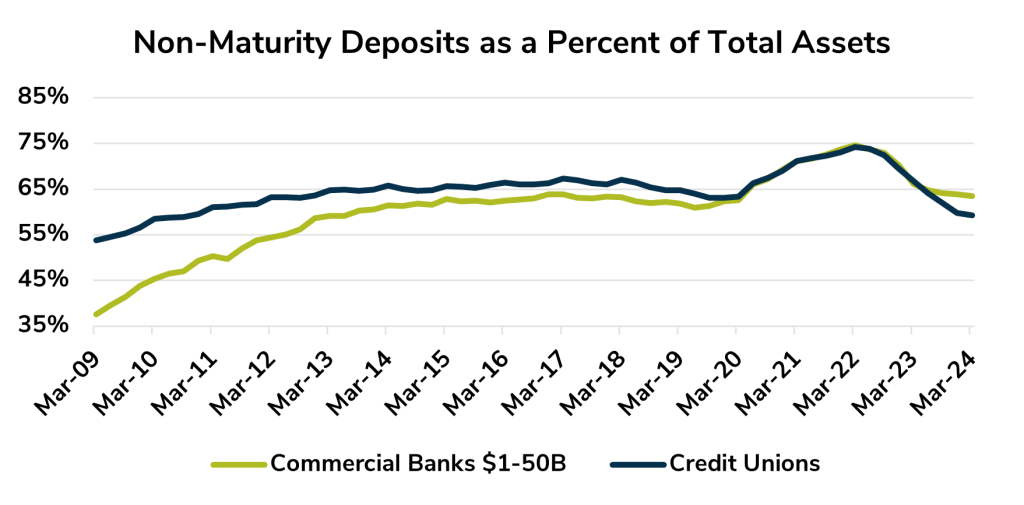
Lastly, the operating environment for banks and credit unions remains challenging, particularly when compared to much of the post-GFC era. As Exhibit 1 illustrates, non-maturity deposits as a percentage of total assets have fallen sharply since the COVID peak in late 2021/early 2022 for both credit unions and commercial banks ($1-50 billion total assets). For credit unions in aggregate, the percentage is back to 2010 levels. Reduced reliance on cheap, core funding makes prudent (and profitable) risk management even more important, including sound asset pricing and hedging as needed. That said, if rate cuts do come in the second half of the year, it would obviously be positive for marginal funding costs. Household credit fundamentals remain solid on a historical basis, which should be positive for institutions with greater exposure to consumer credit looking ahead.
Exhibit 1
Source: S&P Global
To download the PDF of this econ only version, please click here.
To continue reading the full month’s market commentary, and to learn more about current market themes, market sectors, sector performances, and applied strategies, log in to the ALM First portal, and select this month’s commentary in the Resource Center.
If you do not have a login and you would still like to access the document, please send your inquiry to info@almfirst.com.