
Economic Update
- Financial markets are responding favorably to expectations for a narrow range of interest rates, lower oil prices, and significant cap ex from technology firms
- Like ‘Nuke’ LaLoosh in Bull Durham, new Fed Chair Kevin Warsh announced his presence with authority at the June 17 FOMC meeting
- The bond market priced for a more hawkish/less dovish FOMC in the aftermath of the June meeting
We have cleared the midpoint for the year, and investors are contemplating what lies ahead in the second half. The Fed has a new chairman with reform on his mind. The White House appears to be highly motivated to put the Iran conflict to bed and keep energy prices down, although the Iranians will have something to say about that. The AI infrastructure buildout remains a dominant theme for the US economy and financial markets alike, with massive debt raises and subsequent capital expenditures by hyperscalers.
Unemployment remains low and inflation elevated. The latter unfortunately continues to weigh heavier on the bottom quintile of income earners, but the rest of consumers appear to be in good shape. The bond market is priced for 1-2 rate hikes over the next year, and expected rate volatility is relatively low at this point. In other words, current market expectations suggest interest rates trading in a tighter range over the next several months. This has been positive for credit markets in recent weeks, as evidenced by strong investor demand for new debt issuance and tighter spreads relative to Treasuries.
New Sheriff in Town
In last month’s commentary, we discussed material reforms that new Fed Chair Kevin Warsh favored for the central bank – from balance sheet policy to external communication. The question was how quickly he would begin working on these initiatives, and the answer is immediately. Warsh did not tiptoe into his first FOMC meeting as Fed Chairman. If our first look at the Warsh regime taught us anything, it was that he has no plans to be timid in his reform efforts. Starting with the official statement, the June 17 edition was considerably shorter at 114 words, less than half the word count of the prior statement. The biggest change was the removal of forward guidance in the statement, which was a predominant theme in the press conference that followed. When pressed for policy guidance or economic outlook by reporters, Warsh repeatedly pointed back to the official statement.
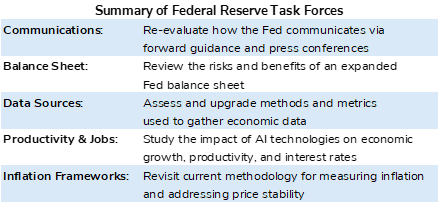
As some had suspected, he also did not participate in the Summary of Economic Projections (SEP), which includes participant forecasts for the fed funds rate (the “dot plot”). This was a clear attempt to deemphasize the value of these forecasts and forward guidance in general. To drive his reform agenda, Warsh has launched five independent task forces staffed with both internal and external experts (Exhibit 1). Warsh said he plans to announce the leaders of each task force soon, and for more impactful decisions, such as shrinking the Fed’s balance sheet, they will give ample advance warning to financial markets to avoid major disruption.
Exhibit 1
There was a lot to unpack from Warsh’s first FOMC meeting, but perhaps the most impactful for markets in the near term was the emphasis on price stability. The official statement ended by noting that inflation remains above target and that “the Committee will deliver price stability.” Warsh hammered home this sentiment in his press conference, noting that the Fed has missed the inflation target for five consecutive years. When asked by a reporter to comment further on the price stability commitment, Warsh didn’t mince words. “We have the capability and commitment to deliver on our price-stability objective of 2%,” said Warsh. “That’s exactly what we’re going to do.” The bond market responded accordingly, sending front-end Treasury yields higher as fed funds futures priced in approximately 1.5 rate hikes for 2026.
To download the PDF of this econ only version, please click here.
To continue reading the full month’s market commentary, and to learn more about current market themes, market sectors, sector performances, and applied strategies, log in to the ALM First portal, and select this month’s commentary in the Resource Center.
If you do not have a login and you would still like to access the document, please send your inquiry to info@almfirst.com.
