
Economic Update
- European political concerns in late May sparked rate volatility in the region not seen since the 2010-2012 Eurozone debt crisis
- The Fed is expected to move forward with a June rate hike, but the May FOMC minutes revealed an unexpected discussion of IOER
- Trade tensions moved back to the top of the headlines at the end of the month following a surprise decision from the White House
- The domestic data trend remains solid, including another strong jobs report in May
Broad market volatility was once again elevated in May. Long-end Treasury yields leaked higher in the middle of the month amid a stronger dollar and higher oil prices, with the 10-year yield reaching a 7-year high of 3.11%. However, in the last week of May, political concerns in Italy and, to a lesser extent, Spain sparked a global flight-to-quality trade that pushed the 10-year yield down 18 basis points (bps) to 2.75% (36 bps swing in just seven trading days). Italian 2-year bond yields surged 150 bps higher in just one day, bringing back fresh memories of the Eurozone debt crisis of 2011/2012. There remains a large amount of excess liquidity in European markets from the European Central Bank (ECB) though, and if we learned anything from recent crises, it’s the power of central bank liquidity in responding to short-term pockets of market volatility.
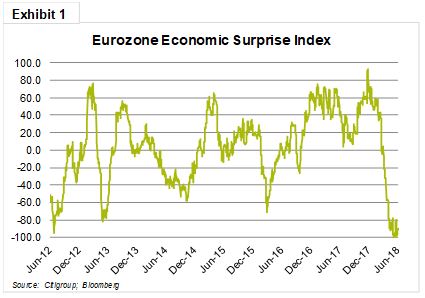
Nevertheless, if larger-scale credit concerns in the Europe are overblown, there are growing questions regarding the viability of the current economic recovery in the region. Economic data have softened in Europe in recent weeks, particularly relative to expectations, and the European Economic Surprise Index has gone from a 7-year high beginning 2018 to a 6.5-year low in early May (Exhibit 1). With softer data, the EUR/USD exchange rate has fallen from 1.25 in early February to 1.15 more recently, and expectations for the ECB to begin reducing policy accommodation in the next 6-12 months have also diminished. The June 2019 Euribor contract has fallen 25 bps since early February as well and is closer to the current spot rate. In other words, the market has effectively unwound pricing for a June 2019 ECB rate hike. Over the last 12 months, we’ve discussed a less-accommodative ECB as perhaps the biggest headwind/wildcard for financial markets and the global economy. The ECB is still expected to end its current asset purchase program in September, unless fresh growth concerns and more tepid inflation readings surface in the coming months. If it appears that the ECB will maintain easy monetary policy for the foreseeable future, it should parlay into greater investor support for long-term government bond yields (not to mention MBS spreads).
The short-term markets are still fully priced for a June rate hike from the Fed, but fed funds futures in late 2018/early 2019 have come in about 5-10 bps over the last few weeks. There also continues to be chatter in the markets regarding the current slope of the yield curve as it relates to future Fed actions. More specifically, will the Fed continue tightening even if it means an inverted yield curve? To be clear, a flattening curve is the norm during a Fed tightening cycle. As Fed Vice Chair Bill Dudley stated in January, a steepening yield curve during a Fed tightening cycle “would suggest that we were behind the curve in removing accommodation.” Multiple Fed leaders addressed this issue of curve slope in separate speeches during the month of May, and the general consensus was that they don’t won’t to intentionally/knowingly invert the yield curve given the potential economic implications. However, as Fed Chair Powell noted in a March 21 speech, previous episodes of inverted curves occurred when inflation was allowed to get out of control, and the Fed had to respond more aggressively (pushing the economy into recession). In the end, the Fed’s most important mandate is price control, and while it has more control over the long-end of the curve than it ever has (asset purchase programs), there are many other factors affecting long-end yields that it simply can’t control. Therefore, if the rate of inflation was rising above the Fed’s comfort zone, it would likely continue tightening even if it meant inverting the curve or causing a recession. That said, if inflation appears to be under control, the recent comments from Fed leaders make it clear that they would like to avoid this scenario as much as they can control it.
A FOMC Minutes Surprise
The minutes of the May 2 FOMC meeting included an unexpected curveball that could potentially have a big impact on, at the very least, money-market interest rates and depository institutions. In October 2008, the Fed began paying interest on both required (IORR) and excess (IOER) reserves. This action was actually scheduled already to be initiated in 2011, but given the significant stress in the financial/banking markets, the date was moved up. Since that time, the IORR and IEOR rates have been at the same level at the upper bound of the Fed’s 25 bps target range for fed funds, and the Fed’s reverse repo program has set the rate at the lower bound of the range.
At the May meeting, FOMC participants discussed lowering IOER from the top-end of the range. There had been no hints of such a discussion from Fed leader speeches in recent months, so market participants were certainly caught off guard with this revelation. More specifically, the minutes suggested that the Fed could raise the fed funds target range by 25 bps in June, but only raise IOER by 20 bps. The desired intent of such an action is presumably to push the effective fed funds rate (EFFR) down closer to the middle of the target range. It has currently traded just 5 bps below IOER, and if that relationship held constant, EFFR would fall 10 bps below the top end of the range (assuming IOER was raised only 20 bps). This would also presumably pressure overnight repo rates (and money market rates in general) lower as well, but the ultimate impact is not totally clear at this point. It will likely depend on demand for reserves (fed funds) by banks, particularly foreign banking organizations (FBOs). As the Fed continues to drain reserves from the system, FBOs could potentially compete for remaining reserves and drive the effective funds rate above IOER, despite the Fed’s efforts to drive the effective rate to the middle of the rate corridor.
Trade Tensions & Domestic Data Trend
Trade tensions rose to the top the headlines again on the last day of May. In a surprise to most analysts, the White House chose to let temporary exemptions for recently announced steel tariffs expire for U.S. allies in Canada, Mexico, and the European Union. Not surprisingly, those nations immediately announced retaliatory trade measures, and while the scope of economic/inflation impacts remain more limited, there’s the risk that these tit-for-tat measures could escalate into more worrisome actions. The Trump administration also chose to move forward with impending tariffs on Chinese imports, and it is still unknown how these actions will impact ongoing negotiations with China, NAFTA, etc.
On the data front, the May jobs report showed a labor market that continues to tighten. Nonfarm payrolls added another 233,000 jobs, and the headline unemployment rate fell to 3.754% unrounded, the lowest since December 1969. Perhaps more importantly, wage growth was hotter than expected (0.3% m/m, 2.7% y/y). Survey measures of business and consumer sentiment rebounded in May after an April dip and are close to post-expansion rights reached in February. Base effects from 2017 should continue to pressure year-over-year measures of core inflation higher in the near-term, and in aggregate, the recent data trend is suffice to keep the Fed in tightening mode, although escalated trade tensions do present potential headwinds for global growth/inflation.
To continue reading this month’s market commentary, and to learn more about current market themes, market sectors, sector performances, and applied strategies, log in to the ALM First portal, and select this month’s commentary in the Resource Center.
