Economic Update
- Financial markets responded well to reduced trade fears in May, including a partial reduction/pause in Chinese tariffs
- Credit sectors exposed to lower income/wealth households have experienced higher delinquencies over the last year, and an increase in unemployment would likely exacerbate the trend
- President Trump reopened the door to GSE privatization on May 21, but its not an easy path to success
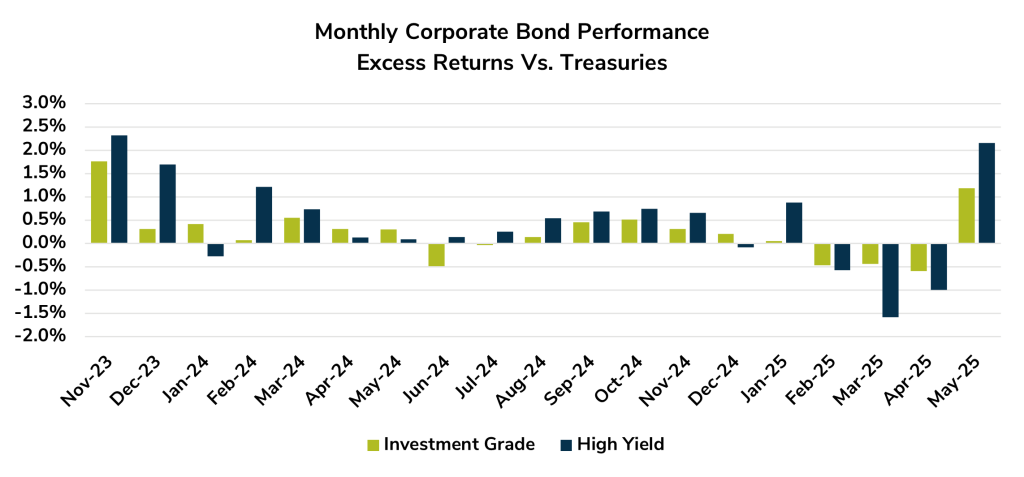
Financial markets bounced back in May, particularly riskier assets. The S&P 500 returned 6.3%, the biggest monthly return since November 2023, and fixed income credit also performed well, particularly on a hedged basis amid the rise in benchmark yields. For corporate credit, both investment grade (+1.19%) and high yield (+2.16%) markets also posted the biggest monthly excess returns in 18 months according to ICE BofA indices (Exhibit 1). However, there is still ground to make up for the cumulative negative returns of the prior three months.
Exhibit 1
Tariff anxiety was lessened on multiple fronts. First, on May 12 the White House announced a significant reduction in Chinese tariffs for a 90-day period, which reinforced the idea of a “Trump put” for market participants, as we discussed briefly in last month’s commentary. This idea was brought to the mainstream near the end of the month when a Financial Times columnist coined the phrase TACO for “Trump always chickens out” to describe an emerging strategy on Wall Street to deal with policy noise from the White House. Nevertheless, market volatility is likely to remain elevated for the foreseeable future as policy announcements remain less predictable.
Later in the month, the US Court of International Trade struck down the Trump administration’s use of the International Emergency Economic Powers Act to justify the Liberation Day tariffs as well as the separate tariffs imposed on Canada, China, and Mexico to curb fentanyl exports to the U.S. The decision was quickly paused by a federal appeals court while it reviews the White House’s petition against the judgement. The announcement was well received by financial markets, but the impact may be limited. If the appeals court decides to uphold the decision, the White House likely has other legal avenues to justify tariffs imposed according to some experts. In the end, trade uncertainty remains high, which makes growth and inflation forecasts more challenging.
Recent Data Flow
The economic data trend has remained solid, even if obstacles are on the horizon. Early in the month, the April CPI report was softer than expected on both a headline and core basis, but the impact of tariffs on consumer prices has yet to be fully realized. Labor market data remain resilient as well. April payrolls growth was better than expected, and the unemployment rate held low at 4.2%. However, there was a hiccup at month-end that will be worth watching in the coming weeks. Initial jobless claims unexpectedly rose 14,000 to 240,000 for the week ended May 24. There have been two other occasions this year when weekly claims rose to 240,000 or above, but both cases were more easily explained by situational factors and quickly reversed back to below 230,000. There were no clear factors driving the most recent rise, and if the trend persists, it will likely garner much greater scrutiny as a potential sign of rising layoffs. Consumer sentiment improved as well as the month progressed, albeit modestly. However, both near-term and long-term inflation expectations remain near historically high levels according to the University of Michigan survey.
Exhibit 2
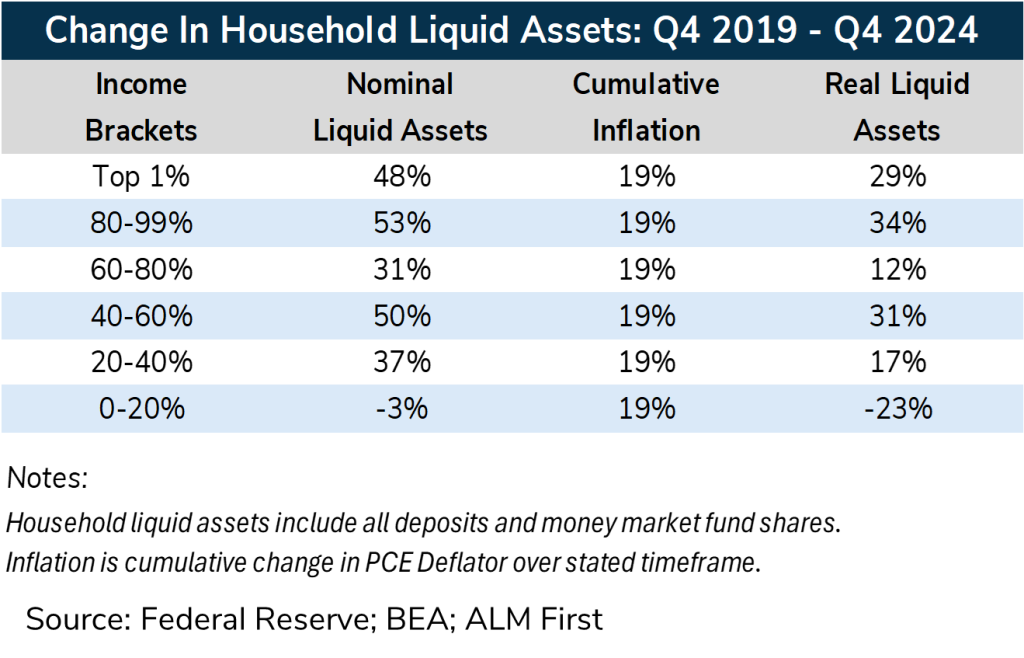
If unemployment were to rise in the coming months, the lowest income earners would be the most susceptible from a credit perspective. Exhibit 2 tracks growth in household liquid assets (deposits + money market fund balances) since the end of 2019 across income quintiles. Even after adjusting for the cumulative effects of inflation, most income brackets have built strong liquidity buffers over the last 5 years, but the lowest quintile is the exception.
Much of the consumer credit losses over the last year have been concentrated in subprime auto loans, personal unsecured loans, and high-LTV mortgages (e.g., FHA first-time homebuyers). A loss of income via higher unemployment would likely bring more stress to credit assets in these sectors.
GSE Privatization Back in Play?
Talk of releasing Fannie Mae and Freddie Mac (FMs) from conservatorship is nothing new, even pre-dating the first Trump administration. However, a more concerted effort from the executive branch began late in Trump 1.0 under then FHFA head Mark Calabria. There wasn’t enough time left in Trump’s first term to make serious progress, but when Trump 2.0 began, market attention shifted back to the prospects of a renewed effort to privatize the FMs.
President Trump made his first public comments on the topic on May 21 via a social media post that he would be working with relevant cabinet members and that the “time would seem to be right” to move forward with privatization. Later on May 27, he posted again that he is working on “taking these amazing companies public” while emphasizing that the government would maintain implicit guarantees of securities issued by the FMs.
As we have noted in previous commentaries, the effort to take these entities public would be a significant and complex endeavor. Initial estimates suggest that a combined entity would need to raise more than $380 billion of capital to meet current regulatory requirements. To put that figure into context, the largest initial public offering (IPO) ever was Saudi Aramco’s $25 billion offering in late 2019. Based on current conservatorship agreements, the $380 billion offering would only account for a 20% ownership in the combined company, with the government owning the remaining 80%. On paper alone, this valuation would make the government’s stake worth more than $1.5 trillion! It’s unlikely coincidental that this renewed focus on GSE privatization comes as Congress works on a budget bill that could add significantly to the current deficit over the next several years.
In reality, it will be very difficult, if not impossible, to raise that amount of capital at a very rich valuation relative to the broader market. The government could work to ease the FHFA’s capital requirements, requiring a smaller issuance, but it still might not be enough to cheapen the valuation to an attractive level, without even considering potential concerns from rating agencies and investors. If the goal is to get this done before 2026 midterm elections, it would be an aggressive timeline, and we’ll perhaps see in the coming weeks how motivated the White House is to push this forward. In the end, investors must be satisfied that credit backing by the federal government is very clear, particularly during times of stress. If not, wider spreads will be required and primary mortgage rates would move higher, the latter a sensitive political issue. We will cover these variables in more depth in future commentaries if the White House does indeed move forward with a plan to privatize the FMs.
To download the PDF of this econ only version, please click here.
To continue reading the full month’s market commentary, and to learn more about current market themes, market sectors, sector performances, and applied strategies, log in to the ALM First portal, and select this month’s commentary in the Resource Center.
If you do not have a login and you would still like to access the document, please send your inquiry to info@almfirst.com.