Site Search

Looking for something? Use the search bar below or visit our Resources page.


Author ALM First

Published

Estimated


Economic Update

  • A correction in equity markets finally surfaced in February due primarily to concerns of rising inflation, higher long-end rates, and tighter monetary policy
  • S. retail sales data were softer in January, but business sentiment, inflation, and labor market data continued to match/surpass expectations
  • Fed leaders have suggested the sell-off is “small potatoes” from a big picture perspective, and gradual normalization is still the plan

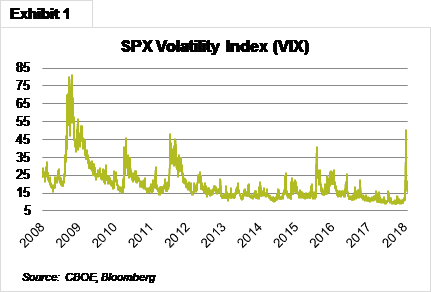
After an effective 12+ month nap, volatility returned to global risk markets in February. For much of 2017 and the first month of 2018, equity markets seemingly traded in one direction. However, in the first week of February, a correction in equity markets finally surfaced. In our January commentary, we noted that a common concern among top equity investors was rising inflation expectations and long-term bond yields, particularly as it affects stock valuations. The 10-year Treasury yield rose 30 basis points (bps) in January on improved wage and inflation data, higher commodity prices, and more hawkish rhetoric from the European Central Bank; by February 2, the 10-year yield was up another 15 bps to a 4-year high. The move in long-end rates was the primary catalyst for a major sell-off in U.S. stocks, and the next Monday, the Dow Jones Industrial Average fell more than 1,100 points (4.6%). At the same time, implied volatility in equity markets exploded higher (see Exhibit 1). The VIX index tracks S&P 500 options on the Chicago Board Options Exchange, and on February 6, the VIX breached 50 for the first time since the end of the credit crisis. By the middle of that week, the S&P 500 had fallen more than 10% from the recent peak on January 26.

As February progressed, volatility subsided somewhat, and equity markets bounced 5% higher from the February 8 low. That said, anxiousness remains in the markets, which is to be expected following a correction. The economic data trend remains positive, although some recent reports have been softer. Specifically, the retail sales control group, which is used in the GDP calculation, was unchanged in January versus expectations for a 0.4% increase, and the December growth figure was revised lower by 50 bps (-0.2%). Surveys of business sentiment remain relatively robust, and on the inflation front, January core CPI was above expectations at 0.3% m/m (1.8% y/y). Additionally, recent labor market data revealed further signs of a tighter job market, with the 4-week moving average of initial jobless claims reaching another new 49-year low in February.

The February pullback in stocks predictably sparked questions regarding its impact on Fed policy. During the Alan Greenspan years, the Fed injected liquidity into the markets during several episodes of equity market volatility, which became known as the “Greenspan put” by traders (also termed moral hazard). Ben Bernanke seemed to follow his predecessor’s lead (albeit under extraordinary circumstances in the wake of the financial crisis), and in 2011, he touted that the Fed’s post-crisis policies had “contributed to a stronger stock market.” Some market participants joked that the Fed now had a third mandate of supporting equity market valuations.

On February 7, New York Fed President Bill Dudley was asked what impact that week’s equity sell-off might have on Fed policy. Dudley was largely dismissive of the implication, calling the week’s events “small potatoes.” The interviewer reminded Dudley of the Fed’s propensity to react to previous episodes of equity weakness (the “Greenspan/Bernanke put”), specifically in 2016 when the Fed paused its rate hikes for 12 months. Dudley countered by noting the very different landscape at the time (slowing global economy, falling commodity prices, etc.), and current anxiousness in risk markets is more attributable to higher growth and inflation expectations, as well as expectations for reduced monetary accommodation. In his first appearance before the House Financial Services Committee as the new Fed Chair, Jerome Powell maintained an optimistic tone with his economic outlook, and his policy comments were generally perceived to be hawkish. As such, it would not be a major surprise to see the updated Summary of Economic Projections (SEP) on March 21 to forecast four rate hikes in 2018 (up from three last December). The markets have priced a 100% probability of a March rate hike since February 7, and futures markets are effectively fully priced for three hikes in 2018.


To continue reading this month’s market commentary, and to learn more about current market themes, market sectors, sector performances, and applied strategies, log in to the ALM First portal, and select this month’s commentary in the Resource Center.

ALM First

ALM First was founded in 1995 with the focus on financial advisory services for credit union clients.

LinkedIn

  Commentary Disclaimer

ALM First Financial Advisors is an SEC registered investment advisor with a fiduciary duty that requires it to act in the best interests of clients and to place the interests of clients before its own; however, registration as an investment advisor does not imply any level of skill or training. ALM First Financial Advisors, LLC (“ALM First Financial Advisors”), an affiliate of ALM First Group, LLC (“ALM First”), is a separate entity and all investment decisions are made independently by the asset managers at ALM First Financial Advisors. Access to ALM First Financial Advisors is only available to clients pursuant to an Investment Advisory Agreement and acceptance of ALM First Financial Advisors\' Brochure. You are encouraged to read these documents carefully. All investments involve risk and may lose money.

The content in this article is provided for informational purposes and should not be relied upon as recommendations or financial planning advice. We encourage you to seek personalized advice from qualified professionals regarding all personal finance issues. While such information is believed to be reliable, no representation or warranty is made concerning the accuracy of any information presented. Statements herein that reflect projections or expectations of future financial or economic performance are forward-looking statements. Such “forward-looking” statements are based on various assumptions, which assumptions may not prove to be correct. Accordingly, there can be no assurance that such assumptions and statements will accurately predict future events or actual performance. No representation or warranty can be given that the estimates, opinions or assumptions made herein will prove to be accurate. Actual results for any period may or may not approximate such forward-looking statements. No representations or warranties whatsoever are made by ALM First Financial Advisors as to the future profitability of investments recommended by ALM First Financial Advisors.

Moreover, this report was prepared as of the date indicated herein. No representation or warranty is made by ALM First that any of the returns or financial metrics detailed herein will be achieved in the future, as past performance is not a reliable indicator of future results. Certain assumptions may have been made in preparing this material that have resulted in the returns and financial metrics detailed herein. Changes to the assumptions may have a material impact on any returns or financial metrics herein. Furthermore, ALM First gives no representation, warranty or undertaking, or accepts any liability, as to the accuracy or completeness of the information contained this report. This report was prepared for informational purposes only without regard to any particular user’s investment objectives, financial situation, or means, and ALM First is not soliciting any action based upon it. This material is not intended as, nor should it be construed in any way as accounting, tax, legal, or investment advice including within the meaning of Section 975 of the Dodd-Frank Wall Street Reform and Consumer Protection Act. Certain transactions give rise to substantial risk and are not suitable for all investors. The strategies discussed herein can have volatile performance and may employ leverage. Moreover, investment advisory fees and expenses may offset trading gains. This report was prepared by ALM First Financial Advisors, LLC. The hereto mentioned report contains information which is confidential and may also be privileged. It is for the exclusive use of the intended recipient(s). If you are not the intended recipient(s), please note that any distribution, copying, or use of this report or the information contained herein is strictly prohibited. If you have received this report in error, please notify the sender immediately and then destroy any copies of it. ALM First neither owes nor accepts any duty or responsibility to the unauthorized reader. ALM First shall not be liable in respect of any loss, damage, or expense of whatsoever nature which is caused by any use the unauthorized reader may choose to make of this report, or which is otherwise a result of gaining access to the report by the unauthorized reader. This content contains information derived from third-party sources. We believe that this third-party data is reliable; however, we cannot guarantee this data’s currency, accuracy, timeliness, completeness, or fitness for any particular purpose.

INDEX BENCHMARKS: Index performance is discussed for illustrative purposes only as a benchmark for each strategy’s performance and does not predict or depict performance of that strategy. While index comparisons may be useful to provide a benchmark for a strategy’s performance, it must be noted that investments are not limited to the investments comprising the indices. Each of the strategy benchmark indices are unmanaged and cannot be purchased directly by investors.

HYPOTHETICAL PERFORMANCE DISCLAIMERS: Performance figures derived from model portfolios are hypothetical in nature and the results of any individual investor will differ as a result of various factors, including investment limitations relative to model portfolio guidelines, availability of same or similar assets, and fee structures. Investments are presumed to have been made at the beginning of the time period and there are no inflows or outflows of cash during the period. There are limitations and risks associated with the use of model performance or hypothetical performance information, and you should be cautious when looking at any presentation of model or hypothetical performance information. Investment strategies should not be based solely on the use of model or hypothetical information. Actual results will be different from those shown in model or hypothetical performance. The model portfolio returns reflect actual trading including the reinvestment of coupon payments and are net of transaction costs, administrative costs and a strategy-specific per annum fee ranging from 5 bps to 50 bps, which is the amount of the highest fee charged to any ALM First Financial Advisors, LLC customer employing that particular strategy during the period under consideration (the “Model Fee”). Actual fees will vary depending on, among other things, the applicable fee schedule and portfolio size. ALM First\'s fees are available upon request and also may be found in its Form ADV Part 2A. Past performance does not guarantee future results.


Strategic Partners

Let’s Work Together

ALM First is your agile partner with a trusted history of delivering results.