Upside data surprises and less dovish Fed guidance have forced markets to once again pare back expectations for a dovish Fed pivot in the coming months
The Fed was created to be an independent, non-political agency, but the November elections could still impact their decision-making framework regarding the timing of the eventual policy shift
Consumer credit performance has deteriorated in recent quarters, particularly for auto loans and unsecured credit, but overall delinquency rates remain below pre-Covid levels for most sectors
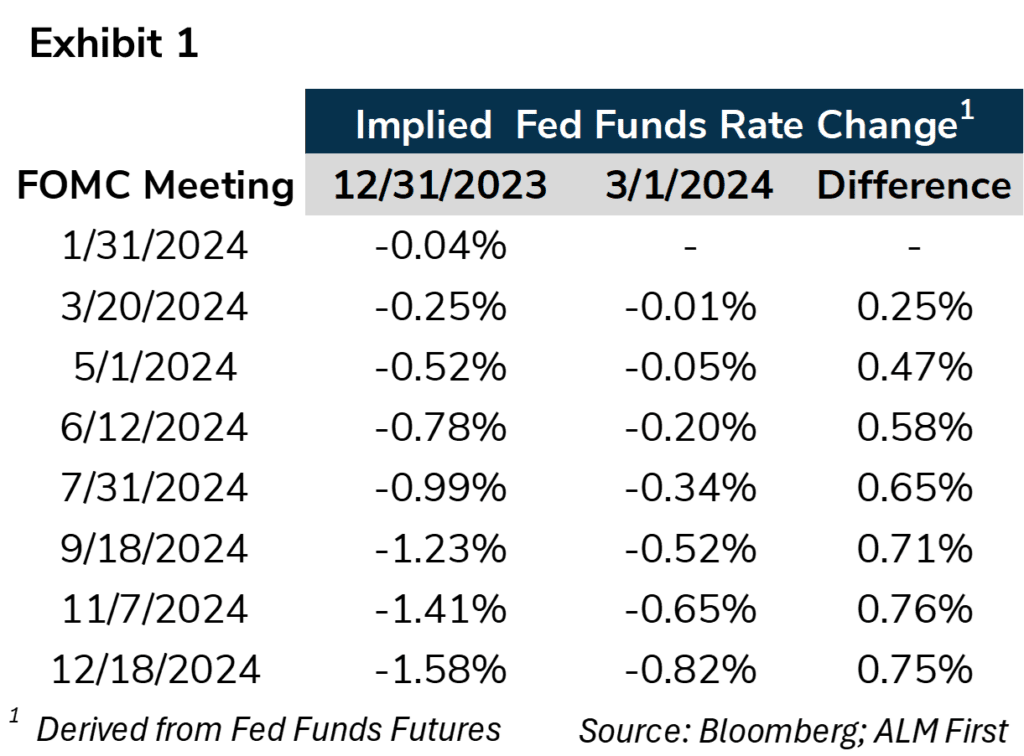
As 2024 began, the bond market was priced for a series of 25 basis point rate cuts, beginning at the March 20 FOMC meeting. As Exhibit 1 illustrates, the market has repriced for a less dovish Fed amid continued upside surprises in recent economic and inflation data. The January CPI report, released on February 13, was the latest bucket of cold water on expectations for an aggressive Fed pivot, showing the highest monthly growth in core prices in 8 months. The January PCE report released later in the month painted no materially different picture for current inflation. Make no mistake, inflation readings appear to be moving in the right direction but are not yet to a level that makes policymakers comfortable with sustainability. Another factor contributing to the repricing of market yields was the release of the January 31 FOMC minutes on February 21, which suggested Fed leaders are in no rush to cut rates. The minutes acknowledged that upside inflation risks have diminished, but some expressed concern that progress toward the Fed’s inflation target could stall in the coming months. Perhaps more importantly, this meeting occurred prior to the release of the January jobs and CPI reports.
Politics & the Fed
The Federal Reserve was created as an independent government agency, and as such, it should make monetary policy decisions with no political motivations. This does not mean that policymakers are immune to the prevailing political environment, and monetary policy most certainly can impact elected officials and their respective campaigns. This puts the Fed in a tricky position, particularly in an election year. Fed leaders typically seek to avoid making policy decisions that could be seen as impacting an election in one way or another. This is a particularly important consideration for the elections in November 2024, a year in which the central bank is contemplating a pivot to rate cuts and less restrictive policy. As we approach November, the Fed would ideally make no material changes to existing policy barring an unforeseen emergency (e.g., 2008 financial crisis). In other words, if by say August/September, it had already pivoted to rate cuts, it would continue doing so through the election. However, on the contrary, if by that same timeframe, the Fed has not pivoted to rate cuts, it may choose to remain on hold through the remainder of the year. Fed leaders will likely say the right things regarding doing what the economy dictates, but if they can avoid being seen as acting in a way that could be politicized, they will likely try hard to do so. That said, it may be an impossible task in the current environment.
For market participants, this brings the September 18 FOMC meeting into greater focus. If the Fed hasn’t initiated rate cuts by that meeting, it may very well choose to avoid starting a rate-cut program so close to the elections. It’s anyone’s guess whether the economic and inflation data will justify a pivot by the June or July FOMC meetings, but after that, the Fed will have some even tougher decisions to make. The last thing any Fed leader wants is to be at the top of political headlines leading to November.
Consumer Credit Update
In last month’s commentary, we highlighted household balance sheets and noted that household net worth has grown relative to pre-Covid levels for all income brackets. This growth in wealth was heavily impacted by rising housing valuations over that timeframe, which provides many homeowners with a safety net against sudden financial hardship. We also looked at New York Fed data on consumer credit delinquencies as of Q3 of last year. The newest Quarterly Household Debt & Credit Report was released in February, which included Q4 2023. The pace of new loans transitioning to serious delinquency (90+ days) accelerated for the 8th consecutive quarter for all consumer credit categories (in aggregate). However, the percentage of consumer loans seriously delinquent is below Q4 2019 levels for all major categories except credit cards and “other”, which includes personal and retail loans/credit. For auto loans, 4.17% of outstanding balances were 90+ days delinquent at the end of 2023, compared with 4.94% at the end of 2019.
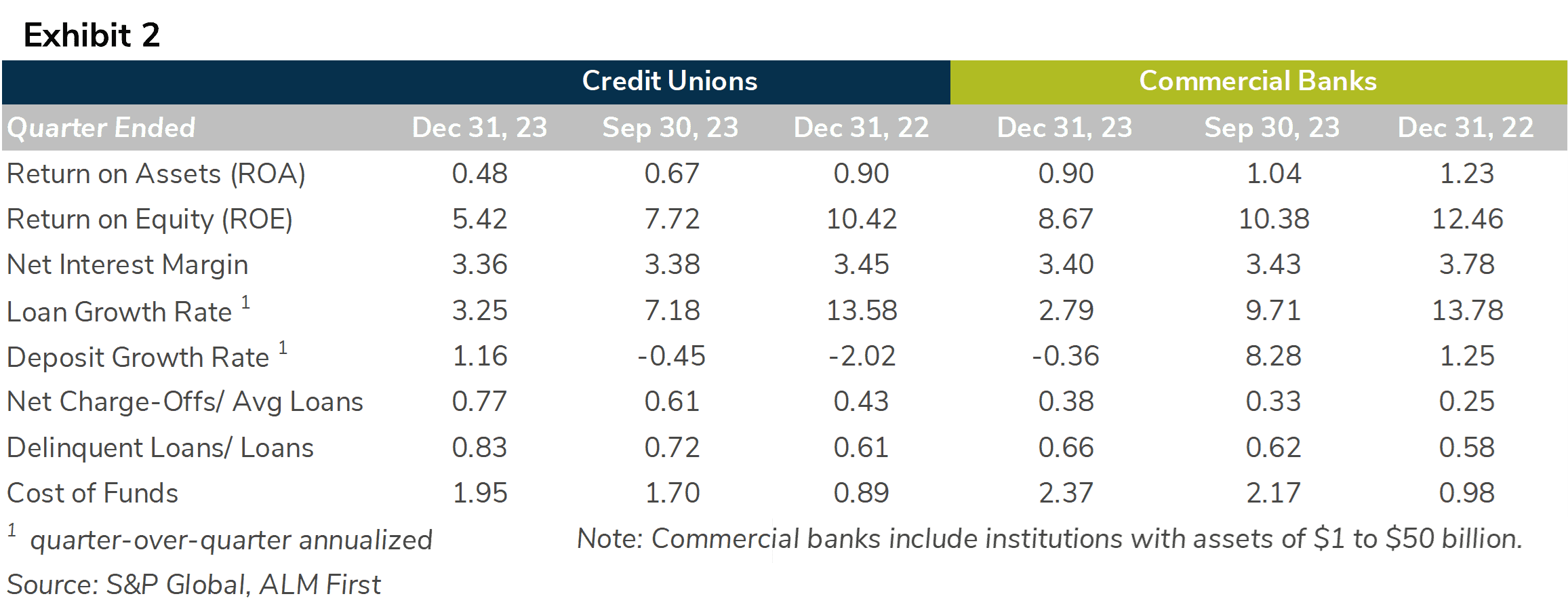
Rising consumer credit costs could be seen once again in quarterly financial data for credit unions. As illustrated in Exhibit 2, aggregate credit union return on assets (ROA) fell to 0.48% in Q4, down from 0.90% a year earlier. This decline in profitability was highly correlated with rising loan charge-offs, which were 0.77% of average loans at the end of the year. This negative credit performance could be seen most in auto and credit card exposures. Unfortunately, headwinds remain for the auto sector. As highlighted in a February 13 Wall Street Journal (WSJ) article, the cost of transportation rose sharply in 2023, including a 20.6% increase in car insurance premiums in January on a year-over-year basis. According to Labor Department data, the average new vehicle price rose from $39,813 in January 2021 to $47,358 in January 2024. Other costs impacting car owners include a 7.9% y/y increase in maintenance and body work, along with an acceleration in value depreciation. According to the WSJ article, AAA estimated that depreciation costs for those who drove 15,000 miles were $4,538 in 2023 versus $3,656 in 2022, a 24% increase.
To download the PDF of this econ only version, please click here.
To continue reading the full month’s market commentary, and to learn more about current market themes, market sectors, sector performances, and applied strategies, log in to the ALM First portal, and select this month’s commentary in the Resource Center.
If you do not have a login and you would still like to access the document, please send your inquiry to info@almfirst.com.