Financial market jitters increased in February amid heightened AI disruption fears and geopolitical tensions
The U.S. and Israel launched a major military operation against Iran, sending oil prices and Treasury yields sharply higher
Speculation that AI advancements posed a threat to traditional software companies sparked fears in both equities and private credit
Financial market jitters escalated in February, even as economic data releases remained generally encouraging. Market anxiety has been driven primarily by two issues: AI disruption fears and geopolitical tensions. The latter came to fruition this past weekend when American and Israeli forces launched a major joint military campaign against Iran, reportedly killing much of the nation’s senior leadership. The initial market reaction included sharply higher oil and natural gas prices, a selloff in equities, and higher global bond yields. The latter was attributable to inflation concerns from higher energy prices. The Strait of Hormuz, just off the coast of Iran, was effectively shut down, cutting off the distribution channel for 20% of the world’s daily oil and light natural gas consumption. It will likely take some time for the dust to settle and markets to get a better idea of the ultimate objectives and potential timeline for U.S. military operations.
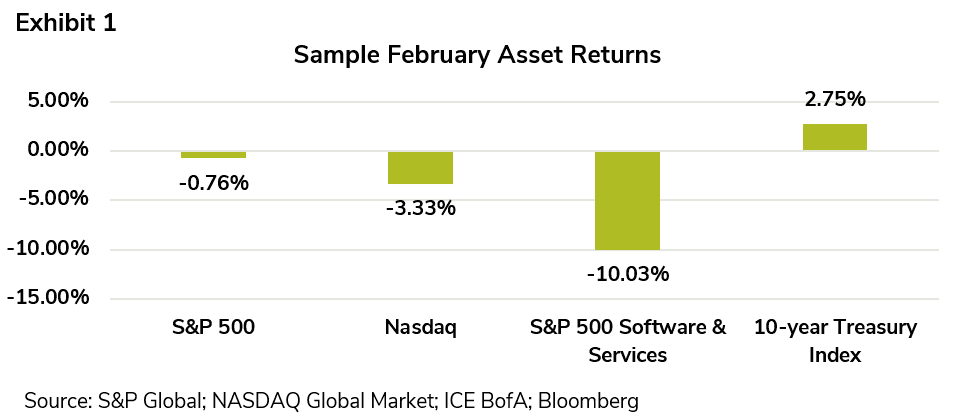
Before the U.S. military action on Iran, risk markets had been reeling from worries that accelerating AI development, particularly agentic systems, could cause significant disruption to many white-collar industries, most notably the software as a service (SaaS) sector. Exhibit1 provides summary return information for various asset classes. The S&P 500 posted its first negative monthly return since last April amid tariff volatility, and the tech-heavy Nasdaq composite index dropped 3.3% in February. The software & services sub-index of the S&P 500 produced a -10% return in February, illustrating the heightened SaaS concerns, and the index is down nearly 21% through the first two months of 2026.
The Fuss About AI
There are other information sources more equipped to provide a deep dive into the risks and opportunities presented by the various potential applications of artificial intelligence. This includes recent essays and articles penned by owners of leading AI companies, including Anthropic’s Dario Amodei. Here, we provide a high-level overview of some of the AI-related scenarios that have been spooking equity investors and creditors alike in recent weeks. Some of these concerns may very well be overblown, but as renowned economist John Maynard Keynes once said: “Markets can remain irrational longer than you can remain solvent.” That’s not to say we’re anywhere close to the point of broad insolvency concerns at this point, but at the same time there have been a growing number of negative headlines in credit markets, particularly surrounding private credit. The latter has included a material focus on exposures to software companies.
We would categorize the recent AI worries into two basic categories – more narrow disruption to technology (e.g., SaaS) and more broad disruption to the overall economy. On the software front, the general worry is that an AI platform like Claude (Anthropic) could write code in hours that previously took thousands of engineers months to complete, potentially allowing large companies to replicate SaaS platforms internally at a fraction of the cost they pay the software service providers. Alternatively, just the threat of internal replication could push software prices down, which unsurprisingly weighed on lofty valuations for those tech companies in February. Private equity firms have been actively targeting software companies for leveraged buyouts over the last several years, using private credit to finance the deals, on the assumption of steady revenue growth. While not exactly the same, one could draw parallels to the mid-2000s when a significant amount of leverage backed an idea that home prices only went higher.
While proponents of AI development highlight significant productivity gains as a large economic benefit, critics suggest that too much too fast threatens a broad surge in unemployment and economic disruption. On February 22, Citrini Research released a blog post titled “The 2028 Global Intelligence Crisis” that sparked a risk-off move in financial markets the following morning. The article was structured as a fictional memo from the future, and it implied that sophisticated AI agents could dramatically reduce staffing needs in several “white-collar” professions, including technology, finance/accounting, and law. In theory, companies would be pressured to cut staff and keep margins high by investing more into AI capabilities instead. While perhaps good for individual companies, the collective effect on the economy would be more draconian from the author’s perspective. That said, it is true that AI agents aren’t consumers of goods and services. They don’t buy cars or homes or Chipotle. This would present obvious risks to credit exposures to those displaced workers and a reduction in demand for goods, services, and credit.
In market terms, it’s a classic sell first, ask questions later. No one knows for certain the ultimate disruption AI will cause to labor markets, or to society, nor the pace at which it will happen. As highlighted in our 2026 market themes, this year is more about digital infrastructure buildout, which is a major economic tailwind given the amount of financing being raised. That said, we don’t expect related anxiety to fully dissipate anytime soon, which would imply more volatile markets in 2026.
To download the PDF of this econ only version, please click here.
To continue reading the full month’s market commentary, and to learn more about current market themes, market sectors, sector performances, and applied strategies, log in to the ALM First portal, and select this month’s commentary in the Resource Center.
If you do not have a login and you would still like to access the document, please send your inquiry to info@almfirst.com.