Financial markets are in a bit of a holding pattern, sandwiched between the recent banking upheaval and the looming debt ceiling negotiations
Recent data suggest a resilient U.S. consumer and persistent inflation pressures
The date at which the Treasury will run out of cash remains fluid, with recent guidance suggesting it could come as soon as June 1
Where do we go from here? Financial markets remain in a mercurial state. While general bank fears have eased in recent weeks, there are still lingering risks (see First Republic Bank). The Fed is widely expected to announce a 25 basis point rate hike at the May 3 meeting, but will that be the last hike of the current cycle? If so, when will the first rate cut come? The answers to these questions rely on a multitude of factors, and one major one is the looming debt ceiling deadline. Beyond current banking troubles and the debt ceiling, there are also worries about a shift in the Bank of Japan’s ultra-accommodative polices that, depending on the timing/pace, could spark a large-scale repatriation of Japanese institutional investments abroad. Could the Fed’s aggressive tightening and consequential volatility cause another shoe to drop in another sector (leveraged loans, CRE, etc.)? To be clear, none of these risks may come to fruition, and the U.S. economy can still theoretically achieve the ideal soft-landing scenario. However, the heightened uncertainty in financial markets right now is palpable, and general risk appetite is subdued. Some have characterized this as a market in limbo, and others, in a more sensational sense, have referred to it as the eye of a hurricane.
General economic fundamentals remain relatively sound for this point in the business cycle. Unemployment is still holding at nearly a 55-year low, and while GDP growth has fallen below trend in the last year (due in large part to price pressures), consumer spending has proven resilient. In the first quarter GDP report, overall growth was weaker than expected at 1.1% q/q (annualized), but personal consumption rose 3.7%, slightly below expectations but the best quarterly rate since the Spring of 2021. Consumption has shifted in recent quarters from big-ticket goods to services and consumer staples, effectively a reversal of the pandemic trend. In short, rumors of the consumer’s demise were greatly exaggerated, to butcher a famous Mark Twain line.
The housing market has shown signs of stabilization as well, with supply constraints supporting current valuations even at higher interest rates. All of this is not to say that tighter credit conditions and/or an external shock couldn’t quickly disrupt the U.S. economy (e.g., debt ceiling), but for Fed leaders, there is little on the data front to suggest a near-term policy reversal is appropriate. Core inflation rates remain well above the Fed’s 2% target. Even if one believes that target should be higher than 2%, current rates remain more than double that rate on a year-over-year basis. Additionally, the Employment Cost Index (ECI), a preferred wage inflation gauge of the Fed, rose more than expected in Q1 at a 1.2% q/q rate. The year-over-year measure of wages & salaries moderated slightly to 5%, but only 30 basis points (bps) below the cycle high.
As for the May 3 FOMC meeting, market attention should be much more focused on the forward guidance within the official statement and Fed Chair Powell’s press conference. At this point in the cycle, it will likely be more challenging for Powell to maintain consensus within the committee, particularly the more hawkish members. As of Monday, the fed funds future market was pricing for one more 25 basis point hike on May 3 and the first rate cut at the December meeting. However, pricing for future rate hikes and cuts has been very volatile in the first four months of 2023.
Debt Ceiling Drama
In the February commentary, we laid out potential consequences of a U.S. default if the debt ceiling wasn’t raised, none of which were pleasant. The Treasury has been utilizing “extraordinary measures” since the debt ceiling of $31.4 trillion was reached in late January. The date at which these measures would be exhausted and the Treasury runs out of cash, referred to as the x-date, was not known with certainty given unknown tax receipts to be collected in the Spring. Initial estimates of the x-date ranged anywhere from early/mid-June to August or beyond. Early tax data in April sparked concerns that the x-date may indeed be at the early end of that range, and this week, the Treasury and non-partisan Congressional Budget Office warned that it could now be as soon as June 1, further exemplifying the fluidity of these projections. President Biden is expected to meet with Republican and Democrat lawmakers next week, and so far, it appears that the negotiations will be as contentious as the 2011 episode, if not more.
Last week, House Republicans were able to pass a bill by a 2-vote margin that would raise the debt ceiling but require spending cuts across several categories. The bill is essentially dead-on-arrival in the Senate, which Democrats control by a slim majority. If we do indeed breach the x-date without a deal in place, the damage will depend on how long the U.S. remains in default. If quick, the damage could be limited. The Treasury would likely prioritize payments to debt holders at the expense of other payments (Social Security, Medicare reimbursements, etc.). However, the longer it goes, the worse the outcome likely becomes.
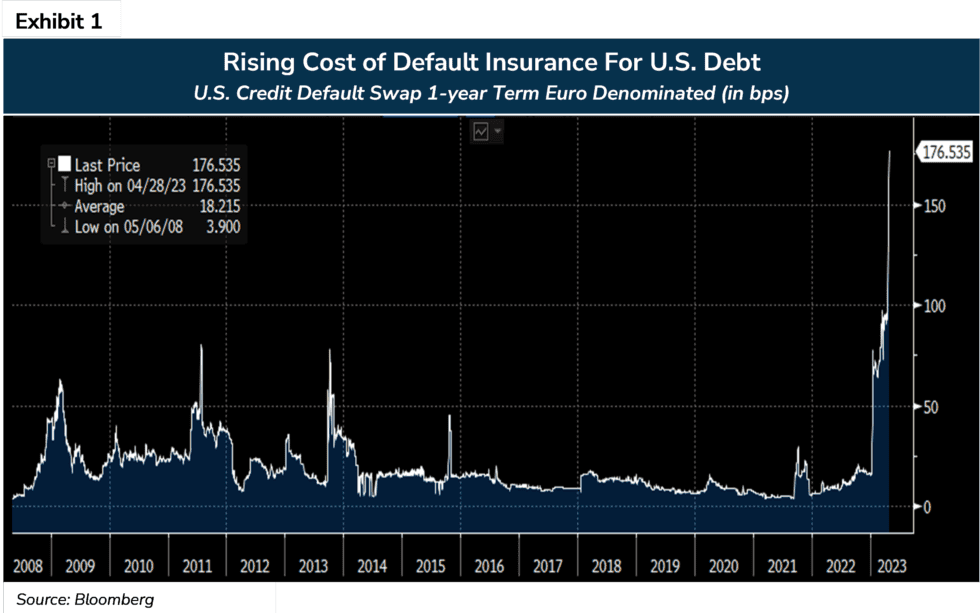
Current market anxiety related to a U.S. default can been witnessed in credit default swaps (CDS) market. The seller of a CDS contract for a particular issuer and tenor agrees to compensate the buyer if a default occurs on the underlying asset within that timeframe. The higher the CDS, the greater probability of default the market is pricing (i.e. rising cost of credit insurance). Exhibit 1 tracks pricing for 1-year CDS on U.S. debt, which is now at an all-time high, exceeding pricing during previous debt ceiling battles, including the highly contentious 2011 episode.
To download this economic update portion of our Monthly Market Commentary, please click here.
To continue reading the full month’s market commentary, and to learn more about current market themes, market sectors, sector performances, and applied strategies, log in to the ALM First portal, and select this month’s commentary in the Resource Center. If you do not have a login and you would still like to access the document, please send your inquiry to info@almfirst.com.