Financial markets were forced to reprice once again for a stronger economy, sticky inflation, and a less dovish Fed
In our 2024 economic themes, we expected consumer spending to finally slow in 2024, but data released so far this year are calling this expectation into question
Freddie Mac made a surprise announcement in April that it plans to purchase closed second-lien mortgages, which could have implications beyond just the mortgage market
Financial markets have had a difficult time discounting the path of the U.S. economy and Fed policy over the last 1-2 years. Perhaps a bit of wishful thinking, practitioners have greatly underestimated the resiliency of both growth and inflation and overestimated the effect of higher interest rates in suppressing each. April included yet another repricing for bonds to be more aligned with the ‘higher for longer’ scenario following more upside data surprises and hawkish Fed rhetoric. It began with the March jobs report on April 5, which showed much higher job growth (+303k) than expected and a slight downtick in the unemployment rate to 3.8%. The next week, core CPI exceeded expectations for March at 0.4% m/m, while the year-over-year metric held steady at 3.8%. On April 16, Fed Chair Powell provided the following assessment during a moderated Q&A session: “The recent data have clearly not given us greater confidence and instead indicate that it is likely to take longer than expected to achieve that confidence.” Later in the month, inflation data within the Q1 GDP report was hotter than expected, sparking yet another selloff in both Treasuries and equities.
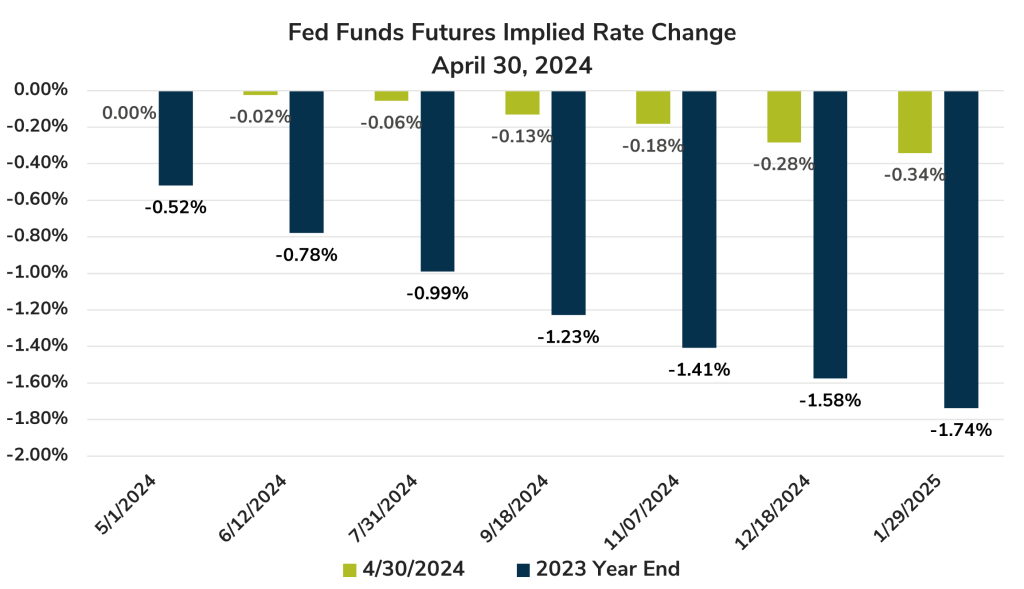
The 5-year Treasury yield rose 50 basis points (bps) in April, the biggest move across the yield curve, and the S&P 500 ended the month with a -4.08% return, the worst month since last September. The performance of both asset classes corresponded with a repricing of market expectations for forward short-term rates. Exhibit 1 looks at fed funds futures pricing at the end of last year compared to April 30 pricing. Futures were priced for 158 bps of rate cuts in 2024 to begin the year, which permeated across the entire yield curve. At the end of April, futures were priced for just 28 bps of rate cuts in 2024. Pricing in Overnight Indexed Swaps (OIS), the floating rate of which is the effective funds rate, is similar to fed funds futures, and the long-term/terminal OIS rate was close to 4% at the end of April, roughly 100 bps above year-end 2023 pricing. This implied OIS terminal rate is also approximately 150 bps above the FOMC median forecast for the long-run fed funds rate from the March 20 meeting.
Exhibit 1
Source: Bloomberg, ALM First
Consumers Still Spending
The top of our list of economic themes for 2024 released in the January commentary was Consumer Spending Finally Cools. The general reasoning for this expectation was that it appeared that excess liquidity of U.S. households had finally been whittled down, at least for most income brackets, thanks to a prolonged spending binge and the cumulative effect of inflation on consumer buying power. So far in 2024, there are no signs of a significant slowdown in household spending. Personal spending adjusted for inflation rose 0.5% in March, 20 bps higher than expected. It was the second consecutive month of 0.5% real spending growth and makes the surprise 0.3% decline in January appear to be more of a weather-driven anomaly. In the Q1 GDP report, personal consumption was below expectations but still a solid 2.5% q/q (annualized).
We began the second quarter with positive momentum related to consumer spending, bringing our expectation of a material slowdown in 2024 into question. As such, Fed leaders should continue to call for patience in foreshadowing any shift to rate cuts until there is clear evidence of a shift in the overall data trend, as Powell expressed in his comments above. However, if the downward trend in inflation reverses course (or continues to hold at elevated levels), then the possibility of additional rate hikes could enter the discussion, which would likely lead to a surge in interest rate volatility to rival or exceed what was experienced in Q3 2023. Credit-risky assets would also likely struggle, particularly securitized credit down the capital structure (i.e., subordinate/mezzanine tranches). From the Fed’s perspective, this would constitute tighter financial conditions, which could help in the inflation battle.
Big Freddie Mac Announcement
On April 16, Freddie Mac announced a proposal for a new product that would purchase closed-end second mortgages of single-family properties. Doing so would theoretically make it cheaper and easier for U.S. homeowners to extract equity from their homes. There is currently an estimated $32 trillion of untapped equity in U.S. homes. If the new product were launched and utilized by many borrowers, it could have notable ramifications beyond just the mortgage market, potentially impacting the U.S. economy as a whole, depending on how the resulting proceeds are used. While a portion of the proceeds could be used to consolidate debt with higher interest rates, some could be used to fuel consumption as well. Additionally, increased utilization of home equity would increase overall household leverage, which could have implications for the pricing of consumer credit, particularly subordinate tranches of securitized credit.
There are still more details to come, including what the ultimate securitized market for the loans purchased by Freddie Mac will look like. What we do know is that they will only purchase closed second loans on properties on which Freddie Mac already owns the first lien, comes from an approved lender, is owner occupied, fixed-rate, amortizes over a 20-year or shorter period, and the combined loan-to-value (LTV) is 80% or less. The comment period for the proposed product is open until May 22. There will be more discussion of potential implications on the mortgage market later in this commentary.
To download the PDF of this econ only version, please click here.
To continue reading the full month’s market commentary, and to learn more about current market themes, market sectors, sector performances, and applied strategies, log in to the ALM First portal, and select this month’s commentary in the Resource Center.
If you do not have a login and you would still like to access the document, please send your inquiry to info@almfirst.com.