
Economic Update
- The Fed executed another 25-basis point rate cut on October 29, but forward guidance was less clear
- Recent Fed releases and public speeches highlight a sharp divide between FOMC hawks and doves regarding inflation and labor market risks
- Recent headlines have brought pockets of credit markets into focus, including increased lending by commercial banks to non-bank financial institutions
The FOMC moved forward with another 25-basis point rate cut on October 29. While the cut was expected, the forward outlook is a bit murkier. Heading into that meeting, the market was pricing 100% probability of a December rate cut, followed by another 100 bps of cuts in 2026. In a speech before the annual National Association for Business Economics (NABE) conference on October 14, Fed Chair Powell had an opportunity to push back on market pricing, but he chose not to and instead focused much of the discussion on the role and size of the Fed’s balance sheet. However, he struck a notably different tone at the press conference following the Oct. 29 meeting. “In the committee’s discussions at this meeting, there were strongly differing views about how to proceed in December,” Powell said in his opening remarks. “A further reduction in the policy rate at the December meeting is not a foregone conclusion. Far from it.”
The updated Summary of Economic Projections (SEP) released following the September 17 FOMC meeting revealed a wide range of opinions on where the fed funds rate would end 2025, as well as the long-run neutral rate. In the speeches that followed that meeting, more dovish Fed leaders expressed concern that recent labor market softening was a harbinger for weaker GDP and reduced inflation in the months ahead. On the other hand, Fed hawks characterized the September cut (and likely the one on Oct. 29) as insurance against further weakness in the labor market but at the same time expressed hesitancy about doing much more policy easing amid ongoing inflation uncertainty. This debate was clearly alive and well during the Oct. 29 meeting, which Powell even suggested should be clearer when the minutes are released. During the press conference, Powell said he believes most of the slowdown in hiring is more attributable to supply-side factors (labor participation and immigration) as opposed to the demand side of the equation (i.e., business investment). Fed policy typically has less impact on labor supply and more on labor demand. This is likely a critical factor in the current outlook of Fed hawks.
The government shutdown and the lack of official government economic data are adding to the challenges of Fed policymakers. These new challenges and the “strongly differing views” of the current committee increase the probability of a pause at the December meeting to provide more time to assess the economy’s trajectory. Lastly, the White House has reportedly settled on five candidates for the next Fed chair when Powell’s term expires next May. They include current governors Chris Waller and Michelle Bowmman, former Fed governor Kevin Warsh, Director of the White House Economic Council Kevin Hassett, and Blackrock CIO Rick Rieder. President Trump has previously suggested that he will decide by the end of this year, which would then go to the Senate for confirmation.
NBFIs and Banks
Fixed income credit has been on a strong run since mid-April after the White House pulled back from what markets perceived as the worst-case scenario on trade policy. Credit spreads moved tighter across most sectors, creating a strong tailwind for performance. Over the last two months, there have been multiple headlines that sparked some jitters, beginning with the bankruptcies of Tricolor (subprime lender) and First Brands (auto supplier) and followed by news of large loan losses by regional banks Western Alliance and Zions. All of these issues involved, to some degree, intermediaries between the ultimate borrower and lenders. As a result, it has shined a light on a segment of financial intermediation that has been growing over the last several years – private credit via non-bank financial institutions (NBFI). In various forms over the last few decades, this can also be referred to as the “shadow banking” system.
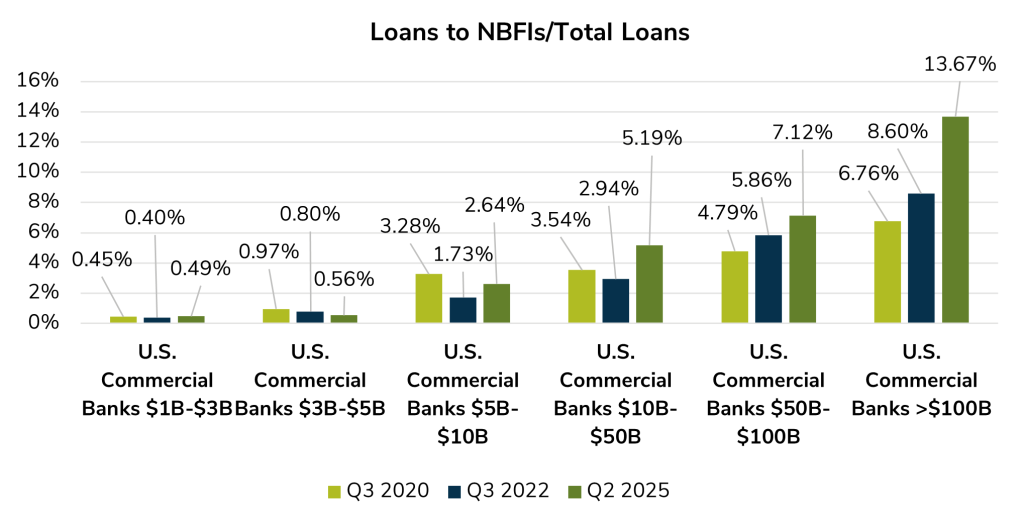
While there is no universal definition, the Federal Reserve defines private credit as a loan negotiated directly between a borrower and a small group of nonbank lenders. According to Moody’s research, US private credit assets under management have tripled over the past decade, far outpacing growth in other forms of credit. At the same time, banks have been operating in a more stringent regulatory environment post-GFC. These private credit loans come with higher regulatory and supervisory costs for banks, opening the door for NBFIs to more efficiently price and hold them. Banks have instead focused more on growing lending to NBFIs in recent years, rising to a total of $1.2 trillion as of late June. In the last year alone, US commercial bank lending to NBFIs has increased 46%, and these loans now represent 6% of total assets on domestic bank balance sheets. As illustrated in Exhibit 1, much of the growth in NBFI lending and total exposure resides on the largest bank balance sheets, but commercial banks of all sizes have gotten involved according to call report data. This trend has coincided with a general decline in demand for more traditional real estate and C&I loans.
Exhibit 1
While banks still compete with NBFIs to a certain extent, they are also ratcheting up financing agreements with them. This is particularly prevalent in private credit loans, which don’t trade in secondary markets and thus have hefty liquidity premiums. This is where banks become a necessary outlet as a liquidity backstop.
The notable growth in NBFI lending as well as bank lending to NBFIs presents fresh questions related to overall credit fundamentals and market structure. There can be multiple parties between the ultimate borrower and the principal lender, which introduces greater risk of misalignment of incentives and information gaps. In the wake of the most recent credit events mentioned above, there were natural questions regarding whether these examples were more related to idiosyncratic factors or signs of emerging systemic risk. For now, it appears more the former, but the answer will likely not become clear until we’ve seen a material slowing in the US economy. There has been deterioration in credit fundamentals for lower-rated private credit and leveraged loans for several months now. Lower interest rates provide some relief to what are almost exclusively floating-rate debt obligations, but these companies have less cushion from a credit perspective.
To download the PDF of this econ only version, please click here.
To continue reading the full month’s market commentary, and to learn more about current market themes, market sectors, sector performances, and applied strategies, log in to the ALM First portal, and select this month’s commentary in the Resource Center.
If you do not have a login and you would still like to access the document, please send your inquiry to info@almfirst.com.
