Site Search

Looking for something? Use the search bar below or visit our Resources page.


Author ALM First

Published

Estimated


Economic Update

  • Some have characterized the latest Fed economic forecasts as the ‘Immaculate Disinflation’
  • The U.S. economy continues to defy expectations with still-healthy fundamentals, but there are multiple headwinds to navigate over the next year
  • The last few years have proved challenging for financial institutions, and maintaining focus and discipline could be even more critical over the intermediate term

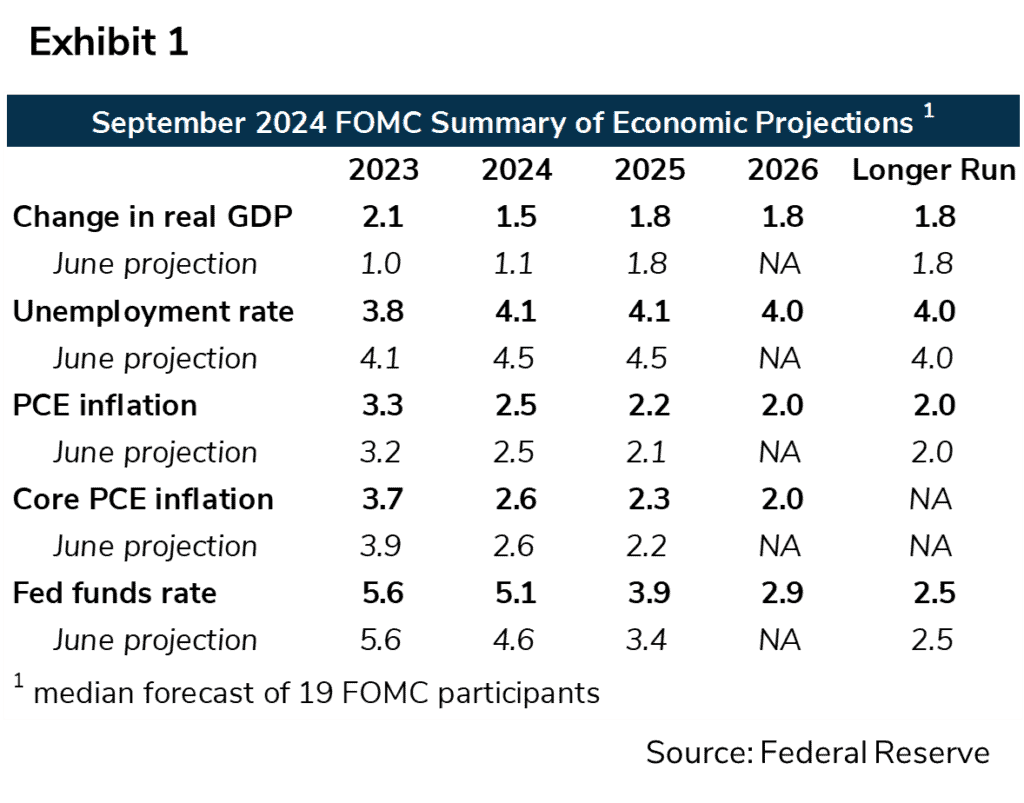
The ‘Immaculate Disinflation’ was perhaps the best characterization of the September FOMC meeting by one economist. More specifically, the updated Summary of Economic Projections (SEP) conveyed a more optimistic outlook where inflation returns near the Fed’s target without any corresponding economic pain. Exhibit 1 provides a summary of the median forecasts from the September release relative to the prior June SEP. While the inflation forecasts were little changed, the median outlooks for GDP growth and unemployment were improved. At the same time, the September projections for the path of the fed funds rate showed less rate cuts through 2025. In other words, the Fed believes it can hold the policy rate in restrictive territory for the next 2-3 years and still maintain trend growth in the economy and historically low unemployment. Some refer to this as the ‘Goldilocks’ scenario for the U.S. economy.

The economy has indeed defied expectations to this point in a cycle that has included 525 basis points (bps) of rate hikes and Fed balance sheet reduction. As noted in several past commentaries, a stimulus-fueled surge in household liquid assets is a likely source for much of the resilience, but can this trend continue over the next two years with no material economic pain? This is a primary source of debate within financial markets today.

There are valid arguments for continued economic prosperity amid still healthy fundamentals. However, others can rightfully point to multiple obstacles ahead. First and foremost is restrictive monetary policy, potentially for a longer timeframe. The risk of doing too much versus too little has emerged as a topic of discussion by multiple Fed leaders in recent weeks. Earlier in this tightening cycle, Fed leaders appeared unanimous in their fear of doing too little, pointing back to lessons learned from the 1970s inflation battle. More recently, some have expressed concern that doing too much is a greater risk now.

Beyond our borders, China is battling contagion in the country’s struggling real estate sector, which has amassed significant debt at both the corporate and local government level. The country has increased stimulus efforts of late, but a full-blown financial crisis and/or significant recession for the world’s second largest economy would clearly impact the rest of the world. For example, multinational corporations in the U.S. and Europe sell many products and services to China. Additionally, there are always geopolitical risks to the global economy, including an escalation of the current war in Ukraine. At the same time, increased political polarization across the globe could result in new geopolitical risks. Therefore, while the U.S. economy may indeed be able to achieve the soft landing forecasted in the September SEP, it will have to overcome various headwinds and obstacles to do so.

Avoiding Distractions

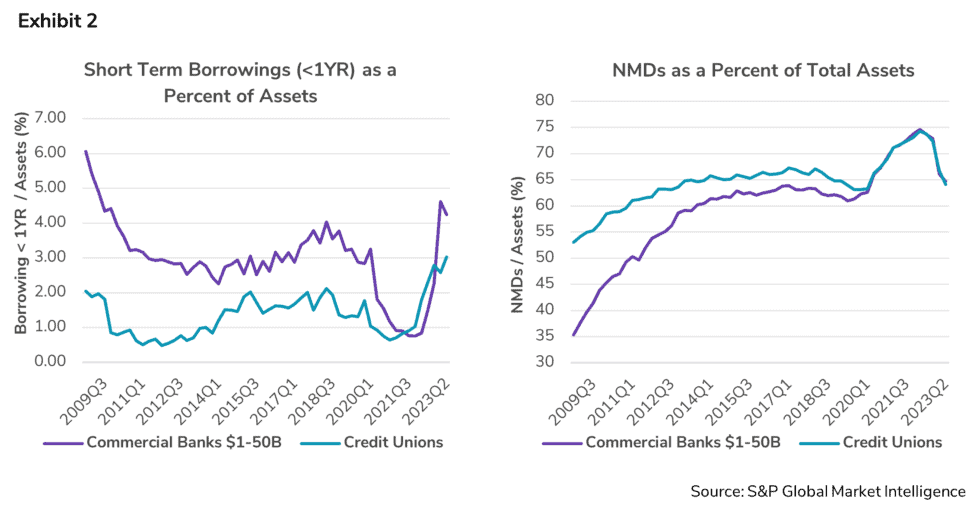
It has been a challenging year for financial institutions amid the most aggressive Fed tightening cycle in several decades and the longest yield curve inversion ever. This followed a pandemic and extraordinary stimulus (both monetary and fiscal) that fueled a wave of deposit inflows with interest rates at the zero bound. As liquidity has drained from the system, financial institutions have had to rely more on wholesale funding sources than they have in over a decade (see Exhibit 2). As a result, the share of non-maturity deposits (NMDs) has fallen sharply in recent quarters for both credit unions and community banks. The share of NMDs rose throughout the post-GFC era, most likely the result of Fed policies that flooded the markets with liquidity (QE) and kept interest rates at historically low levels for much of the period. This environment made it difficult for money market funds and CDs to compete.

We have recently heard arguments from practitioners for various scenarios in the coming years. Some argue that surging budget deficits in the developed world will lead to a debt super cycle that will keep interest rates high for many years to come. One could counter that position by noting that this is not a new trend, but one in the making for at least a decade if not more in places like Japan, Western Europe, and even the U.S. The demographic shift in the developed world and China for more than 20 years has been declining birth rates and aging populations. In other words, the number of savers has been rising relative to spenders, the stimulus boom of the pandemic notwithstanding. This is a disinflationary scenario.

All of this is to say that there are many potential outcomes, both near-term and long-term, that are very difficult, if not impossible, to predict. As such, we would encourage all financial institution managers to avoid the distraction of trying to position for any given rates scenario. There’s simply no reason to do so in a sound asset-liability management framework. If institutions do indeed have to rely more on non-core funding, profitability will be even more contingent upon prudent risk management practices, including asset pricing and capital allocation. Managers should also have all possible risk management tools available, particularly interest-rate derivatives. Doing so allows an institution to avoid being reliant upon making the ‘right’ call on rates or some other economic scenario.


To download this economic update portion of our Monthly Market Commentary, click here.

To continue reading the full month’s market commentary, and to learn more about current market themes, market sectors, sector performances, and applied strategies, log in to the ALM First portal, and select this month’s commentary in the Resource Center. If you do not have a login and you would still like to access the document, please send your inquiry to info@almfirst.com.

ALM First

ALM First was founded in 1995 with the focus on financial advisory services for credit union clients.

LinkedIn

  Commentary Disclaimer

ALM First Financial Advisors is an SEC registered investment advisor with a fiduciary duty that requires it to act in the best interests of clients and to place the interests of clients before its own; however, registration as an investment advisor does not imply any level of skill or training. ALM First Financial Advisors, LLC (“ALM First Financial Advisors”), an affiliate of ALM First Group, LLC (“ALM First”), is a separate entity and all investment decisions are made independently by the asset managers at ALM First Financial Advisors. Access to ALM First Financial Advisors is only available to clients pursuant to an Investment Advisory Agreement and acceptance of ALM First Financial Advisors\' Brochure. You are encouraged to read these documents carefully. All investments involve risk and may lose money.

The content in this article is provided for informational purposes and should not be relied upon as recommendations or financial planning advice. We encourage you to seek personalized advice from qualified professionals regarding all personal finance issues. While such information is believed to be reliable, no representation or warranty is made concerning the accuracy of any information presented. Statements herein that reflect projections or expectations of future financial or economic performance are forward-looking statements. Such “forward-looking” statements are based on various assumptions, which assumptions may not prove to be correct. Accordingly, there can be no assurance that such assumptions and statements will accurately predict future events or actual performance. No representation or warranty can be given that the estimates, opinions or assumptions made herein will prove to be accurate. Actual results for any period may or may not approximate such forward-looking statements. No representations or warranties whatsoever are made by ALM First Financial Advisors as to the future profitability of investments recommended by ALM First Financial Advisors.

Moreover, this report was prepared as of the date indicated herein. No representation or warranty is made by ALM First that any of the returns or financial metrics detailed herein will be achieved in the future, as past performance is not a reliable indicator of future results. Certain assumptions may have been made in preparing this material that have resulted in the returns and financial metrics detailed herein. Changes to the assumptions may have a material impact on any returns or financial metrics herein. Furthermore, ALM First gives no representation, warranty or undertaking, or accepts any liability, as to the accuracy or completeness of the information contained this report. This report was prepared for informational purposes only without regard to any particular user’s investment objectives, financial situation, or means, and ALM First is not soliciting any action based upon it. This material is not intended as, nor should it be construed in any way as accounting, tax, legal, or investment advice including within the meaning of Section 975 of the Dodd-Frank Wall Street Reform and Consumer Protection Act. Certain transactions give rise to substantial risk and are not suitable for all investors. The strategies discussed herein can have volatile performance and may employ leverage. Moreover, investment advisory fees and expenses may offset trading gains. This report was prepared by ALM First Financial Advisors, LLC. The hereto mentioned report contains information which is confidential and may also be privileged. It is for the exclusive use of the intended recipient(s). If you are not the intended recipient(s), please note that any distribution, copying, or use of this report or the information contained herein is strictly prohibited. If you have received this report in error, please notify the sender immediately and then destroy any copies of it. ALM First neither owes nor accepts any duty or responsibility to the unauthorized reader. ALM First shall not be liable in respect of any loss, damage, or expense of whatsoever nature which is caused by any use the unauthorized reader may choose to make of this report, or which is otherwise a result of gaining access to the report by the unauthorized reader. This content contains information derived from third-party sources. We believe that this third-party data is reliable; however, we cannot guarantee this data’s currency, accuracy, timeliness, completeness, or fitness for any particular purpose.

INDEX BENCHMARKS: Index performance is discussed for illustrative purposes only as a benchmark for each strategy’s performance and does not predict or depict performance of that strategy. While index comparisons may be useful to provide a benchmark for a strategy’s performance, it must be noted that investments are not limited to the investments comprising the indices. Each of the strategy benchmark indices are unmanaged and cannot be purchased directly by investors.

HYPOTHETICAL PERFORMANCE DISCLAIMERS: Performance figures derived from model portfolios are hypothetical in nature and the results of any individual investor will differ as a result of various factors, including investment limitations relative to model portfolio guidelines, availability of same or similar assets, and fee structures. Investments are presumed to have been made at the beginning of the time period and there are no inflows or outflows of cash during the period. There are limitations and risks associated with the use of model performance or hypothetical performance information, and you should be cautious when looking at any presentation of model or hypothetical performance information. Investment strategies should not be based solely on the use of model or hypothetical information. Actual results will be different from those shown in model or hypothetical performance. The model portfolio returns reflect actual trading including the reinvestment of coupon payments and are net of transaction costs, administrative costs and a strategy-specific per annum fee ranging from 5 bps to 50 bps, which is the amount of the highest fee charged to any ALM First Financial Advisors, LLC customer employing that particular strategy during the period under consideration (the “Model Fee”). Actual fees will vary depending on, among other things, the applicable fee schedule and portfolio size. ALM First\'s fees are available upon request and also may be found in its Form ADV Part 2A. Past performance does not guarantee future results.


Strategic Partners

Let’s Work Together

ALM First is your agile partner with a trusted history of delivering results.