The term “vibecession” has reemerged to describe the disconnect between consumer sentiment and various economic indicators
Affordability concerns remain the most likely catalyst for this dynamic
We review multiple drivers of the sharp selloff in government bond yields in recent weeks
The term “vibecession” emerged in 2022 to describe a disconnect between relatively strong economic indicators and the public’s perception of the economy. This characterization still appears to be appropriate in the current environment, as evidenced by the most recent consumer confidence reading from the Consumer Board. The index unexpectedly fell 7 points in September to the lowest reading since July 2021. The expectations component of the index has now registered below the Conference Board’s usual recession-level warning level of 80 for 21 of the last 22 months. At the same time, unemployment remains historically low, and as Fed Chair Kevin Warsh recently characterized it, “the labor markets are consistent with full employment.” Consumer spending has remained robust as well, with GDP personal consumption at 3.4% q/q (annualized) in Q2 and seems to be poised for a strong Q3 reading.
Broader economic readings also point to a relatively strong environment. Business investment broadened beyond the technology sector in the Q2 GDP report, and Q3 durable goods orders reports suggest a continuation of that trend. Moreover, the S&P Global US Composite Purchasing Managers Index (PMI), which tracks activity in both manufacturing and service industries, rose to 58.4 in September, the highest level since July 2021. Additionally, the PMI reading is historically consistent with 5% annualized GDP growth, according to S&P.
How do we explain this conundrum where consumer sentiment is so weak while the economy remains relatively strong? The simplest answer is affordability anxiety. While inflation rates have fallen from the 2022 peak, prices remain approximately 25% above where they were 5 years ago. In short, consumers have been unhappy about prices, not worried about their jobs, and people who keep their jobs keep spending. Is this uniform across all income brackets? Probably not. Would a notable selloff in stocks and, consequently, consumer net worth, lead to more constrained spending from higher income brackets? Perhaps. Regardless, the “vibecession” continues for now.
What’s Up with Yields?
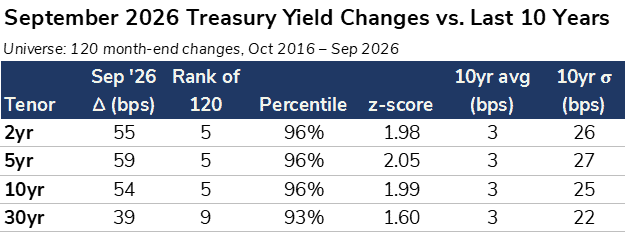
A predominant market theme in September was the sharp selloff in government bonds across the globe, and the U.S. was at the top of the list as it relates to the magnitude of yield increases. Exhibit 1 highlights the yield increases across the Treasury curve in September relative to the last 10 years. For the 2-year, 5-year, and 10-year notes, the yield increase was the 5th largest of the last 120 months, and only 3% of periods had a bigger move (all in 2022).
Exhibit 1
Source”: Bloomberg, ALM First
Bessent’s Buyback
Treasury yields for 5-year and shorter notes tend to be more significantly impacted by expectations for the path of Fed interest rate policy. The long end of the curve is also impacted by these expectations but to a lesser extent. If focusing on the weakness of long-end Treasuries, there are multiple forces to consider. First, inflation expectations matter, and worries related to elevated oil prices and fresh tariffs (Canada) remain prevalent. Broadening economic strength, as discussed above, can also add to this momentum. An example of this connection was on September 23 when the September PMI data was released, fueling a 17-bp increase in intermediate Treasury yields. Expectations of a strengthening economy can further fuel forward inflation expectations.
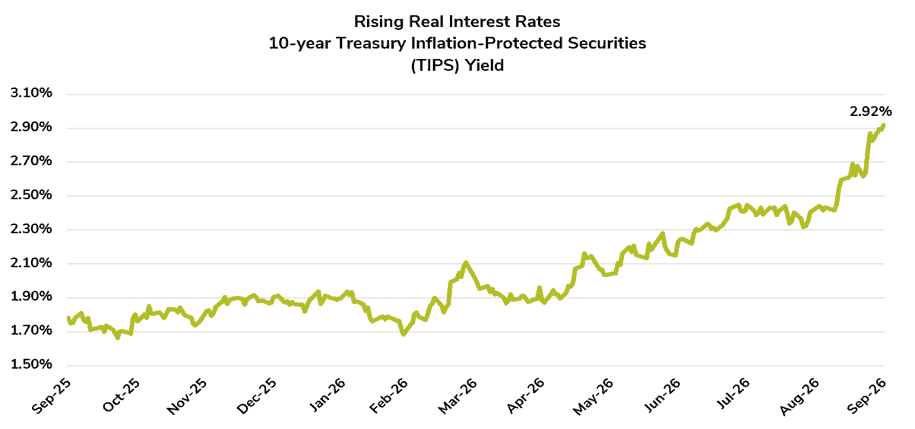
Lastly, there’s simply a great deal of bond issuance, both government and private, in broad markets that is competing for a finite amount of capital. This may explain the sharp increase in long-end real yields. As illustrated in Exhibit 2, the 10-year TIPS yield ended September at 2.92%, the highest since October 2008 during the Great Financial Crisis. In other words, the move is not solely about higher market inflation expectations. This increase in real interest rates coincides with elevated fiscal deficits for the U.S., major European economies, and Japan, which require greater government bond supply to fund. On the private side, hyperscaler technology companies are issuing a large amount of long-term corporate debt to fund AI infrastructure buildout. Furthermore, according to Treasury International Capital (TIC) data, foreign investor demand for corporate and other debt exceeded demand for Treasuries by 40% through the first half of 2026. If the trend holds through 2H 2026, it would be the first time since 2007 such a scenario has happened.
Exhibit 2
Source”: Bloomberg
To download the PDF of this econ only version, please click here.
To continue reading the full month’s market commentary, and to learn more about current market themes, market sectors, sector performances, and applied strategies, log in to the ALM First portal, and select this month’s commentary in the Resource Center.
If you do not have a login and you would still like to access the document, please send your inquiry to info@almfirst.com.