
Economic Update
- The July 31 FOMC minutes and Fed Chair Powell’s Jackson Hole speech set the table for a September rate cut
- The timing and pace of future rate cuts remains uncertain and will depend on the path of various economic metrics
- An economic ‘soft landing’ remains a possibility, even if a historically elusive outcome
In his annual address from Jackson Hole on August 23, Fed Chair Jerome Powell sealed the deal on a September 18 rate cut for all intents and purposes. “The time has come for policy to adjust,” said Powell. “The direction of travel is clear, and the timing and pace of rate cuts will depend on incoming data, the evolving outlook, and the balance of risks.” The bigger question marks going forward are related to the second quote from Powell. How gradual will the Fed’s path of cuts be, and at what level of the fed funds rate will they end the easing cycle? The bond market remains priced for a more aggressive pace in the coming months, with fed funds futures implying 100 basis points (bps) of rate cuts by year end. This would obviously require at least one 50 basis point move over the final 3 FOMC meetings of 2024. As for the terminal rate, forward short-term rates imply the cycle ending in late 2025/early 2026 in the 3%-3.25% range.
Powell’s comments were largely in line with the minutes of the July 31 FOMC meeting, which were released two days prior to his speech. In the minutes, the “vast majority” of participants felt it “would likely be appropriate to ease policy at the next meeting” if the data evolved as expected. The tone in official Fed communication in recent weeks, as well as public comments from Powell and other leaders, conveyed a perception of more balanced risks related to inflation and labor market health. With a rate cut appearing imminent, let’s assess recent data releases that might impact the Fed’s decision of how dovish a path to take.
Assessing Recent Data
For much of the last 2+ years, inflation reports have been the dominant focus for financial markets and the Fed alike. The labor market strengthened to a level not seen in many decades as measured by several metrics, including the unemployment rate, job openings, the quit rate, etc., while inflation readings reached levels not seen since the early 1980s. Near the end of 2023, markets became more confident that the Fed had gotten control of inflation, but better than expected consumption and overall growth in the first quarter raised fresh doubts that the inflation battle had indeed been won. However, as 2024 has progressed, financial markets have once again turned more negative on the economic outlook.
Much has been discussed in recent weeks/months of the Sahm rule, named for former Fed economist Claudia Sahm. The theory was contrived in early 2019 and suggests that if the 3-month moving average of the unemployment rate rises 50 bps above the lowest 3-month average of the preceding 12 months, a recession has begun. The July employment report showed the unemployment rate rising 20 bps to 4.3%, which triggered the 50 bps threshold of the Sahm rule. To be clear, Sahm herself dismissed the idea that the economy is currently in a recession, writing an op-ed for Bloomberg stating definitively her opinion that it is not despite her economic theory suggesting otherwise. As the old adage says, rules are made to be broken.
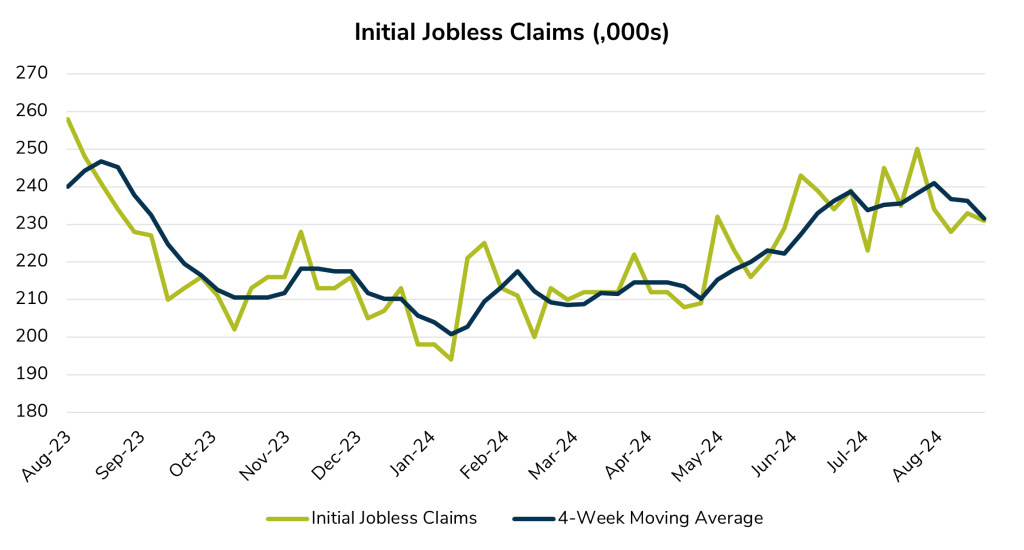
Regardless, financial markets and Fed officials alike have been more focused on employment data than inflation data in recent weeks. In addition to the rising unemployment rate, attention is being paid to the rise in weekly jobless claims. Exhibit 1 tracks initial jobless claims, including a 4-week moving average to smooth out what can be a choppier weekly data series. Jobless claims bottomed out around 200,000 to begin the year, not far off the all-time low of 187,000 reached in September 2022. Claims have steadily risen in 2024, reaching approximately 250,000 in July due to what appear to have been more seasonal/short-term factors. Claims have since settled back in the 230,000 area, still at a historically low level but clearly off the lows of the cycle. This is worth monitoring in the coming weeks/months.
Exhibit 1
Regardless, financial markets and Fed officials alike have been more focused on employment data than inflation data in recent weeks. In addition to the rising unemployment rate, attention is being paid to the rise in weekly jobless claims. Exhibit 1 tracks initial jobless claims, including a 4-week moving average to smooth out what can be a choppier weekly data series. Jobless claims bottomed out around 200,000 to begin the year, not far off the all-time low of 187,000 reached in September 2022. Claims have steadily risen in 2024, reaching approximately 250,000 in July due to what appear to have been more seasonal/short-term factors. Claims have since settled back in the 230,000 area, still at a historically low level but clearly off the lows of the cycle. This is worth monitoring in the coming weeks/months.
Soft Landing Still Possible
The idea of the Fed potentially executing a soft landing for the U.S. economy has been debated for many months now. Based on the totality of data received, a scenario where the Fed runs an aggressive tightening cycle and avoids a recession is still a distinct possibility. However, such an outcome is historically elusive, arguably only occurring once (1994) in modern monetary policy history. As the late MIT economist Rudy Dornbusch once said – “Economic expansions do not die of old age; they are murdered.” Dornbusch was known for his colorful characterizations, but at the same time, it is a reasonable observation.
When an economy slows, it becomes more susceptible to external shocks. While the U.S. economy remains on solid footing, it does appear to be poised to slow in the coming months. The labor market is off its tights, and it appears that consumers have exhausted excess savings from Covid and are now spending at a rate that outpaces income growth (i.e., not sustainable). When the bank failures occurred in Q2 2023, the economy was still growing at an above-trend rate. If GDP growth at the time were 1% or less, would we have been able to avoid a recession given that trigger? There are always risks of unforeseen external shocks, and how strong is an economy’s immune system to withstand them?
To download the PDF of this econ only version, please click here.
To continue reading the full month’s market commentary, and to learn more about current market themes, market sectors, sector performances, and applied strategies, log in to the ALM First portal, and select this month’s commentary in the Resource Center.
If you do not have a login and you would still like to access the document, please send your inquiry to info@almfirst.com.
