Originally published by CUInsight.
On March 13th, a national emergency was declared in response to the COVID-19 pandemic.
The economic impact of the pandemic has raised questions about capital adequacy in the ongoing coronavirus crisis. Economic shutdown and stay-at-home mandates forced many service sector businesses to close and trim their workforce. As a result, businesses suffered from liquidity and solvency constraints, leading to record high initial jobless claims, vastly surpassing the previous recession in 2008. In response, the Federal Reserve and U.S. Treasury launched unprecedented monetary and fiscal measures. Despite the stimulus and economy reopening, consumer behavior and spending are still very much impacted by the public health concern COVID continues to pose. This is expected to negatively impact earnings and GDP in the second half of 2020, which raises the question: Is my financial institution adequately capitalized to sustain the economic fallout? To provide some insight, we reference the latest stress test reports released by the Federal Reserve Board.
Dodd-Frank Act Stress Test Results
The financial crisis of 2007-2008 revealed major liquidity and solvency risks that may exist in the banking system. Consequently, the Federal Reserve Board has been releasing the annual Dodd-Frank Act Stress Test (DFAST), which includes a severely adverse scenario to understand the industry’s sensitivity to severe financial crises. This year, the Board included three additional scenarios particularly relevant to the COVID pandemic. The new scenarios included are a rapid v-shaped recession and recovery, a slower u-shaped recession and recovery, and a double-dip w-shaped recession. 33 of the largest financial institutions were tested over a nine-quarter scenario, spanning from the first quarter of 2020 to the first quarter of 2022. Moreover, the impact of fiscal policy and lending facilities of the Federal Reserve are excluded from the results. Exhibit 1 below, shows the three, primary variables in each scenario.
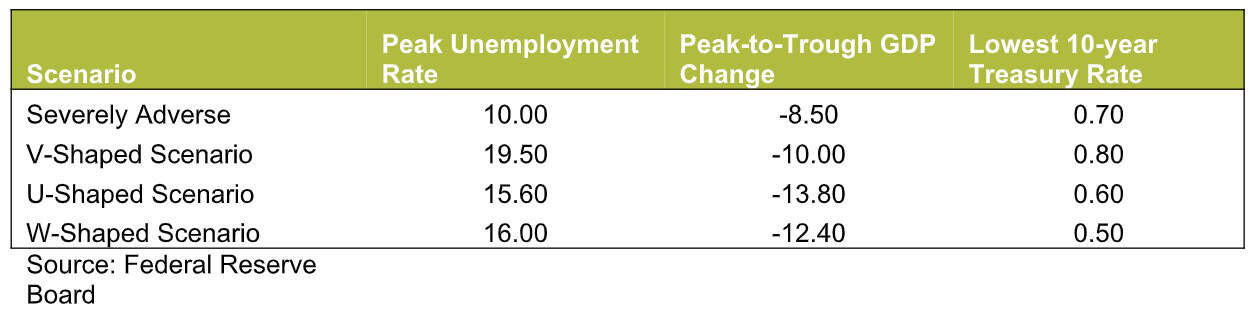
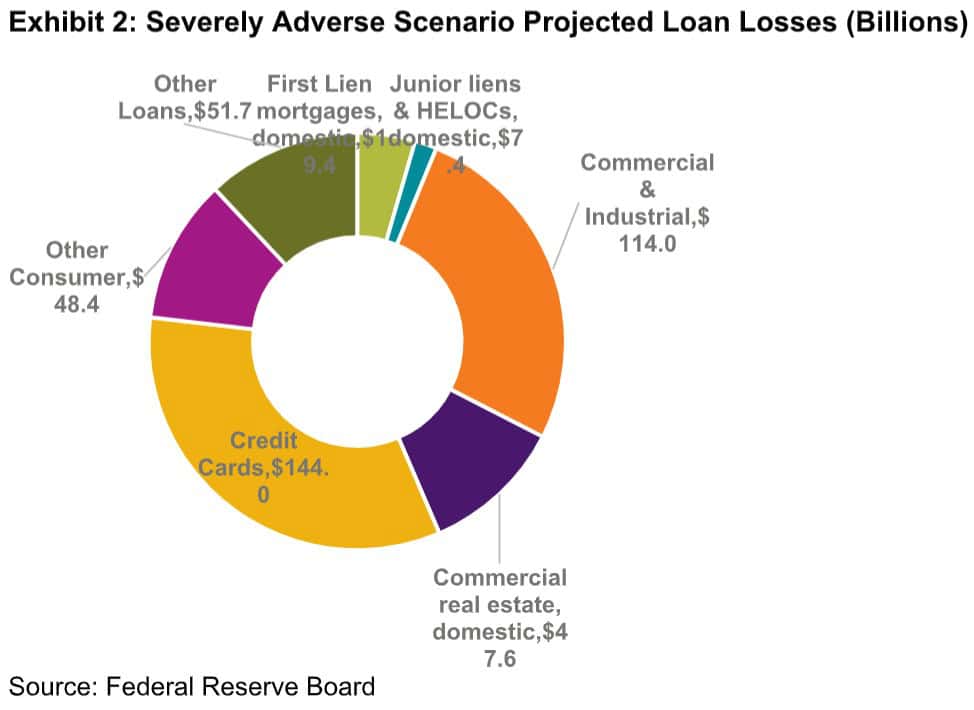
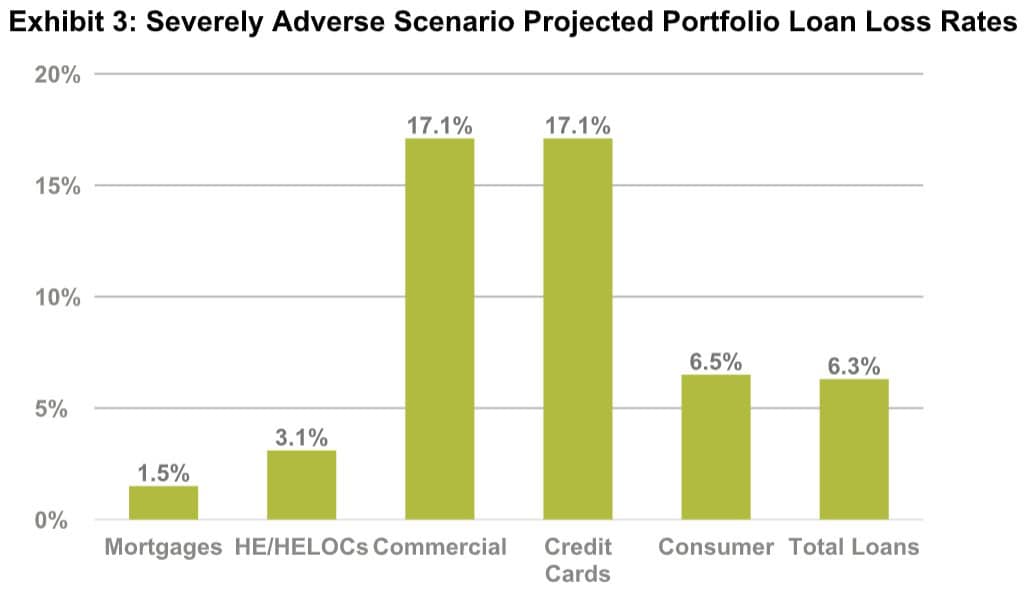
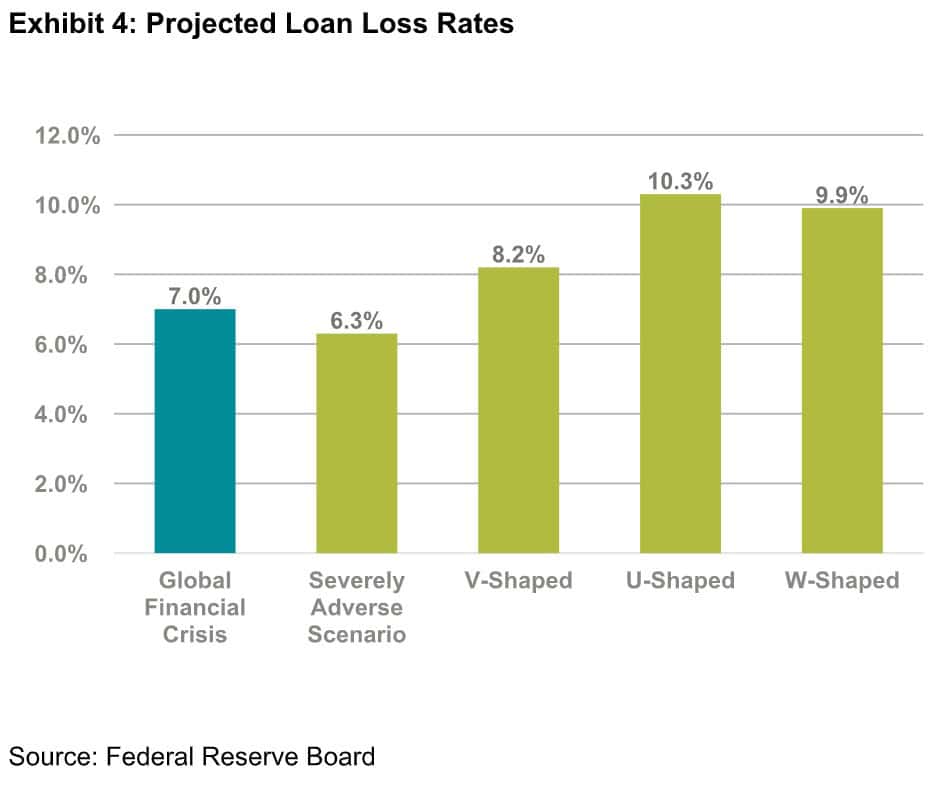
The Federal Reserve Board defines the severely adverse scenario as a “severe global recession accompanied by a period of heightened stress in commercial real estate and corporate debt markets.” In this scenario, aggregated projected loan losses are expected to be $433 billion. The steepest losses are credit cards ($144 billion or 33%) and commercial loans ($161.6 billion or 37%), particularly impacted due to higher unemployment and wider credit spreads. The cumulative loan loss rate for all 33 firms is 6.3% over the nine quarters. However, the loan loss rate varies across firms due to unique portfolio structure and risk characteristics. Exhibit 2 splits out the projected losses and Exhibit 3 shows the projected loan loss rate by loan type. Additionally, the loan loss rate progressively worsens in the three new scenarios. Exhibit 4 displays the projected loan loss rates under each scenario and compares them to the global financial crisis in 2008.