
Leverage ALM First Analytics for Non Maturity Deposit Analysis
In order to provide analytical insights into your intuition’s deposit book, ALM First Analytics utilizes a proprietary, industry-recognized method that evaluates non-maturity deposits via a rigorous econometric investigation of account behavior.
ALM First Analytics couples this model with qualitative overlays, supporting documentation, and sensitivity of key variables. Through our solution, understand how non-maturity deposit account balances and rates behave, both over time and with possible changes in market rates, to create defendable, institution-specific assumptions.
Non Maturity Deposit Analysis Services
ALM First Analytics has two levels of service to analyze non-maturity deposits:

Building Your NMD Model
ALM First Analytics utilizes your historic, institution-specific data to build a robust model:
- Historical NMD data
- Effective final maturity
- Decay rate
- Rate sensitivity factors (beta)
- Non-interest cost
- Anticipated future pricing strategy
Other Considerations
Sophisticated modeling software: leverage our extensive, multi-factor prepayment model based on reputable observed and projected data.
Unbiased Strategic Consulting: we focus on strategic positioning to improve institutional performance and profitability while minimizing risk.
It is preferable to capture an entire interest rate cycle in analyzing data in order to accurately predict dividend rate behavior in future scenarios. For practical purposes, ALM First requests a minimum of five years of monthly data. It is recommend the provided data be updated annually in order to refresh the analysis. If historical data are unavailable, ALM First can work with an institution to develop assumptions using the institution’s anticipated future pricing strategy and ALM First’s internal database of NMD data by FHLB region.
While it is preferable to capture an entire interest rate cycle when analyzing data, the rate environments of the last decade often have made it difficult to capture enough data in changing interest rate environments to develop statistically significant assumptions for all potential future scenarios. Additionally, historical behavior is not always a reliable indicator of future account behavior. There are many factors that are important determinants of value and that may not be predicted from history, including competition, the economy, and the institution’s flexibility in changing offering rates.
Regardless, ALM First is confident in our approach, and our modeling continually passes regulatory scrutiny. For additional testing, ALM First recommends stressing each NMD assumption annually as a “what-if” scenario to determine the potential impact on the institution. Example scenarios include decreasing the effective final maturities, applying multipliers to the rate sensitivity factors, and increasing the decay speeds.
In theory, an account with no maturity has no duration and no economic gain or loss. However, in practice, non-maturity deposits do have duration, as accounts remain with an institution over time, regardless of the prevailing interest rate environment. In economic value analyses, opinions vary as to what weighted average lives and discount rates are appropriate for non-maturity deposits.
One approach is to set the economic value of the accounts equal to par value in all interest rate scenarios. However, par values recognize no economic gain or loss in the value of non-maturity deposits. This means, for example, that the results of the model are unaffected whether a financial institution pays 0.00% or 5.00% on regular checking accounts. ALM First believes that gains or losses should be captured in the model to better assess the economic value of low-cost funds and loyal depositors. Industry theory generally holds that if a financial institution attracts funds at lower rates than its borrowing cost, it creates economic value in its balance sheet. ALM First recommends modeling NMDs at par only as a “what-if” scenario.
For the federally designed Net Economic Value Supervisory Test, standardized values are used for both the base case and shocked scenarios for NMDs. ALM First recommends running this valuation on top of the regular NMD valuation, and this can be completed with each ALM Report. ALM First encourages institutions to use institution-specific assumptions in order to capture values of funds not considered in standardized assumptions, such as depositor loyalty and the strength of the competitive landscape.
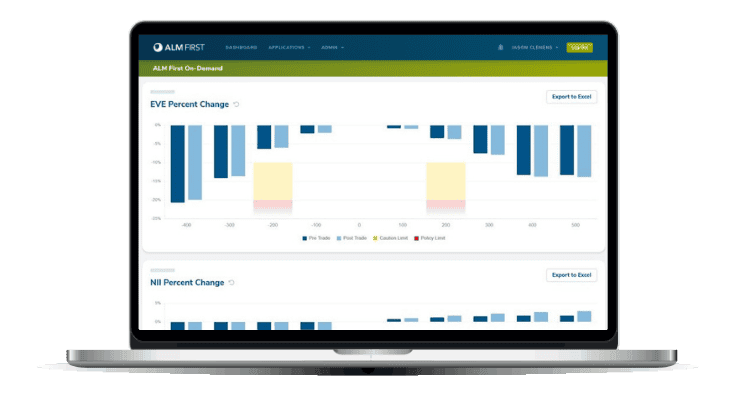
Analytics That Empower. Tools That Deliver.
Experience the power of smarter decision-making with our secure, web-based ecosystem. Designed for financial institutions, my.almfirst.com delivers rich data, advanced analytics, and intuitive dashboards—all in one place. Access on-demand tools to optimize strategies and drive stronger balance sheet performance.
