
Deploying quantitative rigor, ALM First will evaluate multiple scenarios as well as capture tail risk.
Through accurate stress testing and capital planning, your institution can ensure the integrity of its enterprise-wide process and risk appetite statements. Our experts will also assist you in placing a renewed emphasis on model calibration and sustainability. It is essential that your institution remains prepared by evaluating credit risk and idiosyncratic risks, while performing traditional and reverse stress tests, leveraging econometric modeling and PPNR forecasting and identifying unique vulnerabilities and remediation.
Capital Planning & Stress Testing is a Must
Stress testing offers key insights about your institution’s financial positions that exceed regulatory requirements, making stress tests a must for all depositories. ALM First Analytics’ comprehensive examination of the balance sheet allows you as a leader to critically evaluate your current position and potential for success within various scenarios.
Accurate, detailed stress testing analyses provide:
- Confidence that your institution has adequate capital to survive a market downturn
- Assurance of adequacy of allowance for loan and lease losses
- Identification of possible future problems, such as an over-concentration
- Improved decision-making as management sees the need to set risk-tolerance levels
- Enhanced capital and asset planning by verifying risk-reward assumptions
- Clarification of the institution’s position to the regulators
- A diagnosis of areas needing strategic and operational improvement
Credit Migration Analysis
- Advanced Risk Tracking: Monitor and forecast changes in credit quality across loan portfolios.
- Predictive Models: Utilize statistical and machine learning models to analyze credit transitions.
- Stress Testing: Evaluate adverse scenarios’ impact on credit quality to enhance decision-making.
- Custom Insights: Leverage institution-specific data and macroeconomic indicators for actionable recommend
Credit Scoring Models
- Model Development: Design robust credit scoring frameworks tailored to institutional lending needs.
- Validation & Compliance: Ensure regulatory alignment and reliable performance under diverse conditions.
- Enhanced Decision Support: Enable optimized credit approvals, risk-based pricing, and portfolio management.
The Value of ALM First Analytics
Establishing and executing a capital stress testing process requires time and modeling capacity. You can benefit by partnering with ALM First Analytics – we are experienced in developing an organized approach that helps keep the program moving smoothly.

ALM First Analytics will:
Run required scenarios: Scenario simulations are critical. As part of stress testing, the Federal Reserve issues scenarios that incorporate a baseline status, as well as those that assume adverse and severely adverse economic environments.
Implement assumptions about loss and recovery: A cornerstone of capital stress testing is determining the assumption of principal losses and severities. To ensure assumptions are appropriately designed for the balance sheet, delinquency, and charge-off information should be captured across all collateral types. By understanding the depository’s performance in a typical environment, it will be easier to predict results under adverse market conditions.
Execute analyses: Conducting regression analyses both on performance and on changes in macroeconomic variables will help an institution understand its sensitivity to economic factors. To be most helpful, these analyses should incorporate unique scenarios unrelated to current market performance, as they wouldn’t be included in the model projections.
Prepare reports: To aid in strategic planning and auditing, testing, and capital planning, ALM First Analytics’ methods are transparent and well-documented for easy auditing. These include highlighting key variables, assumptions, and the institution’s sensitivity to particular changes. For maximum effectiveness, these credit-monitoring reports should be available during planning sessions, liquidity discussions, and profitability analyses.
ALM First will employ and customize the supervisory scenarios suggested by the Federal Reserve in a baseline, adverse, and severely adverse scenario.
Baseline Scenario – follows a contour very similar to the average projections from surveys of economic forecasters.
Idiosyncratic risk scenarios – are utilized to evaluate specific risks that are driven by an investment’s unique characteristics rather than overall market trends.
Severely Adverse Scenario – is the most severe of the scenarios and is characterized by a substantial weakening in economic activity across all of the economies included in the scenario. In addition, a significant further weakening in the U.S. housing market occurs. This scenario is designed to reflect the economic and financial conditions typical of a severe post-World War II U.S. recession.
Reverse stress testing – Stress testing can be applied in “reverse”, as well, whereby a specific adverse outcome is assumed that is sufficient to breach your institutions capital ratios and is commonly referred to as “break the bank” scenario. The key objective of the reverse stress testing is to overcome disaster myopia and the possibility that a false sense of security might arise from regular stress testing in which institutions identify manageable impacts.
Capital stress testing for larger institutions comes out of the “Dodd-Frank Wall Street Reform and Consumer Protection Act,” which resulted in the Dodd-Frank Act Stress Testing (DFAST) regulation. The NCUA requires federally insured credit unions with $10 billion or more in assets to submit capital plans and perform capital stress tests. In concert with Dodd Frank, the Federal Reserve Board created the Comprehensive Capital Analysis and Review (CCAR) rule, which applies to bank-holding companies with assets of $50 billion or more in assets.
Market Trend Analysis: Develop models for economic drivers and institutional performance metrics.
Scenario Forecasting: Projects future financial conditions using advanced econometric techniques.
Regulatory Support: Align modeling practices with regulatory requirements for compliance assurance.
Risk Sensitivity Analysis: Identifies potential impacts of macroeconomic changes, like interest rate shifts and reverse-stress testing.
Idiosyncratic Risk Scenario Development: Data-driven analysis and documentation for mitigation strategies and regulatory compliance.
Revenue and Expense Forecasting: Develop models to project pre-provision net revenue (PPNR) under various scenarios.
Scenario Analysis: Evaluate the financial impact of different economic and business conditions.
Comprehensive Model Design: Incorporate key drivers such as interest income, non-interest income, and operational expenses.
Regulatory Stress Testing Support: Align PPNR models with regulatory stress testing requirements (e.g., CCAR/DFAST/NCUA).
Strategic Insights: Deliver actionable recommendations to optimize profitability and manage risk effectively.
Risk Visualization and Benchmarking: Utilize loss exposure heatmaps and performance benchmarking to assess portfolio risks, identify trends, and compare performance against industry standards.
Advanced Analytics and Alpha Discovery: Leverage powerful tools to explore portfolio performance, uncover institution-specific or portfolio-specific alpha, and optimize decision-making.
Rates Platform: ALM First has been curating leading intelligence on lending and deposit rates through structured and unstructured data so that we can provide comprehensive market and competitive data across regulated financial depositories, neobanks, and specialty lenders.
Capital represents the portion of a financial institution’s balance sheet that is not legally required to be repaid to anyone. It is a foundation of the balance sheet and must be able to withstand major economic movements. These stress tests evaluate capital strength.
- Capital belongs to the stakeholders: shareholders and members
- Capital is first in line for losses and first in line for profits
- Capital is a type of funding that an institution uses to finance the purchases of assets and the making of loans
- Capital designates the percentage of assets that a financial institution can stand to lose without becoming insolvent
- Strong capital promotes public confidence, both in the institution and in the financial system as a whole
Like with many questions, the answer is “It depends.” The institution needs sufficient capital to protect itself from negative events, to prove its health and long-term viability, and to meet regulatory, rating, and investor-determined requirements.
However, excess capital is a bad idea. It is expensive; it carries more risk for investors than debt securities or deposits; a financial institution holding excess capital must earn higher profits, all else equal, to generate the same return on equity for capital providers; and the government’s deposit guarantee makes excess capital less valuable and transfers risk from the government to the investor.
The best way to determine a proper capital holding requires a solid understanding of your current position, smart planning, and strong analytics.
Model and Process Validations
ALM First has continued to see growth in the validation service offerings and continues to be a reliable partner for financial institutions to determine the functional ability of their internal or external interest rate risk and liquidity models. Recently there has been more interest in CECL validations to determine the appropriate marks for ACL, and the validation team has been working toward enhancing the CECL validation report and methodology. Learn more about CECL Pro.
Valuation Services
ALM First performs valuation services for any financial institution or company looking to have a fair market analysis of any business. This ranges from fair market analysis used to determine goodwill in the M&A process to providing executives with fair market valuations and business insights for whole businesses or business units for any sector, with a historical emphasis on financial institutions and technology firms.
ALM Reporting
The myalm portal, ALM reporting for ALM IRR clients will significantly enhance the client experience, as well as improve the reporting capabilities of ALM First to help serve their clients. As well as reporting for IRR, myalm will allow ALM First clients to access all their ALM products in one location including Interest Rate Risk (IRR) reporting and benchmarking metrics. ALM First endeavors to be a trusted infomediary of balance sheet analytics through synthesizing financial information available in disparate public domain sources and facilitate the flow of relevant data and actionable insights to its clients in an accessible format. In the near future, this will feature push-only APIs and a large language model to interact with the data beyond reports and dashboards. Due to various data privacy regulations and compliance protocols, ALM First is currently fortifying its infrastructure in order to deliver in a controlled environment. Moreover, ALM First is enhancing its mobile viewing and additional browser support for the portal.
Static Pool Analysis
This product is still in development, and at the conclusion of the development process the static pool product line will allow ALM First clients to have a greater understanding of the balance sheet and how assets and liabilities perform over time. It will allow for executives measure and track prepayments, credit loss, curtailment, etc. across the loan book by varying loan features such as collateral, interest rate, zip code, DTI, LTV, etc., and it also allow for the same across deposit accounts. The goal of the product is to allow institutions to monitor, track, and forecast balance sheet changes as there are changes to the membership, economic environment, or geography changes.
Branch and Deposit Product Performance Measurement
This product is still in development, and upon completion we will allocate all direct, indirect, and overhead expenses to branch centers and products, providing a detailed understanding of the costs associated with servicing deposits and assessing profitability at various levels including branches, products, and customer/member segments, facilitating informed decision-making to enhance financial performance.
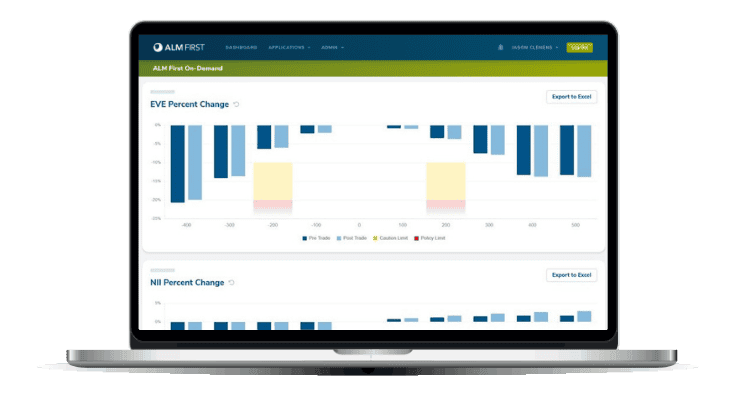
Analytics That Empower. Tools That Deliver.
Experience the power of smarter decision-making with our secure, web-based ecosystem. Designed for financial institutions, my.almfirst.com delivers rich data, advanced analytics, and intuitive dashboards—all in one place. Access on-demand tools to optimize strategies and drive stronger balance sheet performance.
