
Series: Ask ALM
Retaining the mortgage servicing rights (MSR) when mortgages are sold can potentially bring substantial returns on capital for institutions that have competitive advantages in servicing mortgages.
However, since MSR assets typically have inherent price volatility, it may be important to evaluate hedging opportunities carefully.
MSR assets are essentially interest-only (IO) strips on mortgage bonds. Owners of these assets receive the interest portion of the payments of the underlying bond for a period of years. Likewise, MSR assets grant the owner a stream of servicing fees over the life of the associated mortgages, so the longer the life, the better. If interest rates fall, however, more borrowers will likely decide to prepay their mortgages. This may cause the IO’s price to decline because the income stream will be shortened with no offsetting principal effect. As with most mortgage bonds, MSRs tend to exhibit negative convexity, e.g., as interest rates decline, asset values decline at an increasing rate.
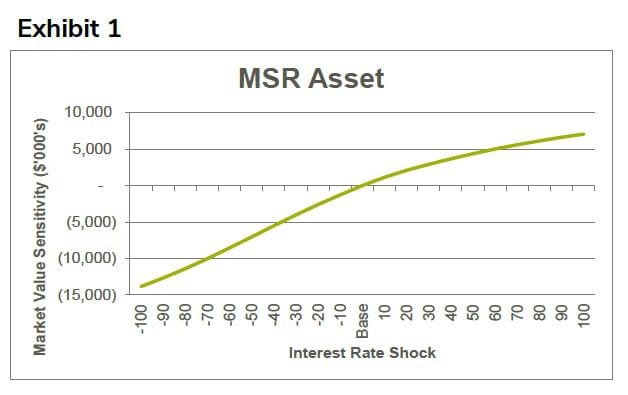
Exhibit 1 illustrates the price volatility of a MSR portfolio. In this example, the base market value is $26 million. Looking at the simulated price movements, we see that a down 100 basis points (bps) interest-rate shift means the asset loses nearly $15 million, or more than half its value. The up 100 bps rate shift reveals a much less significant increase in value, approximately $7 million, illustrating the negative convexity.
There are two approaches that institutions commonly follow to hedge the market sensitivity of MSR asset portfolios: static or dynamic.
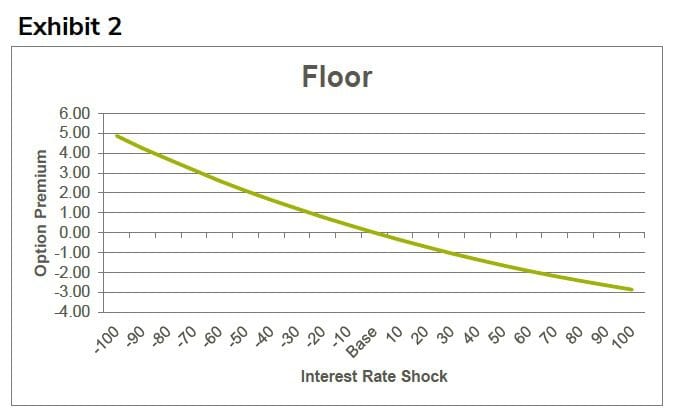
With a static approach, firms typically use option contracts and hold them until expiration. For MSR assets specifically, typical hedging instruments are call options on Treasury note futures or interest-rate floors. As interest rates decline, both these options increase in value at an increasing rate, so the declining value of the MSR asset is offset, see Exhibit 2.
Alternately, a dynamic hedging approach usually involves rebalancing a combination of Treasury note futures and mortgage-backed securities, prompted either by an updated sensitivity profile, or a predetermined change in interest rates. Rebalances are typically done when interest rates move outside a predetermined corridor; 20 bps or 25 bps moves are common.
During periods of low realized volatility, dynamic strategies potentially outperform static ones, because the frequency of rebalancing may decrease, and the associated costs wouldn’t be incurred. Plus, firms that bought options with the static approach paid for convexity protection that was unnecessary.
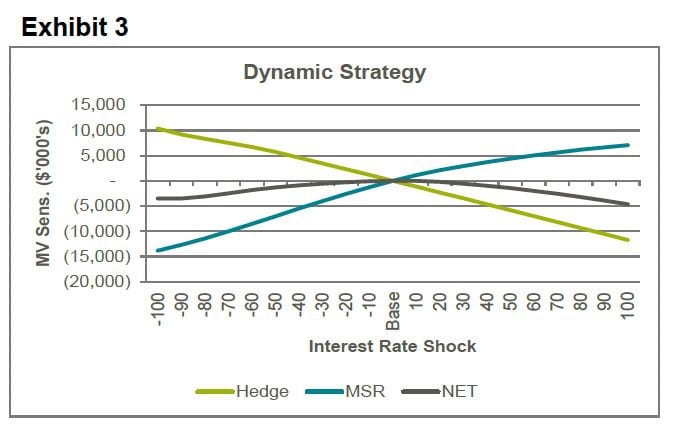
Exhibit 3 illustrates an example of dynamically hedging an MSR asset. The net line shows a decrease in the volatility of the MSR asset, as the line is much flatter than that of the asset.
The rapid fall in Treasury rates and corresponding decline in mortgage rates since March has sparked a boom in refinancing activity. This environment has put downward pressure on MSR valuations as increased prepayments have shortened their lives. However, there is a silver lining. More refinancing means more mortgage production and active originators are able to offset declining valuations with new dollars in the servicing portfolio.
Of course, these new servicing strips are coming on at current rates which creates an interesting dynamic in which the portfolio is clearly bifurcated between new loans with lower rates and more seasoned, higher coupon loans. Exhibit 4 shows the value difference between the two.
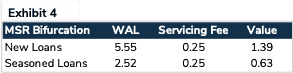
As the table illustrates, these new loans are adding value to servicing portfolios given their expected lives helping to organically mitigate the decline in value associated with the older, higher coupon loans. So those originators who have stayed active in the current market and added to their servicing portfolios are doing better than those who have essentially sat on the sidelines. The biggest winners were institutions who not only added to their books, but hedged the risk as well. Exhibit 5 is a stylized example illustrating three different originators.
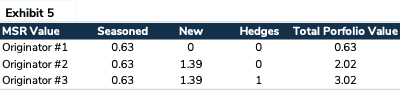
Since hedgers are long bonds, they get to cut the coupon on their hedges and are essentially getting paid to hedge. Additionally, given the low levels of volatility, they are not spending much in rebalancing costs.
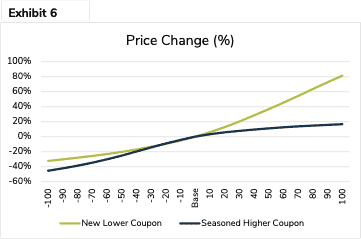
Going forward, this bifurcation in the pipeline may present new challenges in terms of hedging since performance of the two segments could be quite different, see exhibit 6. One possible solution, and one that ALM First may recommend, would be to hedge these segments with two different TBA positions. The newer loans would be hedged with a production coupon like 30-year 2.5s, while the older portion would be hedged with a higher coupon such as 30-year 3.0.
Hedging strategies require frequent monitoring, as well as maintenance of sophisticated trading models, making them very complex to administer. They also require a significant investment of operational resources. This may be why some firms choose not to engage in hedging activities. However, in the long run, hedging MSR assets can be profitable. When used effectively, it can deliver substantially higher risk-adjusted returns on capital and give an institution a significant competitive advantage within the mortgage banking marketplace.
Learn more about the benefits of ALM First’s MSR Hedging Service or contact us today to discuss your institution’s specific needs.
