
In Part 2 of our series, we moved beyond strategy and into structure—exploring six useful practices for anyone charged with post-merger integration.
From crafting detailed timelines to organizing a launch event that sets the tone for the first 100 days, we offered the essential design elements that shape a resilient and responsive integration program.
This third and final blog in our series includes more pragmatic advice and recommendations, including the tools we use daily. Benjamin Franklin makes the case that “The best investment is in the tools of one’s own trade.”
Let’s explore tool options that can assist with integration on your next transaction.
Collaboration Tools
Can you remember the days of uploading spreadsheets to file servers, when only one person was able to access a file at a time? Those days are long gone, and we’re better for it. Today, all institutions involved in sizeable mergers will have enterprise productivity platforms.
One of the earliest wins for integration management leaders is the selection of appropriately useful and cost-effective software to help enable your team to function seamlessly. It is common to have merging organizations with disparate tech stacks. It is your role to sift through and identify the options that complement your integration operating model.
Here is a breakdown of the four recommended categories needed at a minimum for integration management operations:
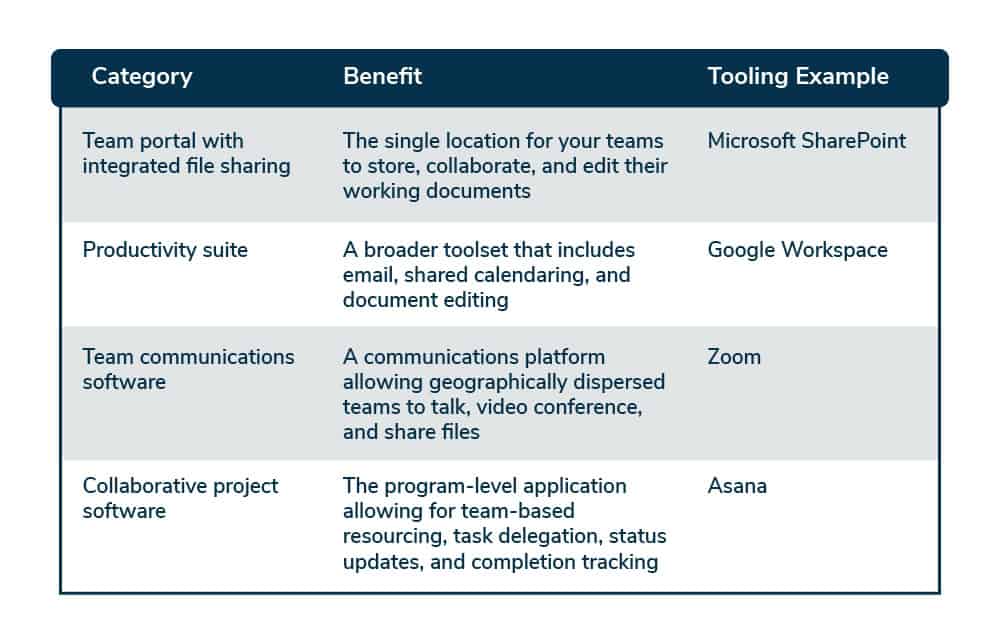
We recommend that tool selection be made as early as possible to give your IT teams plenty of time to analyze, prototype, purchase, test, and configure. Blending technology can become complicated, especially with divergent vendors. When possible, start asking about collaboration tools as soon as due diligence is completed. And make friends with the CIOs or IT directors so your requests will not be delayed.
The best-case scenario is to have a fully functioning integration management tool base ready to go on Day 1. Announcing the full tool stack during the launch event will inspire confidence and make it clear that the merger integration phase is getting off to a successful start.
Artifact Repository
An artifact repository is a centralized, structured hub that houses the essential tools, templates, and documentation used throughout post-acquisition integration process. It serves as the single source of truth for integration teams, enabling consistency, transparency, and speed across workstreams. By having your critical resources in one accessible location, the repository supports alignment across stakeholders, accelerates onboarding, and reduces duplication of effort, all of which are vital in the fast-paced environment of post-merger execution.
Below is a sample artifact repository structure. In Figure 1, the top-level project folder can house frequently accessed and public information that most merger integration participants will refer to for progress. Figure 2 demonstrates how this structure can be replicated for as many workstreams as needed. While there can be cultural hurdles to getting both organizations to operate within a single structure, this is a low-hanging change management technique that can start building a common operating culture. The sooner workstream collaboration is achieved, the sooner a newly unified organization starts to develop.
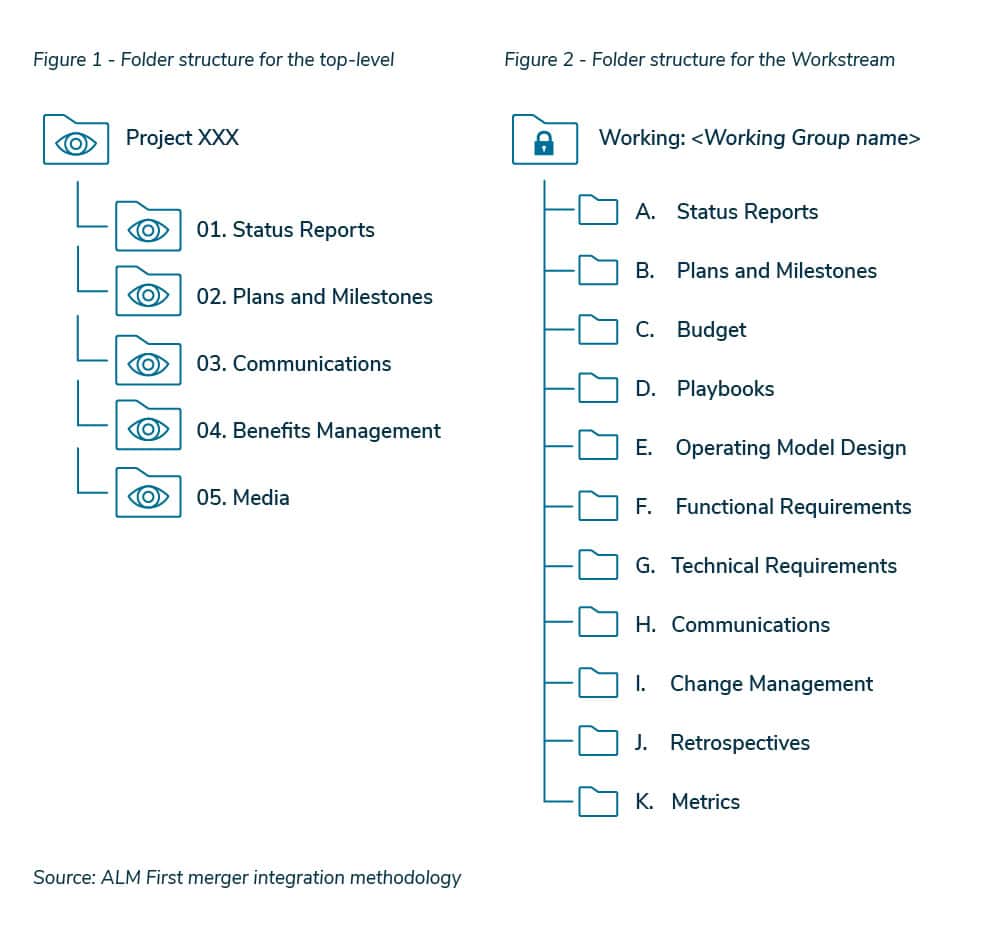
The repository typically includes a suite of foundational artifacts that guide and govern the integration process. These foundational artifacts include:
- M&A Integration Playbook – A step-by-step guide for managing the overall M&A lifecycle within the business from strategy and targeting to integration planning and execution to value creation.
- Workstream Charters – A document each functional workstream develops to define scope, objectives, and ownership for their respective team.
- Milestone Tracker – A tool used to monitor progress and flag risks.
- Integration Project Plan – A system used to track progress of cross-functional tasks and interdependencies, owner(s), and due dates.
- Synergy Capture Model – A tool to capture and quantify expected value and track realization.
- Communication Plan – An orderly system to help coordinate cross-functional stakeholder messaging and cadence.
- Organizational Design Maps – A visual representation of structural changes and reporting lines to support workforce alignment.
- Value Driver Dashboard – A platform to highlight the key levers of deal value and monitor performance against integration targets.
- RAID (Risks, Assumptions, Issues, & Decisions Made) Log – A systematic approach for tracking and managing:
- Risks: note any risks from both a criticality and probability perspective, along with any mitigation activities. See sample below.
- Assumptions: document any assumptions made during an integration program.
- Issues: track and manage issues and the actions being taken to address them. (see sample below)
- Decisions Made: document key choices and approvals to help ensure accountability.
Together, these artifacts provide the operational backbone, enabling teams to stay focused, informed, and aligned.
RAID (Risks, Assumptions, Issues, & Decisions Made) Log
As introduced above, a RAID log is used to systematically record and continually manage highly impactful discussions and decisions that affect the merger integration journey. It provides a structured way to track what is happening, what could happen, the likelihood of events and their impact. Of course, effective management requires cataloguing any mitigation strategies and action plans.
Capturing and managing the log should be done through a tool befitting the complexity of your merger integration program. Certainly, there are plenty of enterprise risk management (ERM) tools out there with plenty of deep features. ALM First and Forvis Mazars have ERM teams who can help with vendor selection if you do not already have a corporate tool. In some cases, your compliance team may direct you to use their existing tool. However, when you have flexibility or just need a simpler tool, the sample below is a good starting point to track risk and issues. For further samples of a RAID log, please contact us.
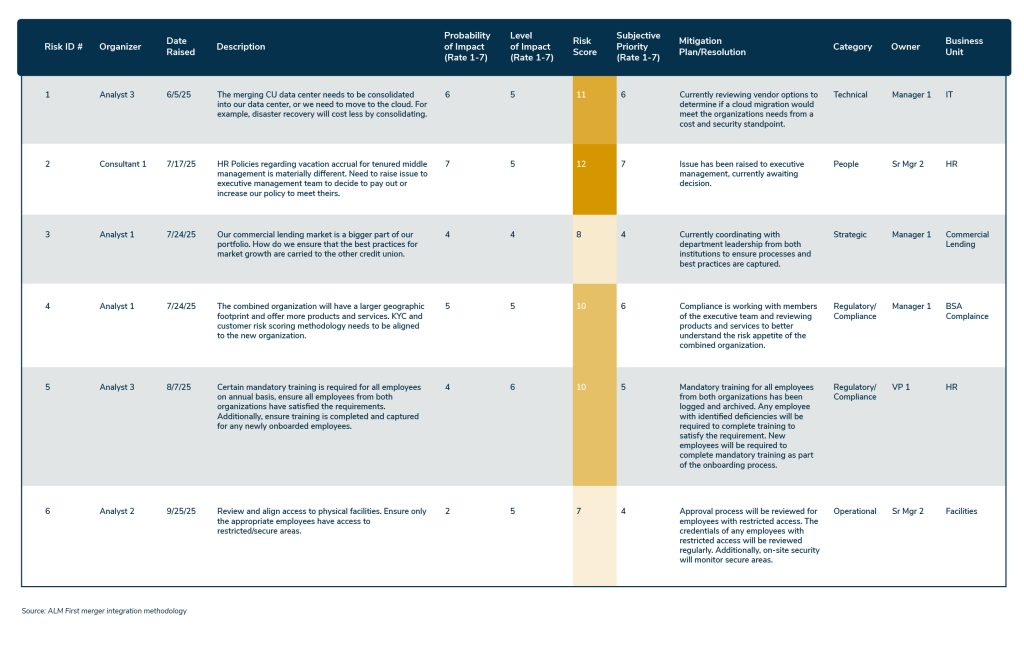
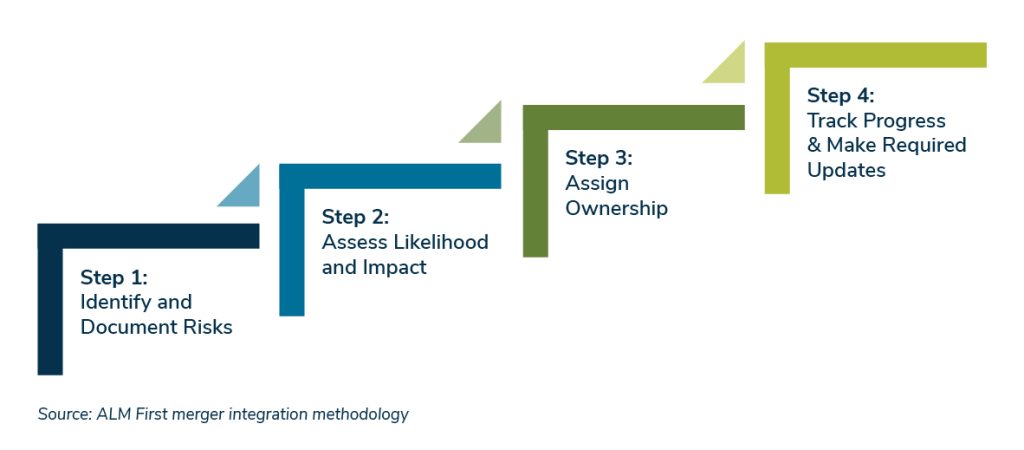
Regardless of whether you use an enterprise software solution or a basic Excel file, consistency in managing your risk and issue tracker is incredibly important. We recommend following the simple, yet impactful, four steps below. This repeatable scalability delivers two major benefits. First, it reduces errors and miscommunication by standardizing how risks and issues are tracked and resolved. Second, it can improve efficiency, helping enable faster decision making and smoother collaboration.
As we’ve explored throughout this series, the journey from merger agreement to successful integration is far more than a transactional process—it’s a strategic transformation. The early stages of preparation set the tone, but the deliberate planning and thoughtful design of the integration journey ultimately determine whether the merger delivers on its promise. By aligning planning > process > tools, organizations can move forward with confidence and clarity.
Remember, even the best-laid plans require agility. Integration is not a one-size-fits-all endeavor. It’s a dynamic process that must adapt to cultural nuances, stakeholder expectations, and evolving market conditions. Through this series, we’ve provided high-level fundamentals that can be adjusted to suit your immediate transaction.
We invite you to connect with us via LinkedIn to ask questions. We are building a community of merger integration practitioners to collaborate and enhance value on our integration journeys.
Learn more about Forvis Mazars’ Post-merger integration team at https://www.forvismazars.com/group/en/services/financial-advisory/deals/post-merger-integration
Want to discuss your credit union’s post-merger integration in more detail? Contact ALM First’s team of experts to learn more.
