Site Search

Looking for something? Use the search bar below or visit our Resources page.


Author ALM First

Published

Estimated


Economic Update

  • The first quarter was historically bad for fixed income, and April did nothing to break the bearish trend
  • Recent economic data support the narrative of an overheated labor market and inflation risks
  • There are plenty of potential obstacles for future economic growth, including global catalysts (Russia/Ukraine and China slowdown) and tighter monetary policy in the U.S. and abroad

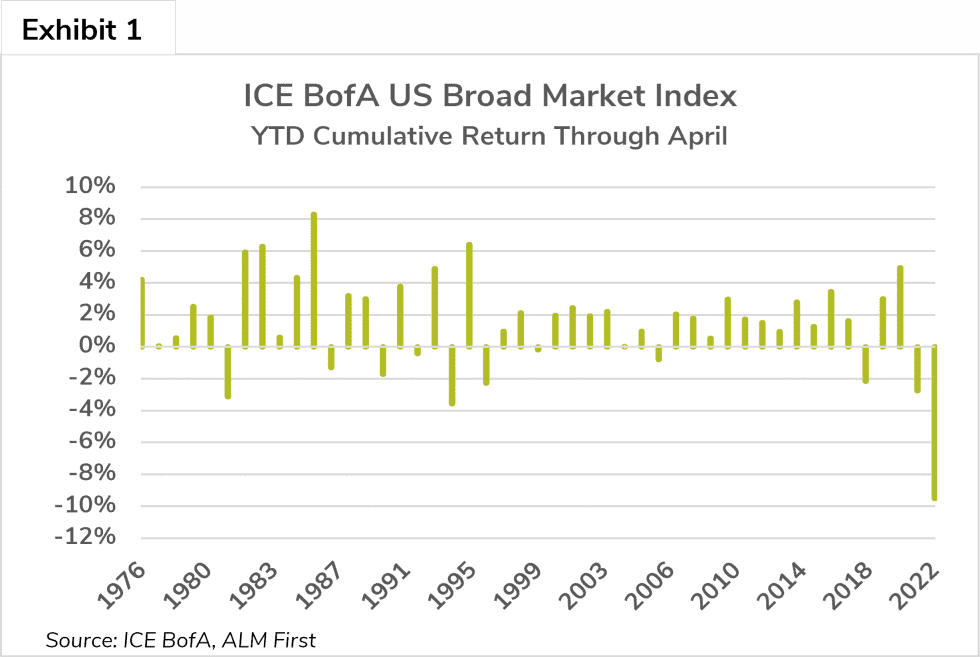
Last month, we highlighted the fact that the first quarter was the worst for broad fixed income in 42 years. April was not the start of a rebound. The ICE BofA US Broad Market Index slid another 3.67%, bringing the YTD return to -9.50%. Since the index began in January 1976, the second worst start of a calendar year through April was 1994 at -3.57%, nearly 6 points better than the current year (see Exhibit 1). Uncertainty related to the path of inflation and the consequential Fed response continues to be the most significant driver of volatility in the bond market, and the fed funds futures market is now priced for four 50 basis point rate hikes at the next four FOMC meetings. This would get the funds rate back to the Fed’s current neutral policy rate by September, and any hikes after that would take policy into restrictive territory. To be clear, the actual neutral policy rate is never known with certainty in real time, and if you polled a group of economists on what the neutral rate is, you would likely see a wide range of opinions. Nevertheless, this aggressive steepening of the forward path of short-term rates has had its impact on the full-term structure of interest rates, and fixed income spreads resumed the 2022 widening trend in April after a brief pause in the second half of March.

Recent economic data releases did little to change the narrative of an overheated labor market fueling high inflation rates. There was some attention paid to a surprise contraction of the U.S. economy in Q1 according to the first estimate of GDP. Headline growth contacted by 1.4% q/q (annualize) versus expectations of a 1% gain, but the miss was largely attributable to a drag from trade and inventories. The former included a significant increase in imports relative to exports, representing ongoing strength in consumer demand, but inflation played a big role as well, with the GDP price index rising by 8% q/q (annualized), the highest since 1981. Consumption by businesses and consumers was decent in Q1, with private domestic demand up 3.7% (highest since Q2 2021), but consumer spending did come in below expectations at 2.7%.

Wage inflation was another big area of focus at the end of the month. The Employment Cost Index (ECI) surged 1.4% q/q in the first quarter (see Exhibit 2), 20 bps more than the previous record in 2003 (inception Q4 1996). ECI is a preferred measure of wage inflation by the Fed because it also includes bonuses and other in-kind benefits, and it undoubtedly caught the attention of Fed leaders already worried about the inflationary implications of an overheated labor market.

Globally, there are multiple areas of concern that could ultimately impact U.S. growth. Risk of escalation in the Russia/Ukraine war remains at the forefront, and the European economy faces higher recession risk in the next 12 months as it deals with surging energy costs and expectations for tighter monetary policy to combat inflation. China has made headlines in recent weeks related to the draconian lockdowns in major population centers like Shanghai as part of its “zero Covid” approach, which threatens to impact both global growth and inflation.

Perhaps the biggest question mark for the U.S. economy is how consumer demand will be able to weather current inflation pressures and higher interest rates. Household balance sheets began the current inflation cycle in relatively strong financial condition as measured by household liquid assets and wealth. Pre-Covid, household liquid assets (checking, savings, and money market accounts) grew by approximately $500 billion per year over the prior decade according to Federal Reserve data. These assets rose by $2.7 trillion in 2020 and $2.2 trillion in 2021, including a $700 billion increase in Q4 2021. This growth in consumer buying power was boosted by unprecedented fiscal and monetary stimulus and has allowed companies to more easily pass along cost increases to end users. However, according to a recent Wall Street Journal article, some corporate executives are suggesting that “inflation fatigue” may be starting to take effect. Some companies selling consumer staples suggest shoppers are not turning more to discount brands, and others selling bigger-ticket home goods, such as mattresses and other home items, have warned recently of falling demand.

Another question mark is the ultra-hot housing market, where we have seen national home price averages soar. With mortgage rates up more than 200 basis points this year, affordability has become an even greater issue for homebuyers. All this said, Fed Chair Pro Tempore Powell and his colleagues have made clearer recently that getting inflation under control is a higher priority than achieving a soft landing, as it should be for any central bank. In other words, it will likely take clear signs of inflation risks subsiding before providing less hawkish guidance, even if recession signals are rising.


To continue reading this month’s market commentary, and to learn more about current market themes, market sectors, sector performances, and applied strategies, log in to the ALM First portal, and select this month’s commentary in the Resource Center. If you do not have a log in and you would still like to access the document, please send your inquiry to info@almfirst.com.

ALM First

ALM First was founded in 1995 with the focus on financial advisory services for credit union clients.

LinkedIn

  Commentary Disclaimer

ALM First Financial Advisors is an SEC registered investment advisor with a fiduciary duty that requires it to act in the best interests of clients and to place the interests of clients before its own; however, registration as an investment advisor does not imply any level of skill or training. ALM First Financial Advisors, LLC (“ALM First Financial Advisors”), an affiliate of ALM First Group, LLC (“ALM First”), is a separate entity and all investment decisions are made independently by the asset managers at ALM First Financial Advisors. Access to ALM First Financial Advisors is only available to clients pursuant to an Investment Advisory Agreement and acceptance of ALM First Financial Advisors\' Brochure. You are encouraged to read these documents carefully. All investments involve risk and may lose money.

The content in this article is provided for informational purposes and should not be relied upon as recommendations or financial planning advice. We encourage you to seek personalized advice from qualified professionals regarding all personal finance issues. While such information is believed to be reliable, no representation or warranty is made concerning the accuracy of any information presented. Statements herein that reflect projections or expectations of future financial or economic performance are forward-looking statements. Such “forward-looking” statements are based on various assumptions, which assumptions may not prove to be correct. Accordingly, there can be no assurance that such assumptions and statements will accurately predict future events or actual performance. No representation or warranty can be given that the estimates, opinions or assumptions made herein will prove to be accurate. Actual results for any period may or may not approximate such forward-looking statements. No representations or warranties whatsoever are made by ALM First Financial Advisors as to the future profitability of investments recommended by ALM First Financial Advisors.

Moreover, this report was prepared as of the date indicated herein. No representation or warranty is made by ALM First that any of the returns or financial metrics detailed herein will be achieved in the future, as past performance is not a reliable indicator of future results. Certain assumptions may have been made in preparing this material that have resulted in the returns and financial metrics detailed herein. Changes to the assumptions may have a material impact on any returns or financial metrics herein. Furthermore, ALM First gives no representation, warranty or undertaking, or accepts any liability, as to the accuracy or completeness of the information contained this report. This report was prepared for informational purposes only without regard to any particular user’s investment objectives, financial situation, or means, and ALM First is not soliciting any action based upon it. This material is not intended as, nor should it be construed in any way as accounting, tax, legal, or investment advice including within the meaning of Section 975 of the Dodd-Frank Wall Street Reform and Consumer Protection Act. Certain transactions give rise to substantial risk and are not suitable for all investors. The strategies discussed herein can have volatile performance and may employ leverage. Moreover, investment advisory fees and expenses may offset trading gains. This report was prepared by ALM First Financial Advisors, LLC. The hereto mentioned report contains information which is confidential and may also be privileged. It is for the exclusive use of the intended recipient(s). If you are not the intended recipient(s), please note that any distribution, copying, or use of this report or the information contained herein is strictly prohibited. If you have received this report in error, please notify the sender immediately and then destroy any copies of it. ALM First neither owes nor accepts any duty or responsibility to the unauthorized reader. ALM First shall not be liable in respect of any loss, damage, or expense of whatsoever nature which is caused by any use the unauthorized reader may choose to make of this report, or which is otherwise a result of gaining access to the report by the unauthorized reader. This content contains information derived from third-party sources. We believe that this third-party data is reliable; however, we cannot guarantee this data’s currency, accuracy, timeliness, completeness, or fitness for any particular purpose.

INDEX BENCHMARKS: Index performance is discussed for illustrative purposes only as a benchmark for each strategy’s performance and does not predict or depict performance of that strategy. While index comparisons may be useful to provide a benchmark for a strategy’s performance, it must be noted that investments are not limited to the investments comprising the indices. Each of the strategy benchmark indices are unmanaged and cannot be purchased directly by investors.

HYPOTHETICAL PERFORMANCE DISCLAIMERS: Performance figures derived from model portfolios are hypothetical in nature and the results of any individual investor will differ as a result of various factors, including investment limitations relative to model portfolio guidelines, availability of same or similar assets, and fee structures. Investments are presumed to have been made at the beginning of the time period and there are no inflows or outflows of cash during the period. There are limitations and risks associated with the use of model performance or hypothetical performance information, and you should be cautious when looking at any presentation of model or hypothetical performance information. Investment strategies should not be based solely on the use of model or hypothetical information. Actual results will be different from those shown in model or hypothetical performance. The model portfolio returns reflect actual trading including the reinvestment of coupon payments and are net of transaction costs, administrative costs and a strategy-specific per annum fee ranging from 5 bps to 50 bps, which is the amount of the highest fee charged to any ALM First Financial Advisors, LLC customer employing that particular strategy during the period under consideration (the “Model Fee”). Actual fees will vary depending on, among other things, the applicable fee schedule and portfolio size. ALM First\'s fees are available upon request and also may be found in its Form ADV Part 2A. Past performance does not guarantee future results.


Strategic Partners

Let’s Work Together

ALM First is your agile partner with a trusted history of delivering results.
