
Economic Update
- It was a historically bad quarter for fixed income as the market repriced for a much more aggressive Federal Reserve to combat the highest inflation readings since the early 1980s
- There are multiple sources of uncertainty weighing on financial markets, and all tie back to an uncertain course of inflation
- Fed Chair Powell unveiled an economic metric that is causing unease for policymakers – the number of job openings relative to total unemployed persons
Awful. That’s an appropriate description of the historically poor fixed income performance in the first quarter of 2022. Inflation readings have risen to four-decade highs, and have resulted in a barrage of higher rates, wider spreads, and a surge in rate volatility in anticipation of a much more aggressive Fed to combat these price pressures. Consequently, the ICE BofA US Broad Market Index (investment-grade fixed income) generated a -6.05% return in Q1, the worst quarterly figure since 1980. March was particularly bad, with front-end Treasury yields up as much 93 basis points (bps) over the month, and the broad market index posting a -2.8% return, the sixth worst monthly return since the index’s inception in 1976. Of the 10 worst performance quarters on record, only twice did the index generate a negative return in the following quarter (Q4 1979/Q1 1980 and Q1 1994/Q2 1994).
At the root of the poor performance in bond markets are the following sources of economic and market uncertainty:
- The course of inflation
- The Fed’s response to inflation risks
- Russia/Ukraine conflict
- Covid
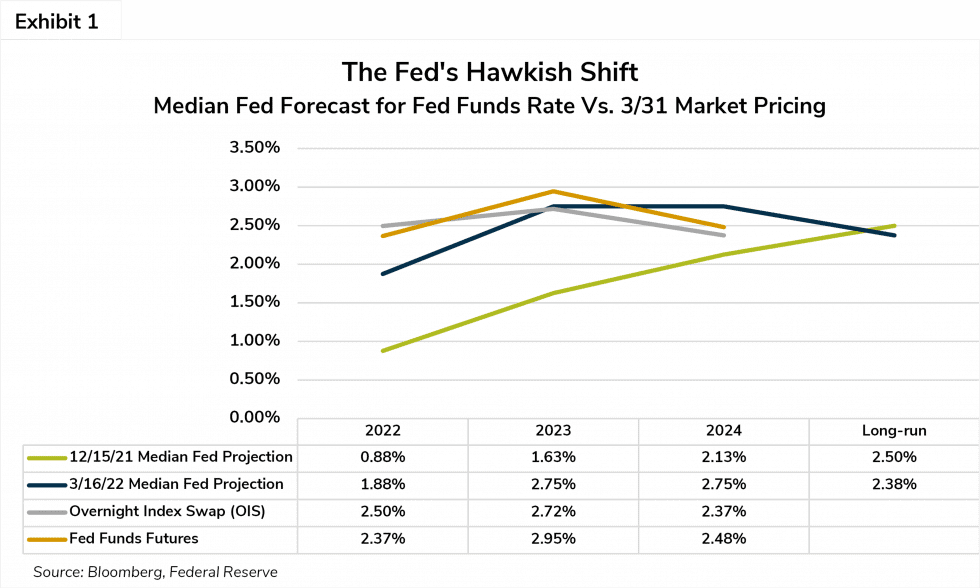
The first two are obviously highly correlated and have been the greatest drivers of risk factors in fixed income markets. Inflation has risen to multi-decade highs, and the unique circumstance of the current environment impacting both supply and demand make forecasting the ultimate course of inflation much more difficult. Fed leadership has clearly become unnerved by the path of inflation in recent months, and both the March 16 FOMC meeting and recent public appearances by Powell and his colleagues have revealed a significantly hawkish shift from Q4 last year, as illustrated by Exhibit 1. Fixed income markets repriced accordingly, and short-term markets are now priced for a 2.50% fed funds rate at year-end.
Beyond the human tragedy, Russia’s invasion of Ukraine has only added to inflation worries via increases in food, energy, and other commodity prices. The Russia/Ukraine war also presents both near- and long-term risks to the global economy. In the near-term, a spillover beyond Ukraine’s border into a NATO country would threaten a significant escalation of the conflict, likely initiating direct involvement from the United States. In the long run, there’s risk of destabilization in Russia and Ukraine, both of which are key exporters of food, energy, and other commodities.
Last, but certainly not forgotten, is Covid. It has clearly moved to the background of the news cycle in recent months thanks to a significant decline in cases domestically and abroad. However, China recently lockdown multiple regions due to a flare up in new cases, which further adds to supply chain issues and inflation risks.
As discussed in last month’s commentary, uncertainty is risk for financial markets, and these sources of uncertainty have fueled a significant sell-off in the bond market in the first quarter and led to negative returns for equities as well. On a positive note, fixed income spreads began to stabilize (and contract in many cases) during the final two weeks of March for several sectors, including MBS and corporates, despite the steady rise in rates.
A Fed War on Job Openings?
For much of the last two quarters, markets have been looking for more guidance from the Fed on what may drive their policy decisions going forward. During the March 16 FOMC press conference, we may have gotten a new clue.
“Well, if you take a look — take a look at today’s labor market, what you have is 1.7 plus job openings for every unemployed person. So that’s a very, very tight labor market, tight to an unhealthy level, I would say… We’re hearing from companies that they can’t hire enough people. They’re having a hard time hiring. So that’s really the thinking there is, we know, these are fairly well-understood channels, interest sensitive. And basically across the economy, we’d like to slow demand so that it’s better aligned with supply; give supply, at the same time, time to recover; and get into a better, you know, a better alignment of supply and demand. And that over time should bring inflation down.” – Fed Chair Powell 3/16/2022
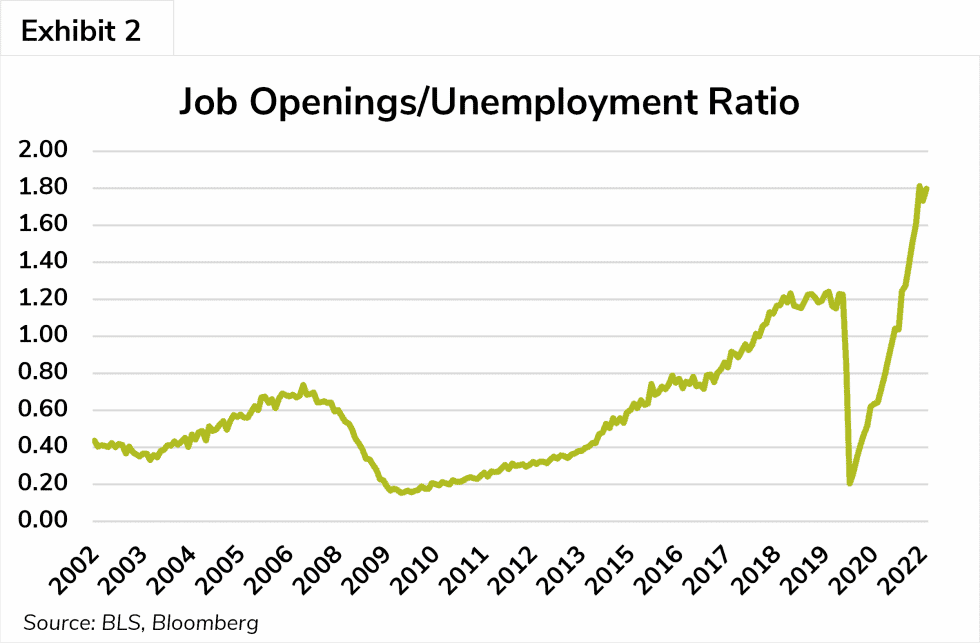
The current number of job openings relative to the number of unemployed persons is a metric that is clearly making Fed leaders uneasy as it relates to inflation pressures. Another important takeaway from Powell’s response is their opinion that job creation is interest-rate sensitive, so they are looking to raise short-term interest rates to a level that reduces the imbalance between supply and demand in the labor force. By emphasizing these points, the Fed has provided the market at least one metric to focus on as it relates to progress towards its economic goals and Exhibit 2 tracks this ratio over the last 20 years. To that end, the February Job Openings and Labor Turnover Survey (JOLTS) released on March 29 was the first glimpse of the market reaction to job openings data. Openings were expected to fall by 260,000 to 11 million, but instead they rose slightly relative to the prior month. The 2-year Treasury yield, which is more sensitive to changes in near-term interest rate policy expectations, rose nearly 10 bps after the report was released. While this wasn’t the biggest intra-day move we’ve seen in recent weeks, it did clearly reveal an increased market reaction function for this metric.
To combat the “unhealthy” tightness in labor markets, even some of the more dovish Fed leaders have suggested an openness to multiple 50 bps rate hikes this year, including most recently Mary Daly (San Francisco Fed). The bond market is now priced for an aggressive response, with fed funds futures showing 125 bps of rate hikes over the next three meetings, including a 50 bps hike at the May 4 meeting. Lastly, there has been much chatter in recent weeks regarding yield curve inversion as a signal of market pricing for Fed policy error and a pending recession. In modern history, there has only been one “soft landing” at the end of a Fed tightening cycle, which occurred in 1994/1995. The Fed is banking on stronger household balance sheets to cushion some of the blow of higher inflation and interest rates, but Powell and his colleagues have made it very clear that the top priority is cooling down an overheated labor market that is driving the demand side of inflation pressures, even if that comes with a hard landing.
To continue reading this month’s market commentary, and to learn more about current market themes, market sectors, sector performances, and applied strategies, log in to the ALM First portal, and select this month’s commentary in the Resource Center. If you do not have a log in and you would still like to access the document, please send your inquiry to info@almfirst.com.
