
Site Search

Looking for something? Use the search bar below or visit our Resources page.


Author ALM First

Published

Estimated


Economic Update

  • Election week has finally arrived, and economists and market participants continue to contemplate various outcomes as it relates to future fiscal policy, regulation, etc.
  • Q3 GDP growth was better than expected, aided by aggressive monetary and fiscal policy
  • The resurgence in COVID-19 cases in Europe has sparked fresh lockdowns in the U.K., France, and Germany, and fears that another wave could occur in the U.S. weighed on risk assets in October

Thankfully, the moment has finally arrived. By the time this commentary is published, election day will have passed, and we can only hope that the presidency and congressional elections will have been decided. That is perhaps an overly optimistic expectation, but either way, economists and financial market participants have been contemplating the various scenarios (Blue wave, Red wave, or status quo) and how it might impact fiscal policy, regulation, etc. Recent polling suggests a Blue wave (Biden wins and Democrats gain majority in Congress) is the highest probability event, but nearly everyone is less confident in polling figures given the 2016 election surprise. Nevertheless, we can still speculate on likely policy initiatives in each scenario. The general market expectation is that a Blue wave would result in the largest fiscal stimulus bill, which all else equal would be bearish for Treasury yields. At the same time, a very active Fed should limit significant curve steepening. A status quo or scenario where Republicans retain majority in the Senate would likely result in the smallest fiscal stimulus.

If Biden wins, his top priorities are expected to be COVID containment, which would include a large stimulus and infrastructure spending package, and a tax reform bill that would likely include raising the corporate tax back to 28%. However, if Republicans retain majority in the Senate, these initiatives become less probable, and Biden would likely have to rely more on executive orders amid legislative stagnation. Executive orders related to regulatory actions would be a higher probability either way, particularly regulations related to fossil fuels and the energy sector (more so than increasing regulation on the financial sector). In a status quo scenario, we would expect more of the same over the next four years, with the Trump administration focused on confronting China and other trading partners via tariff threats.

Strong Q3 Growth, But COVID-19 Resurges…

The first estimate of Q3 GDP growth was released on October 29, and it showed the economy expanding by 33.1% quarter-over-quarter (annualized) following the 31.4% Q2 decline, reflecting aggressive monetary and fiscal policy in response to the COVID crisis. The Q3 gain was by far the largest quarterly figure on record, but the economy remains down 3.5% (not annualized) from the end of 2019. A robust 40.7% increase in personal consumption boosted Q3 growth, and a strong September retail sales report provided a nice launching point for Q4. However, the pace of growth is expected to slow dramatically for the current quarter, with the current Bloomberg median economist survey projecting a 4% quarterly rate to finish 2020. Exhibit 1 tracks real GDP in dollar terms, using the median economist survey from Bloomberg to project forward into 2022. If these projections were to hold, GDP would not get back to Q4 2019 levels until the third quarter of next year.
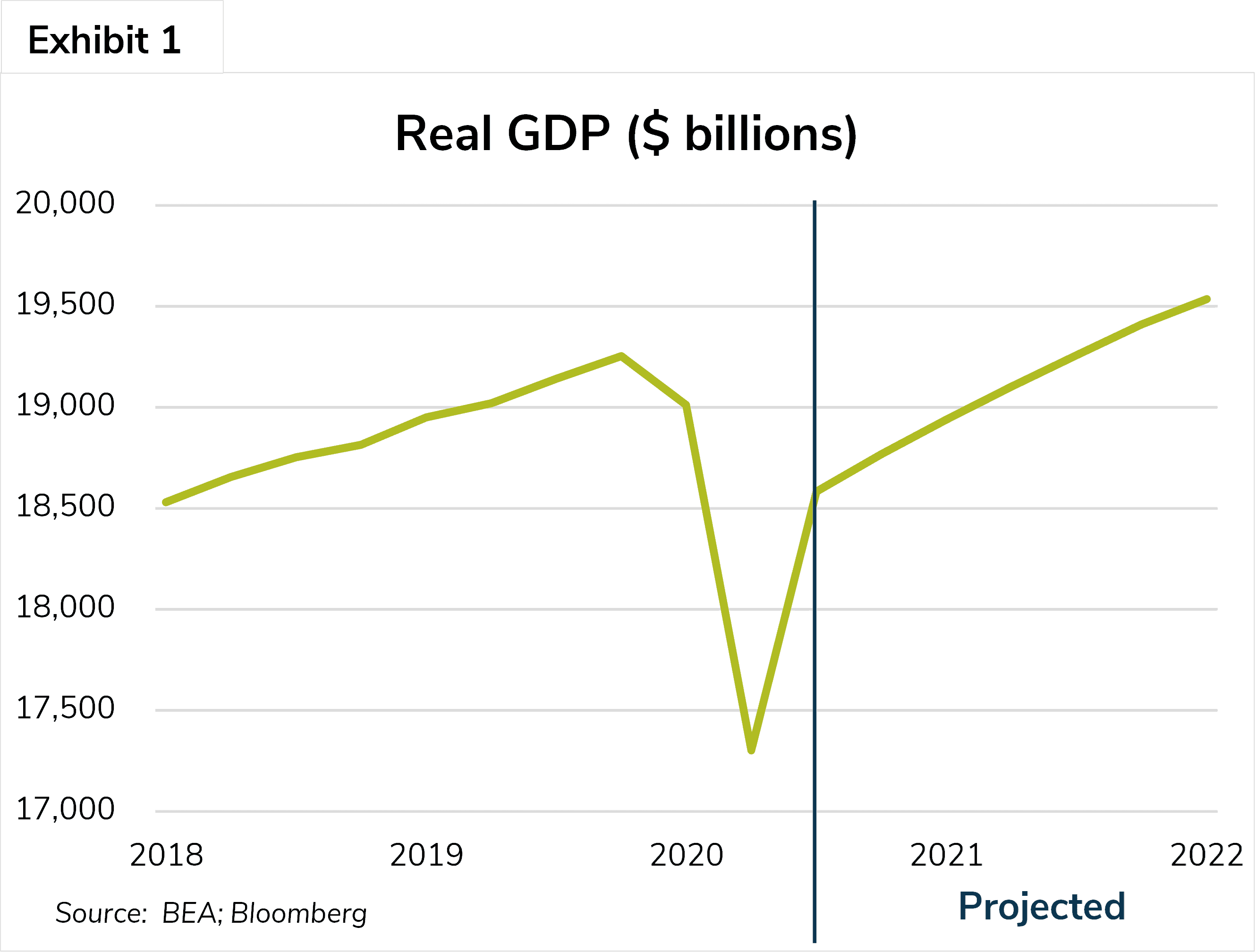
Exhibit 1, MMC, November 2020

Rising COVID cases in Europe and the U.S. in October weighed on risk sentiment, reminding market participants that virus containment remains a major determinant of economic outlook. The S&P 500 posted a -5.6% return in the final week of October, the worst week of performance since March and fueled by COVID concerns. Resurgence of the virus has been met with renewed restrictions in parts of Europe. On October 31, British Prime Minister Boris Johnson announced a new 4-week lockdown for England in response to the recent outbreak that sparked concerns of hospitals being overwhelmed if nothing was done. The U.K. joins European neighbors France, Germany, and Belgium in instituting a second lockdown to limit the rapid spread of the virus. There have not yet been any new restrictions announced in the U.S., but if the current trend continues, government leaders will likely be pressured to respond. However, even without restrictions, some could choose to voluntarily restrict activity, and either way, consumption and overall growth would be affected…


To continue reading this month’s market commentary, and to learn more about current market themes, market sectors, sector performances, and applied strategies, log in to the ALM First portal, and select this month’s commentary in the Resource Center.

ALM First

ALM First was founded in 1995 with the focus on financial advisory services for credit union clients.

LinkedIn

  Commentary Disclaimer

ALM First Financial Advisors is an SEC registered investment advisor with a fiduciary duty that requires it to act in the best interests of clients and to place the interests of clients before its own; however, registration as an investment advisor does not imply any level of skill or training. ALM First Financial Advisors, LLC (“ALM First Financial Advisors”), an affiliate of ALM First Group, LLC (“ALM First”), is a separate entity and all investment decisions are made independently by the asset managers at ALM First Financial Advisors. Access to ALM First Financial Advisors is only available to clients pursuant to an Investment Advisory Agreement and acceptance of ALM First Financial Advisors\' Brochure. You are encouraged to read these documents carefully. All investments involve risk and may lose money.

The content in this article is provided for informational purposes and should not be relied upon as recommendations or financial planning advice. We encourage you to seek personalized advice from qualified professionals regarding all personal finance issues. While such information is believed to be reliable, no representation or warranty is made concerning the accuracy of any information presented. Statements herein that reflect projections or expectations of future financial or economic performance are forward-looking statements. Such “forward-looking” statements are based on various assumptions, which assumptions may not prove to be correct. Accordingly, there can be no assurance that such assumptions and statements will accurately predict future events or actual performance. No representation or warranty can be given that the estimates, opinions or assumptions made herein will prove to be accurate. Actual results for any period may or may not approximate such forward-looking statements. No representations or warranties whatsoever are made by ALM First Financial Advisors as to the future profitability of investments recommended by ALM First Financial Advisors.

Moreover, this report was prepared as of the date indicated herein. No representation or warranty is made by ALM First that any of the returns or financial metrics detailed herein will be achieved in the future, as past performance is not a reliable indicator of future results. Certain assumptions may have been made in preparing this material that have resulted in the returns and financial metrics detailed herein. Changes to the assumptions may have a material impact on any returns or financial metrics herein. Furthermore, ALM First gives no representation, warranty or undertaking, or accepts any liability, as to the accuracy or completeness of the information contained this report. This report was prepared for informational purposes only without regard to any particular user’s investment objectives, financial situation, or means, and ALM First is not soliciting any action based upon it. This material is not intended as, nor should it be construed in any way as accounting, tax, legal, or investment advice including within the meaning of Section 975 of the Dodd-Frank Wall Street Reform and Consumer Protection Act. Certain transactions give rise to substantial risk and are not suitable for all investors. The strategies discussed herein can have volatile performance and may employ leverage. Moreover, investment advisory fees and expenses may offset trading gains. This report was prepared by ALM First Financial Advisors, LLC. The hereto mentioned report contains information which is confidential and may also be privileged. It is for the exclusive use of the intended recipient(s). If you are not the intended recipient(s), please note that any distribution, copying, or use of this report or the information contained herein is strictly prohibited. If you have received this report in error, please notify the sender immediately and then destroy any copies of it. ALM First neither owes nor accepts any duty or responsibility to the unauthorized reader. ALM First shall not be liable in respect of any loss, damage, or expense of whatsoever nature which is caused by any use the unauthorized reader may choose to make of this report, or which is otherwise a result of gaining access to the report by the unauthorized reader. This content contains information derived from third-party sources. We believe that this third-party data is reliable; however, we cannot guarantee this data’s currency, accuracy, timeliness, completeness, or fitness for any particular purpose.

INDEX BENCHMARKS: Index performance is discussed for illustrative purposes only as a benchmark for each strategy’s performance and does not predict or depict performance of that strategy. While index comparisons may be useful to provide a benchmark for a strategy’s performance, it must be noted that investments are not limited to the investments comprising the indices. Each of the strategy benchmark indices are unmanaged and cannot be purchased directly by investors.

HYPOTHETICAL PERFORMANCE DISCLAIMERS: Performance figures derived from model portfolios are hypothetical in nature and the results of any individual investor will differ as a result of various factors, including investment limitations relative to model portfolio guidelines, availability of same or similar assets, and fee structures. Investments are presumed to have been made at the beginning of the time period and there are no inflows or outflows of cash during the period. There are limitations and risks associated with the use of model performance or hypothetical performance information, and you should be cautious when looking at any presentation of model or hypothetical performance information. Investment strategies should not be based solely on the use of model or hypothetical information. Actual results will be different from those shown in model or hypothetical performance. The model portfolio returns reflect actual trading including the reinvestment of coupon payments and are net of transaction costs, administrative costs and a strategy-specific per annum fee ranging from 5 bps to 50 bps, which is the amount of the highest fee charged to any ALM First Financial Advisors, LLC customer employing that particular strategy during the period under consideration (the “Model Fee”). Actual fees will vary depending on, among other things, the applicable fee schedule and portfolio size. ALM First\'s fees are available upon request and also may be found in its Form ADV Part 2A. Past performance does not guarantee future results.


Strategic Partners

Let’s Work Together

ALM First is your agile partner with a trusted history of delivering results.