Recession speculation ratcheted higher on July 28 when it was reported that GDP contracted for a second straight quarter
The Q2 GDP report did show signs that Fed tightening is having a negative impact on sectors more sensitive to interest rates, such as residential and business investment
The FOMC has now hiked the fed funds rate 225 bps since mid-March, the fastest pace of rate hikes since 1980
Recession fears have impacted financial markets since mid-June when it became clearer that the Fed and other major central banks were more fully committed to combatting inflation risks with aggressive rate hikes and balance sheet reduction. This speculation was bolstered last week with the initial estimate of Q2 GDP growth, which declined at a 0.9% annualized pace over the period. This marked two consecutive quarters of negative GDP growth, a metric sometimes misunderstood as defining a recession by the official scoretracker of business cycles, the National Bureau of Economic Research (NBER). It’s unlikely that the NBER will score the first half of 2022, if for no other reason than the negative Q1 print was primarily attributable to a widening trade gap rather than true declining economic output. More importantly, job growth remained high and unemployment still near historic lows, trends that continued throughout the second quarter as well.
The second quarter data, however, did reveal signs of an economy that, if not declining, may have peaked. Real final sales to domestic purchasers, which excludes trade and inventories, fell 0.3% in Q2 after rising 2% in Q1 and 1.7% in Q4 2021. Several more interest-rate sensitive categories weakened in the second quarter, including residential and business investment. The decline in residential investment is less surprising given the sharp rise in mortgage rates and subsequent decline in housing activity. Spending on consumer durables and business investment on equipment and structures also contracted during the quarter.
While waning consumer and business consumption should alleviate some inflation pressures, there were no signs of easing price pressures in Q2. May and June CPI reports both surprised to the upside, and the Q2 GDP price index also exceeded expectations. A very tight labor market continues to fuel wage inflation as well. After setting a record high in Q1 of 1.4% q/q, the Employment Cost Index (ECI) rose 1.3% q/q in Q2, slightly above expectations of a 1.2% increase, and included a 1.4% increase in the wage and salary components. ECI is a preferred wage inflation gauge of Fed leaders because it includes bonuses and other in-kind benefits.
Fed Stays Aggressive
With inflation still running well above normal, the Fed moved forward with a second consecutive 75 basis point rate hike at the July 27 FOMC meeting. The fed funds rate is now up 225 bps since mid-March to 2.50%, the fastest 5-month pace of rate hikes since 1980. In the press conference that followed last Wednesday’s decision, Fed Chair Powell acknowledged that a “slowdown” in the pace of hikes would be appropriate “at some point,” but he resisted any commitment to a specific timeline. Powell did specifically point to last Friday’s ECI report as something they would be paying attention to, the results of which did little to dampen Fed concerns.
With that in mind, Minneapolis Fed President Neel Kashkari, typically one of the most dovish Fed leaders, said Sunday that he was “surprised” by the reaction in the bond market to the 7/27 FOMC decision and subsequent economic data on Friday. Front-end yields fell 17-23 bps in the second half of last week (post-FOMC) despite disappointing inflation data on Thursday and Friday. Kashkari said the bar for any rate cuts at this point would be “very, very high” and that the Fed is a “long way away” from getting inflation under control.
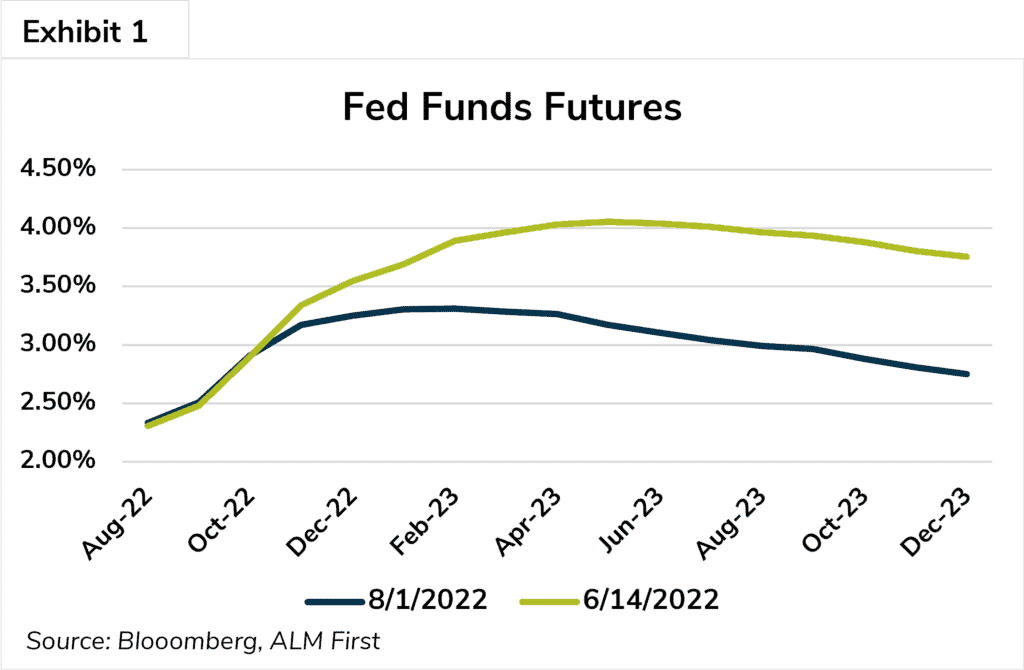
It wouldn’t be unreasonable to side with Kashkari on the idea that the Treasury market appears a bit overbought in recent days/weeks given that recent inflation reports have showed no signs of easing. However, the market is pricing for what it speculates is to come, not what is today, and the popular buzz phrase of late has been “Fed pivot.” Exhibit 1 provides a good illustration of how the fed funds futures market has repriced for expectations of a less hawkish Fed, particularly in 2023. Short-term Treasury yields peaked on June 14 in anticipation of the Fed having to raise the funds rate to 4% by next March. As of August 1, the market is pricing for a 0.3% lower funds rate by year end, and 100 bps less rate hikes by the end of 2023.
Looking ahead, there are several important economic data releases that will impact market pricing for future Fed action, most notably the next two CPI reports (July and August) to be released ahead of the September FOMC meeting. Labor market data, including JOLTS job openings, will be closely watched as well. Fed funds futures are currently priced for a little more than a 50 bps hike on 9/21, and depending on this upcoming data, the market could fluctuate between pricing for a 50-75 bps hike at that meeting.
To continue reading this month’s market commentary, and to learn more about current market themes, market sectors, sector performances, and applied strategies, log in to the ALM First portal, and select this month’s commentary in the Resource Center. If you do not have a log in and you would still like to access the document, please send your inquiry to info@almfirst.com.