Site Search

Looking for something? Use the search bar below or visit our Resources page.


Author ALM First

Published

Estimated


Economic Update

  • Fed Chair Powell delivered another hawkish speech in Jackson Hole, implying a “higher for longer” mantra even as efforts to rein in inflation come with economic pain
  • August was another painful month in a historically bad year for fixed income investors, and recent labor market and inflation data suggest the Fed won’t let up anytime soon
  • Residential rent prices have surged over the last year, and the lag effect could apply upward pressure on the housing inflation metric of CPI for months to come

Higher for longer. That is the message from Fed leaders of late regarding the fed funds rate, combating market speculation of a Fed pivot at some point in 2023. The bond market has been swifter to accept this guidance from policymakers, with front-end Treasury yields repricing approximately 50 basis points (bps) higher in August leading up to Jerome Powell’s August 26 Jackson Hole speech. However, there had been a large pocket of equity bulls still holding out hope that Fed leaders’ inner-dove would emerge, but the combination of renewed hawkishness from Powell in Jackson Hole and more hot data on inflation and the labor market has effectively poured cold water on hopes that the Fed is contemplating a pause or 2023 rate cuts at this point.

Prior to Jackson Hole, Powell had acknowledged that a slowdown in the Fed’s tightening effort may be appropriate “at some point,” and even though he offered no timeframe for the vague observation, it further emboldened the “Fed pivot” camp. With this in mind, Powell delivered a much more concise 10-minute speech, the shortest by a Fed chair at the Jackson Hole conference since 2010, with the likely goal of leaving no room for obscure comments to be misconstrued as dovish.

Fed leaders have also made it clearer in recent weeks that price stability is the priority at this point and that a soft landing for the economy is a secondary and unlikely objective. To achieve the goal of price stability, Powell suggested it will require a “sustained period of below-trend growth” via “softening of labor market conditions” that will “bring some pain to households and businesses.” In other words, the decision-making framework has become much simpler for Fed policymakers with a dual mandate of price stability and full employment. With inflation rates significantly above target and unemployment near 50-year lows, they must continue tightening financial conditions until these factors become more balanced, and the labor market, and economy as a whole, cools off.

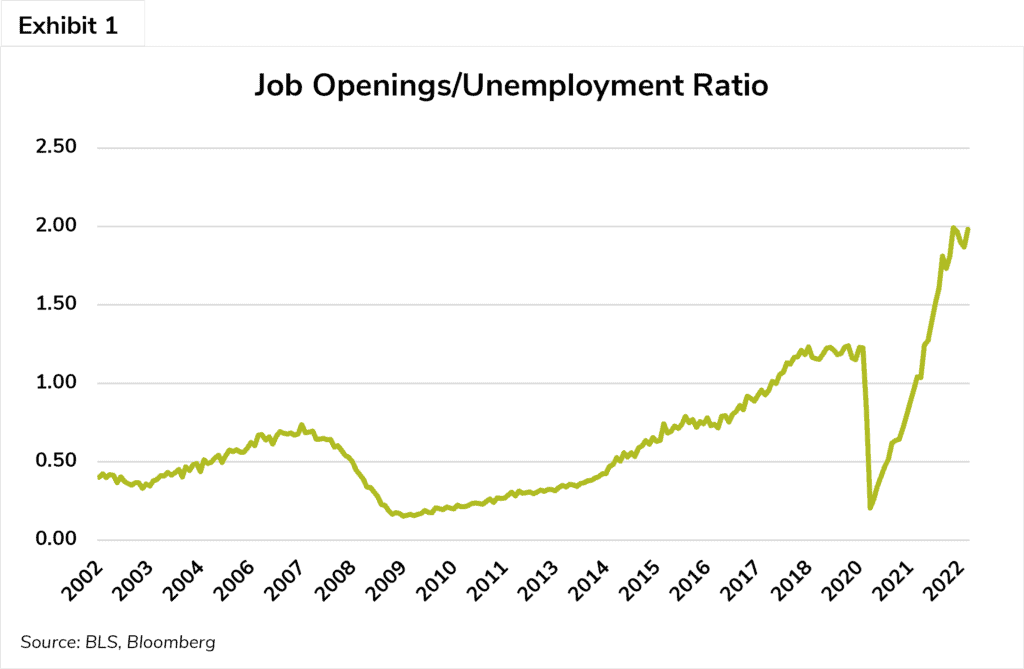
To that end, the data of late have shown little signs of the recession narrative that emerged in mid-June, at least not yet. In the labor market, job growth remains strong and unemployment low. One metric that has been a clear area of focus for Fed Chair Powell is the number of job openings relative to the total number of unemployed persons. After rising to a 2:1 ratio in March (see Exhibit 1), it appeared to be moving in the right direction in the months that followed, albeit still well above historical norms. However, the ratio unexpectedly rose back near the March peak in July, with more than 11.2 million openings.

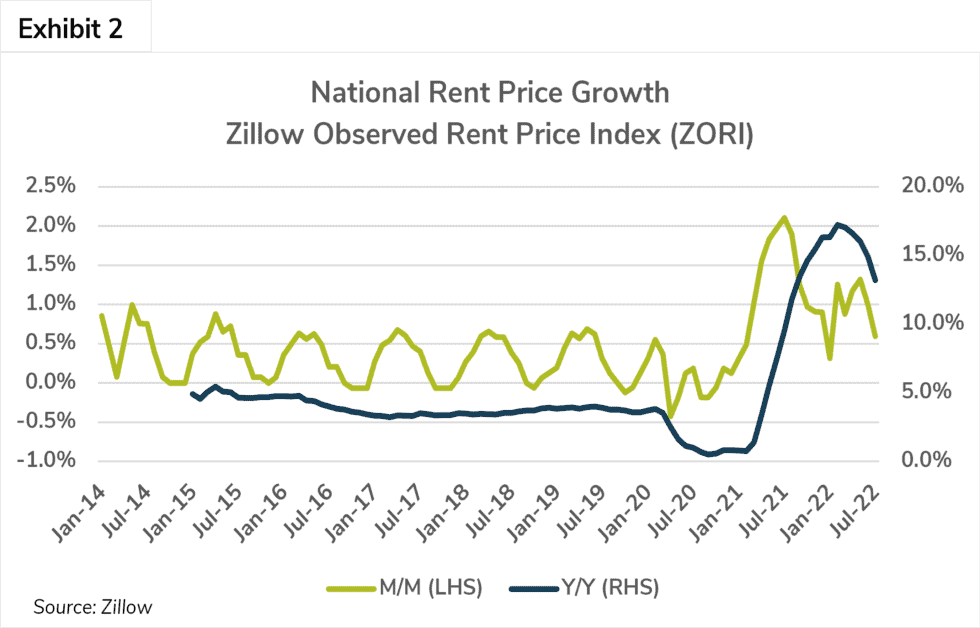
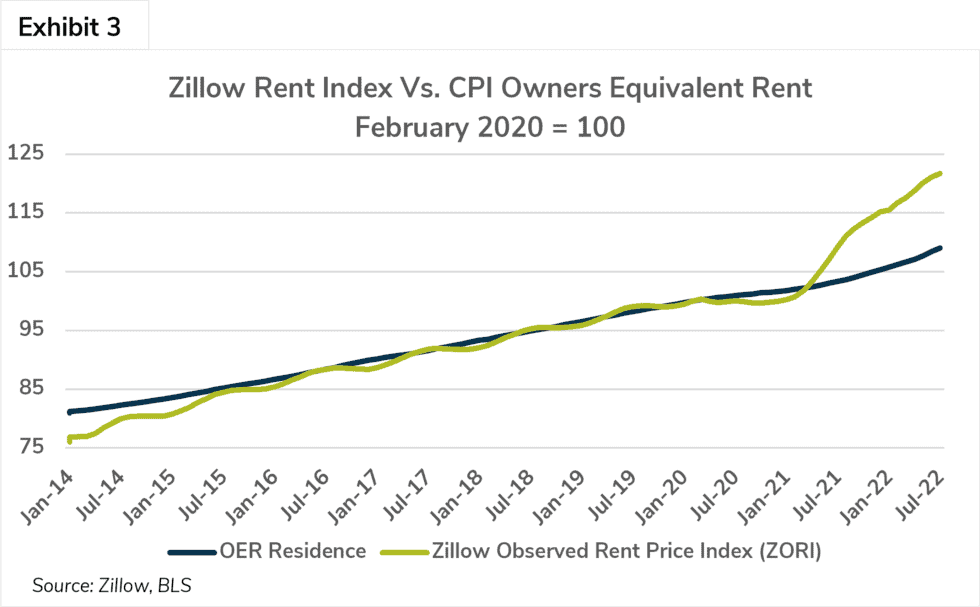
The July CPI report showed signs of improvement, at least superficially, but the underlying details were less constructive. The downside surprise in headline CPI was attributable to the decline in gas prices, and the lower-than-expected increase in the core measure was driven by declines in more volatile categories, while stickier categories continued to show upward price pressures. One category of particular importance as it relates to the core CPI tabulation is housing/shelter costs, which account for roughly 1/3rd of the headline rate and 40% of the core calculation. Most of the shelter inflation measure is captured with what is referred to as Owners’ Equivalent Rent (OER). The surge in home prices in 2020 and 2021 has been well documented, but rent prices have also risen sharply, as illustrated in Exhibit 2. It does appear that rent prices have peaked and are showing signs of easing. However, as Exhibit 3 illustrates, there is a lag in the time it takes for higher rent prices to flush through the monthly CPI data, so OER could be a contributor to above-trend core inflation for several months. This is unlikely lost on Fed leadership.

Looking Ahead

August was a painful reminder that financial markets are not out of the woods yet in what has been a historically bad year. As we have noted for several months now, volatility is likely to remain elevated until there is more clarity on inflation turning the corner and heading lower on a sustained basis, and it’s hard for that to happen when the labor market is still burning hot. A recent study by the New York Fed suggested that 40% of the inflation experienced in the prior two years was attributable to supply chain constraints, while the remaining 60% was attributable to stimulus-fueled demand. Their analysis made clear their opinion that these two are linked, and without supply-side constraints, inflation would have been 6% at the end of 2021, down from 9% but still well above target. Barring any new energy or other shock, the researchers opine that “ongoing easing of supply bottlenecks will cause a substantial drop in inflation in the near term.” If true, that could be the light at the end of the tunnel that fixed income and equity investors have been seeking, but then again, forecasters at the Fed haven’t had a good run recently. Short-term fixed income markets currently imply a terminal fed funds rate of approximately 4% realized in Q2 of next year, and Fed officials are trying to make clear of late that they intend to hold short-term rates at elevated levels for “some time.” Time will tell.


To continue reading this month’s market commentary, and to learn more about current market themes, market sectors, sector performances, and applied strategies, log in to the ALM First portal, and select this month’s commentary in the Resource Center. If you do not have a log in and you would still like to access the document, please send your inquiry to info@almfirst.com.

ALM First

ALM First was founded in 1995 with the focus on financial advisory services for credit union clients.

LinkedIn

  Commentary Disclaimer

ALM First Financial Advisors is an SEC registered investment advisor with a fiduciary duty that requires it to act in the best interests of clients and to place the interests of clients before its own; however, registration as an investment advisor does not imply any level of skill or training. ALM First Financial Advisors, LLC (“ALM First Financial Advisors”), an affiliate of ALM First Group, LLC (“ALM First”), is a separate entity and all investment decisions are made independently by the asset managers at ALM First Financial Advisors. Access to ALM First Financial Advisors is only available to clients pursuant to an Investment Advisory Agreement and acceptance of ALM First Financial Advisors\' Brochure. You are encouraged to read these documents carefully. All investments involve risk and may lose money.

The content in this article is provided for informational purposes and should not be relied upon as recommendations or financial planning advice. We encourage you to seek personalized advice from qualified professionals regarding all personal finance issues. While such information is believed to be reliable, no representation or warranty is made concerning the accuracy of any information presented. Statements herein that reflect projections or expectations of future financial or economic performance are forward-looking statements. Such “forward-looking” statements are based on various assumptions, which assumptions may not prove to be correct. Accordingly, there can be no assurance that such assumptions and statements will accurately predict future events or actual performance. No representation or warranty can be given that the estimates, opinions or assumptions made herein will prove to be accurate. Actual results for any period may or may not approximate such forward-looking statements. No representations or warranties whatsoever are made by ALM First Financial Advisors as to the future profitability of investments recommended by ALM First Financial Advisors.

Moreover, this report was prepared as of the date indicated herein. No representation or warranty is made by ALM First that any of the returns or financial metrics detailed herein will be achieved in the future, as past performance is not a reliable indicator of future results. Certain assumptions may have been made in preparing this material that have resulted in the returns and financial metrics detailed herein. Changes to the assumptions may have a material impact on any returns or financial metrics herein. Furthermore, ALM First gives no representation, warranty or undertaking, or accepts any liability, as to the accuracy or completeness of the information contained this report. This report was prepared for informational purposes only without regard to any particular user’s investment objectives, financial situation, or means, and ALM First is not soliciting any action based upon it. This material is not intended as, nor should it be construed in any way as accounting, tax, legal, or investment advice including within the meaning of Section 975 of the Dodd-Frank Wall Street Reform and Consumer Protection Act. Certain transactions give rise to substantial risk and are not suitable for all investors. The strategies discussed herein can have volatile performance and may employ leverage. Moreover, investment advisory fees and expenses may offset trading gains. This report was prepared by ALM First Financial Advisors, LLC. The hereto mentioned report contains information which is confidential and may also be privileged. It is for the exclusive use of the intended recipient(s). If you are not the intended recipient(s), please note that any distribution, copying, or use of this report or the information contained herein is strictly prohibited. If you have received this report in error, please notify the sender immediately and then destroy any copies of it. ALM First neither owes nor accepts any duty or responsibility to the unauthorized reader. ALM First shall not be liable in respect of any loss, damage, or expense of whatsoever nature which is caused by any use the unauthorized reader may choose to make of this report, or which is otherwise a result of gaining access to the report by the unauthorized reader. This content contains information derived from third-party sources. We believe that this third-party data is reliable; however, we cannot guarantee this data’s currency, accuracy, timeliness, completeness, or fitness for any particular purpose.

INDEX BENCHMARKS: Index performance is discussed for illustrative purposes only as a benchmark for each strategy’s performance and does not predict or depict performance of that strategy. While index comparisons may be useful to provide a benchmark for a strategy’s performance, it must be noted that investments are not limited to the investments comprising the indices. Each of the strategy benchmark indices are unmanaged and cannot be purchased directly by investors.

HYPOTHETICAL PERFORMANCE DISCLAIMERS: Performance figures derived from model portfolios are hypothetical in nature and the results of any individual investor will differ as a result of various factors, including investment limitations relative to model portfolio guidelines, availability of same or similar assets, and fee structures. Investments are presumed to have been made at the beginning of the time period and there are no inflows or outflows of cash during the period. There are limitations and risks associated with the use of model performance or hypothetical performance information, and you should be cautious when looking at any presentation of model or hypothetical performance information. Investment strategies should not be based solely on the use of model or hypothetical information. Actual results will be different from those shown in model or hypothetical performance. The model portfolio returns reflect actual trading including the reinvestment of coupon payments and are net of transaction costs, administrative costs and a strategy-specific per annum fee ranging from 5 bps to 50 bps, which is the amount of the highest fee charged to any ALM First Financial Advisors, LLC customer employing that particular strategy during the period under consideration (the “Model Fee”). Actual fees will vary depending on, among other things, the applicable fee schedule and portfolio size. ALM First\'s fees are available upon request and also may be found in its Form ADV Part 2A. Past performance does not guarantee future results.


Strategic Partners

Let’s Work Together

ALM First is your agile partner with a trusted history of delivering results.