
Site Search

Looking for something? Use the search bar below or visit our Resources page.


Author ALM First

Published

Estimated


Economic Update

  • 2020 has been a very difficult year on many fronts, and the economic outlook for Q4 is less certain with Congress unable to agree on additional fiscal aid
  • Despite the uncertainty, the economic data trend, as a whole, continues to exceed expectations, although the September jobs report surprised to the downside
  • The September FOMC statement included a change to the Fed’s forward guidance to account for the recent policy framework shift to average inflation targeting, and the updated Summary of Economic Projections shows no change in the fed funds rate through 2023

With the third quarter in the rear-view mirror, we can only hope that the remaining three months of 2020 will bring a more positive ending to what has been a very difficult year. However, the current political theater leading up to the November election does not offer much encouragement, and several sectors of the U.S. economy continue to suffer from Covid-driven social distancing measures. While the Fed is taking extraordinary measures to support the economy within its defined limitations, Congress has remained at a stalemate regarding additional fiscal aid amid the ongoing pandemic. There have been some positive developments on that front in the last week, but the probability of getting a deal done before year-end still appears low. However, it’s not all doom and gloom. Despite this negative backdrop, the economic data have continued to exceed expectations, with the Citi Economic Surprise Index holding significantly above its historical average (see Exhibit 1). Will the lack of additional fiscal aid stymie this positive momentum in Q4? That is the question many economists have been pondering of late.
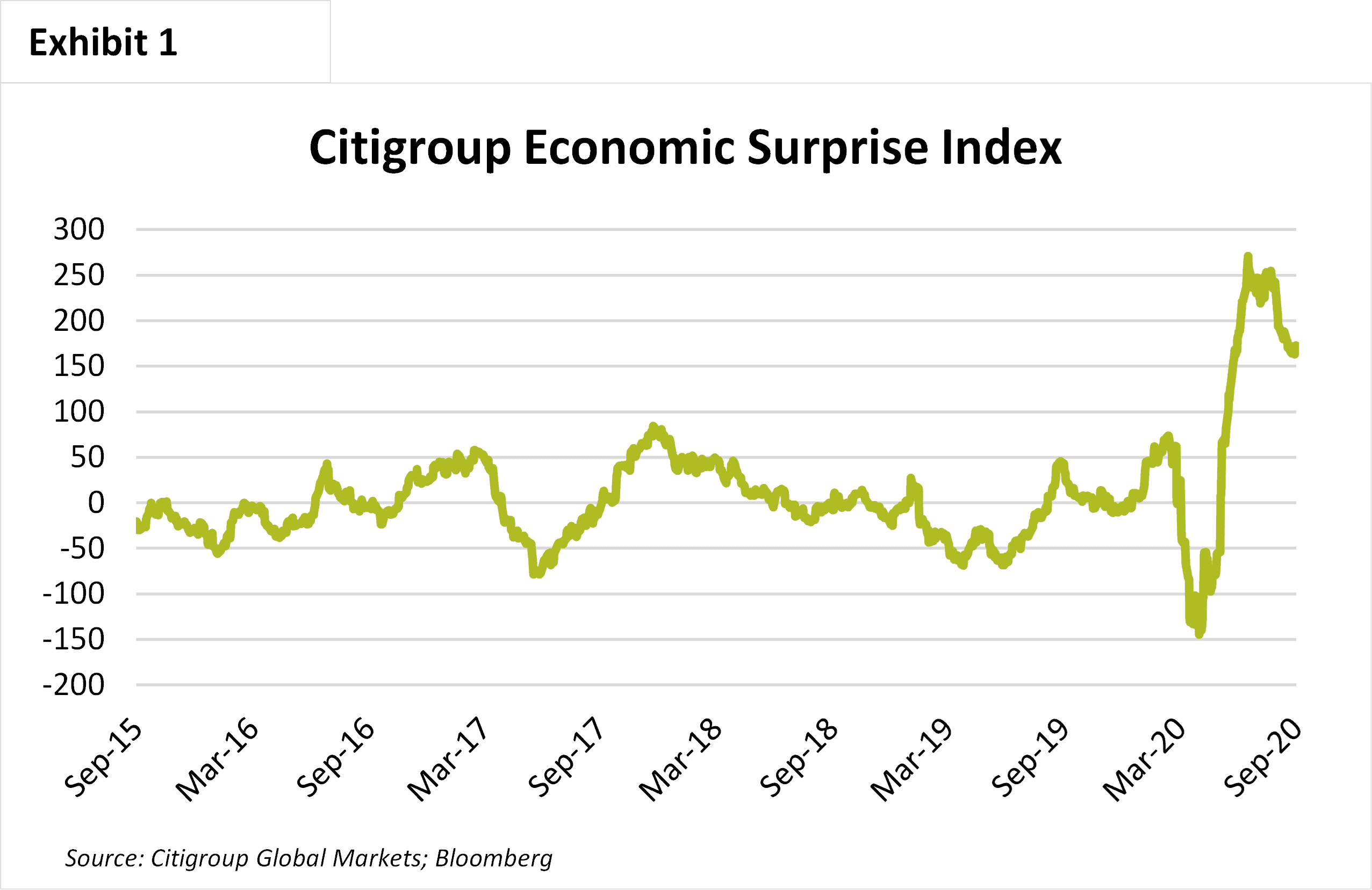
Exhibit 1, MMC, October 2020

Continuing the economic data discussion, the housing market continues to perform well on a national basis, including home sales and prices. Core capital goods orders significantly exceeded expectations in August, suggesting business investment is rebounding despite general uncertainty related to Covid and the election. However, the retail sector continues to face significant challenges. To be clear, these challenges did not begin with Covid in the age of Amazon and other digital marketplaces, but the pandemic has clearly expedited the demise of many U.S. retailers. According to the bi-annual bankruptcy report from BDO, 29 retailers have filed for Chapter 11 through August, on pace to eclipse the 2010 record of 49 retail business failures in the wake of the financial crisis.

On the inflation front, the August PCE report showed some signs of life, with the year-over-year core metric rising 20 basis points (bps) to 1.6%. However, we would be careful to presume inflation pressures will be an issue anytime soon. Market inflation expectations, as measured by TIPS breakeven yields, remain stubbornly low even after the Fed’s recent policy framework change to an average inflation targeting approach (more on that below).

The labor market will continue to be a central focus of financial markets, and the September jobs report, while good, revealed some potential areas of concern. The headline unemployment rate fell 50 bps to 7.9%, but the main driver for the decline was less auspicious. Household employment rose by 275,000 in the month, but the official labor force contracted by 695,000, which pushed the labor force participation rate down 30 bps to 61.4%. The latter will likely be a bigger talking point in economic and policy circles in the coming days/weeks. With enhanced Federal unemployment benefits expiring back in July, one would have reasonably expected labor participation to increase at this point. This may increase calls for additional fiscal aid from Congress, but both sides continue to struggle to reach an agreement.

The Doves Are Here To Stay

The September FOMC official statement included new policy guidance in line with the recent framework changes, including a shift to average inflation targeting. The Committee now expects to keep the fed funds rate unchanged until “inflation has risen to 2% and is on track to moderately exceed 2% for some time.” The FOMC also released its updated Summary of Economic Projections (SEP), which included projections through 2023 for the first time (see Exhibit 2). The median participant forecast for the fed funds rate shows no hikes through the end of 2023. Furthermore, the inflation rate is projected to be at 2% by that time and the unemployment rate at 4%…


To continue reading this month’s market commentary, and to learn more about current market themes, market sectors, sector performances, and applied strategies, log in to the ALM First portal, and select this month’s commentary in the Resource Center.

ALM First

ALM First was founded in 1995 with the focus on financial advisory services for credit union clients.

LinkedIn

  Commentary Disclaimer

ALM First Financial Advisors is an SEC registered investment advisor with a fiduciary duty that requires it to act in the best interests of clients and to place the interests of clients before its own; however, registration as an investment advisor does not imply any level of skill or training. ALM First Financial Advisors, LLC (“ALM First Financial Advisors”), an affiliate of ALM First Group, LLC (“ALM First”), is a separate entity and all investment decisions are made independently by the asset managers at ALM First Financial Advisors. Access to ALM First Financial Advisors is only available to clients pursuant to an Investment Advisory Agreement and acceptance of ALM First Financial Advisors\' Brochure. You are encouraged to read these documents carefully. All investments involve risk and may lose money.

The content in this article is provided for informational purposes and should not be relied upon as recommendations or financial planning advice. We encourage you to seek personalized advice from qualified professionals regarding all personal finance issues. While such information is believed to be reliable, no representation or warranty is made concerning the accuracy of any information presented. Statements herein that reflect projections or expectations of future financial or economic performance are forward-looking statements. Such “forward-looking” statements are based on various assumptions, which assumptions may not prove to be correct. Accordingly, there can be no assurance that such assumptions and statements will accurately predict future events or actual performance. No representation or warranty can be given that the estimates, opinions or assumptions made herein will prove to be accurate. Actual results for any period may or may not approximate such forward-looking statements. No representations or warranties whatsoever are made by ALM First Financial Advisors as to the future profitability of investments recommended by ALM First Financial Advisors.

Moreover, this report was prepared as of the date indicated herein. No representation or warranty is made by ALM First that any of the returns or financial metrics detailed herein will be achieved in the future, as past performance is not a reliable indicator of future results. Certain assumptions may have been made in preparing this material that have resulted in the returns and financial metrics detailed herein. Changes to the assumptions may have a material impact on any returns or financial metrics herein. Furthermore, ALM First gives no representation, warranty or undertaking, or accepts any liability, as to the accuracy or completeness of the information contained this report. This report was prepared for informational purposes only without regard to any particular user’s investment objectives, financial situation, or means, and ALM First is not soliciting any action based upon it. This material is not intended as, nor should it be construed in any way as accounting, tax, legal, or investment advice including within the meaning of Section 975 of the Dodd-Frank Wall Street Reform and Consumer Protection Act. Certain transactions give rise to substantial risk and are not suitable for all investors. The strategies discussed herein can have volatile performance and may employ leverage. Moreover, investment advisory fees and expenses may offset trading gains. This report was prepared by ALM First Financial Advisors, LLC. The hereto mentioned report contains information which is confidential and may also be privileged. It is for the exclusive use of the intended recipient(s). If you are not the intended recipient(s), please note that any distribution, copying, or use of this report or the information contained herein is strictly prohibited. If you have received this report in error, please notify the sender immediately and then destroy any copies of it. ALM First neither owes nor accepts any duty or responsibility to the unauthorized reader. ALM First shall not be liable in respect of any loss, damage, or expense of whatsoever nature which is caused by any use the unauthorized reader may choose to make of this report, or which is otherwise a result of gaining access to the report by the unauthorized reader. This content contains information derived from third-party sources. We believe that this third-party data is reliable; however, we cannot guarantee this data’s currency, accuracy, timeliness, completeness, or fitness for any particular purpose.

INDEX BENCHMARKS: Index performance is discussed for illustrative purposes only as a benchmark for each strategy’s performance and does not predict or depict performance of that strategy. While index comparisons may be useful to provide a benchmark for a strategy’s performance, it must be noted that investments are not limited to the investments comprising the indices. Each of the strategy benchmark indices are unmanaged and cannot be purchased directly by investors.

HYPOTHETICAL PERFORMANCE DISCLAIMERS: Performance figures derived from model portfolios are hypothetical in nature and the results of any individual investor will differ as a result of various factors, including investment limitations relative to model portfolio guidelines, availability of same or similar assets, and fee structures. Investments are presumed to have been made at the beginning of the time period and there are no inflows or outflows of cash during the period. There are limitations and risks associated with the use of model performance or hypothetical performance information, and you should be cautious when looking at any presentation of model or hypothetical performance information. Investment strategies should not be based solely on the use of model or hypothetical information. Actual results will be different from those shown in model or hypothetical performance. The model portfolio returns reflect actual trading including the reinvestment of coupon payments and are net of transaction costs, administrative costs and a strategy-specific per annum fee ranging from 5 bps to 50 bps, which is the amount of the highest fee charged to any ALM First Financial Advisors, LLC customer employing that particular strategy during the period under consideration (the “Model Fee”). Actual fees will vary depending on, among other things, the applicable fee schedule and portfolio size. ALM First\'s fees are available upon request and also may be found in its Form ADV Part 2A. Past performance does not guarantee future results.


Strategic Partners

Let’s Work Together

ALM First is your agile partner with a trusted history of delivering results.