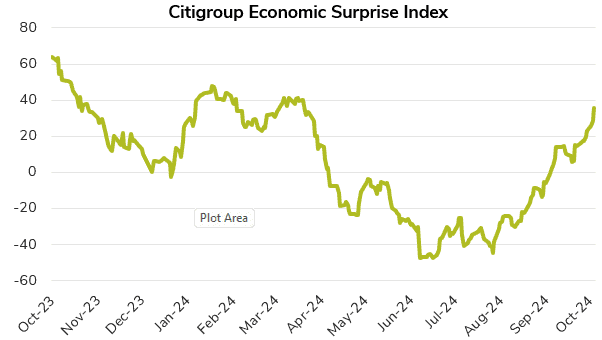
The economic data trend has consistently outpaced expectations over the last two months, contributing to higher benchmark yields over that time period
The October jobs report was an exception to this trend, but there was significant noise in the data due to storms and strikes
There are multiple scenarios for market participants to consider related to this week’s elections, from interest rates to regulations
The U.S. continued to defy expectations in October, from jobs to inflation to consumer spending to GDP. Exhibit 1 tracks the Citigroup Economic Surprise Index, which measures actual economic data relative to expectations on a daily basis. A positive reading implies that the releases, in aggregate, have been stronger than expected, and a negative reading implies the opposite. A surprise index doesn’t necessarily tell us whether the data are good or bad, but it does somewhat reflect general market sentiment in a given period relative to actual trends. The Citi index has moved steadily higher since late August, and U.S. benchmark rates have consequently moved higher as well. Since the day before the FOMC reduced the fed funds rate by 50 basis points (bps) on September 18, 5-year & 10-year Treasury yields have risen approximately 75 bps.
Exhibit 1
Source: Citigroup; Bloomberg
This increase in benchmark yields has largely corresponded with fed funds futures pricing a less dovish path of rate cuts over the next 12-18 months. To begin the month of October, markets were priced for 193 bps of additional cuts through the end of 2025, but as of 10/31, it had shifted down to just 121 bps, a 72-bps difference. Circling back to the economic data trend, we did receive a worse than expected jobs report on November 1 with just 12,000 jobs added to nonfarm payrolls in October (+100k expected), but there was quite a bit of noise in the data attributable to multiple hurricanes and the Boeing strike. The extent of this noise won’t likely be known until the November report is released in a little over a month from now. The magnitude of labor market softening will be a significant determinant of the Fed’s future rate cut decisions based on recent guidance from Fed Chair Powell and other Fed leaders.
Election Outcomes
By the time this commentary is published, election day will likely have passed, but the final results are less likely to be known at that point. There are multiple scenarios that could potentially impact financial markets, including a Red sweep (White House and majority in both houses of Congress), a Blue sweep, or divided government. Some interest rate strategists attribute part of the recent selloff in benchmark yields to markets pricing a higher probability of a Red sweep, which is expected to further increase the current fiscal deficit given expectations of a full extension of the Tax Cuts & Jobs Act (TCJA) of 2017 items set to expire in 2025 by Trump and Republicans in Congress. A Blue sweep would also likely lead to increased deficits, albeit less so given Harris’ proposal of only extending tax cuts for households making less than $400,000 per year. She has also proposed increasing the corporate tax rate from 21%-28%, both of which would be considered positive for current deficits independent of potential long-term economic implications.
While the front-end of the Treasury curve should be more anchored to expectations for Fed policy, longer maturities have greater sensitivity to fiscal matters, particularly as it relates to supply expectations (i.e., debt required to fund budget deficits). Expectations for continued deficit spending could bring higher yields and a steeper yield curve. The scenario expected to have the smallest impact on interest rates would be divided government, where one party controls the White House and another one or more houses of Congress. This would make it more difficult for the White House to push any major initiatives through Congress.
On the regulatory front, a Trump White House is expected to focus on deregulation, and in his previous administration, FHFA Director Mark Calabria worked to recapitalize and privatize Fannie Mae and Freddie Mac in the housing finance complex after having been in conservatorship since 2008. Those efforts ended very early in the Biden administration when Calabria was replaced. Would this again be focus of a 2nd Trump administration? To this point, there has been very little, if any, discussion given the focus on larger matters like immigration, trade policy, etc., but there’s certainly a likelihood that Trump’s FHFA director and Treasury Secretary picks may choose to restart this effort. If Democrats maintain control of the White House and at least one house of Congress (i.e., status quo), there will likely continue to be a focus from the CFPB on banking fees and other related matters. What is less certain is whether the CFPB would finally allow for conventional streamline mortgage refinances to be considered a qualified mortgage under the Harris administration.
Lastly, Basel 3 endgame remains unresolved. One of the major sticking points that led the FDIC board to reject Fed Vice Chair Barr’s rewrite was the magnitude of increased capital requirements for large banks. There has been a push from the progressive wing of the Democrat party to significantly increase bank capital requirements, while Republicans have generally perceived the proposal to be too onerous on banks. Whatever the final rule says related to capital requirements could have a notable impact on bank demand for booking mortgage loans to their balance sheets as well as demand for 0% risk-weighted securities.
To download the PDF of this econ only version, please click here.
To continue reading the full month’s market commentary, and to learn more about current market themes, market sectors, sector performances, and applied strategies, log in to the ALM First portal, and select this month’s commentary in the Resource Center.
If you do not have a login and you would still like to access the document, please send your inquiry to info@almfirst.com.