
Economic Update
- Rate volatility reached fresh 2022 highs in September as inflation persisted and central banks passed through significant monetary policy tightening
- The FOMC announced a third consecutive 75 basis point (bp) rate hike at the September meeting, marking 300 bps of rate hikes in just six months
- Financial market conditions could become a greater focus for some Fed leaders moving forward, although most have suggested current inflation pressures reduce their response options at this point
Interest rate volatility has been a major theme for fixed income markets in 2022. As we’ve noted several times this year, volatility will likely remain elevated until there is more clarity with regard to the path of inflation and the consequential Fed response. The last two months provided no relief on either front. An overheated labor market and ongoing upside surprises for multiple inflation metrics fueled new highs for U.S. rates and rate volatility in September, and the Fed is showing no signs of relenting. Exhibit 1 provides an updated look at the Citigroup Economic Surprise Index, which measures data surprises relative to market expectations. A positive reading implies that data releases have been stronger than expected, and vice versa for negative readings. After reaching a 25-month low in June, the index has moved steadily higher thanks in large part to upside surprises for jobs and inflation data.
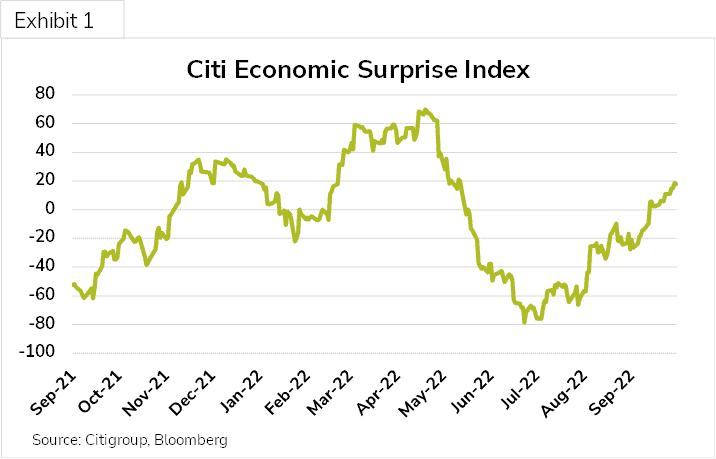
As a result, the Fed announced a third consecutive 75 basis point rate hike at the September 21 FOMC meeting, capping 300 basis points (bps) of rate hikes in just a six-month period. Moreover, the updated Summary of Economic Projections revealed a median FOMC participant forecast of 125 bps more hikes by year-end, or 425 bps in just 9 months. The ultra-hawkishness of the Fed has wreaked havoc in currency markets as well. The U.S. Dollar Index (DXY), which tracks the dollar relative to other major world currencies, ended September up more than 17% on the year, and the U.K.’s pound sterling reached an all-time low versus the dollar. Global central banks are forced to keep pace with the Fed or risk further currency depreciation while also battling emerging economic growth risks.
The volatility in U.K. government bonds (Gilts) last week was extreme and followed a curiously-timed tax cut announcement by the country’s new government. The 10-year Gilt yield surged 130 bps in just 4 days before the Bank of England (BoE) announced an emergency intervention to buy government bonds as needed to bring stability to the market, sparking an incredible 60 bps yield rally intraday last Wednesday. The volatility expectedly spilled into other markets, including U.S. Treasuries. The 5-year Treasury yield experiencing the biggest daily move on September 28 since the Great Financial Crisis (GFC), and the 10-year yield traded in a 35 bps range last week, breaching 4% for the first time since 2008 just before the BoE announcement.
All the while, several Fed leaders were on the record last week calling for no letup in the historic pace of tightening in an effort to keep inflation from becoming more entrenched and metastasizing across the broad economy. Not surprisingly, questions of financial market stability have emerged as this tightening works its way through markets at a torrid pace. Bank of America high-yield credit strategists authored a research piece late last week titled “This Is How It Breaks,” noting that their proprietary Credit Stress Index is now at what has been historically considered a critical level. Liquidity has weakened in the highest credit quality sectors as well. J.P. Morgan strategists highlighted that market depth in the Treasury market is the weakest since April 2020 amid the highest rate volatility experienced since the GFC. Additionally, dispersion in off-the-run Treasury yields is now above March 2020 levels, and bid/ask spreads in on-the-run Agency MBS coupons are well above recent historical averages. The biggest question at this point is whether this emerging stress in financial markets will cause the Fed to reconsider the pace of rate hikes suggested at the September FOMC meeting. Powell & Co. have noted past policy mistakes of the 1970s as prematurely pulling back policy tightening while inflation pressures remain, leading to the policy tightening actions of the Volker Fed in the early 1980s.
In a September 30 speech, Fed Vice Chair Lael Brainard seemed to acknowledge these emerging risks of too little vs. too much. “We are committed to avoiding pulling back prematurely,” said Brainard. “We also recognize that risks may become more two-sided at some point.” In a separate speech, Mary Daly (San Francisco Fed) also suggested an emerging debate regarding whether financial conditions are tightening more than expected. “If that’s the case, then slowing the pace of increases but still heading for the right terminal rate would be appropriate,” said Daly. On the other side of the spectrum, James Bullard (St. Louis Fed) suggested last week that markets had correctly “digested” the Fed’s intentions as communicated by the updated September FOMC forecasts while downplaying any economic growth or inflation implications by the recent market volatility.
What’s Next?
With so much near-term economic uncertainty, it shouldn’t be surprising to see significant volatility and deteriorating liquidity in the bond market. Core inflation rates are likely to remain elevated for at least the rest of 2022 due to shelter and healthcare prices, which combine for 51% of core CPI and 35% of core PCE. However, markets will look for leading signs of trend reversal in the overall economy, particularly various labor market metrics, consumption, and business investment. All of this will impact market pricing for the fed funds terminal rate, as well as how fast we get there. As of September month-end, U.S. rates were priced for a terminal rate of approximately 4.5% by February 2023. For depositories navigating this volatile environment, community-based financial institutions remained well capitalized, in aggregate, at the end of Q2. However, the largest banks have been sidelined in fixed income markets for several months due to leverage and risk-based capital constraints, leaving no true backstop buyer for Agency MBS and other high credit quality sectors with the Fed now absent. Institutions that have been more disciplined with asset pricing, capital allocation, and liquidity risk management in 2022 may have more dry powder to be liquidity providers should fixed income spreads widen further from already wide levels on a historical basis. Fed leaders should be paying close attention to financial market conditions. In more normal times, when inflation was closer to its target, they might be able to respond by pausing, or even reversing, rate hikes, as Lael Brainard suggested last Friday. However, until there are visible signs of cracks in some of the metrics driving stickier inflation, notably jobs and wage growth, the Fed will unlikely deviate from their current narrative. The last thing Fed leadership wants their legacy to be is the overseers of runaway, hyper-inflation.
To continue reading this month’s market commentary, and to learn more about current market themes, market sectors, sector performances, and applied strategies, log in to the ALM First portal, and select this month’s commentary in the Resource Center. If you do not have a log in and you would still like to access the document, please send your inquiry to info@almfirst.com.
